
Livraison le jour même ou le lendemain

Qualité garantie

Débloquez vos offres de bienvenue: Livraison GRATUITE | Jusqu'à -80 % | 30 jours d'essai gratuits à JoyPlus
Téléchargez l'application
A portable garment steamer can replace your ironing board for a quick refresh before heading to work, a meeting, or catching a flight. But not all models are created equal. A compact device may lack battery life, while a more powerful one can quickly become heavy and cumbersome.
Before buying a garment steamer, be sure to check its electrical compatibility, steam output, water tank capacity and safety features. These are the criteria that prevent unpleasant surprises after a few uses.
A high wattage doesn't necessarily guarantee faster steaming. Power mainly affects the heating time and the appliance's ability to produce steam. Continuous steam flow, measured in grams per minute, remains a key indicator for assessing real efficiency.
For a lightweight shirt, a moderate flow may suffice. For denim, linen or a thick jacket, it's better to choose an appliance with a clearly stated continuous flow rate and a function that keeps the steam activated.
Some appliances sold on international markets operate on 110-120 V, whereas UK sockets typically deliver 220-240 V. The Rolipo 1200 W, for example, is listed as 120 V on its product sheet. So you must not plug it directly into a UK socket without a suitable converter, or you risk damaging it.
For a purchase intended for the UK, look for an explicit mention of 220-240 V, 50/60 Hz, as well as a plug compatible with local electrical installations.
A small tank may be enough for one shirt, but can become particularly frustrating when you need to steam several garments. Conversely, a larger tank generally makes the appliance heavier, especially when held at arm's length.
Here are some useful benchmarks:
A garment steamer with a removable water tank is easier to fill and empty. A translucent tank also allows you to monitor the water level during use.
An appliance that heats up in 30 to 45 seconds is generally suitable for morning use or at the office. When travelling, this delay becomes even more important if you want to freshen up an outfit in a few minutes before heading out.
Runtime depends on the tank capacity, steam flow rate and the mode used. The figures quoted by manufacturers should be taken as estimates: intensive steam use can significantly reduce the actual duration.
The flow rate, expressed in g/min, corresponds to the amount of steam produced continuously. A value between 20 and 25 g/min is generally suitable for everyday shirts, dresses and trousers. Thicker fabrics require more passes, as well as good tension on the garment.
For silk, nylon and other delicate textiles, always check the care label. Test on an inconspicuous area and maintain the recommended distance. Even a steamer marketed as suitable for delicate fabrics does not exempt you from following the garment manufacturer's instructions.
Steam can cause serious burns. Where possible, choose an appliance equipped with anti-drip protection, automatic shut-off and a heating indicator. A steam lock is handy during long sessions: it saves you from holding the button down continuously.
After each use, empty the tank and let the appliance cool down. If your water is hard, follow the descaling recommendations. Never add perfume, essential oil or household cleaner to the tank, unless the manual explicitly allows it.
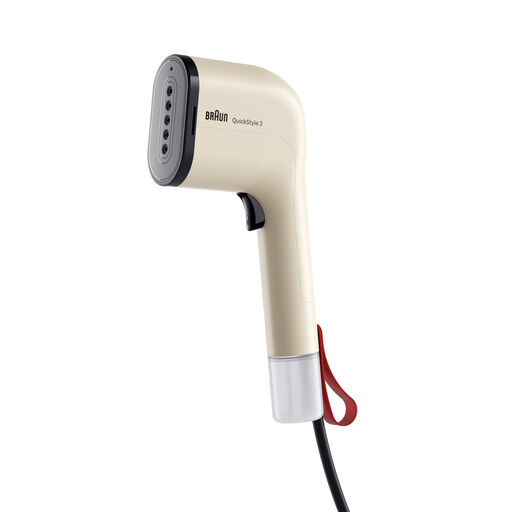
Why this choice suits this profile: With its slim design, stated weight of 770 g and 30-second heating time, it's perfect for getting started or doing small daily touch-ups.
The product sheet states a voltage of 240 V, a removable tank and a heat-resistant pouch. However, with only 70 ml, the tank limits the appliance to short sessions.
20 g/min continuous steam, iCare technology claimed, 2 m cord and a compact size that's easy to slip into luggage.
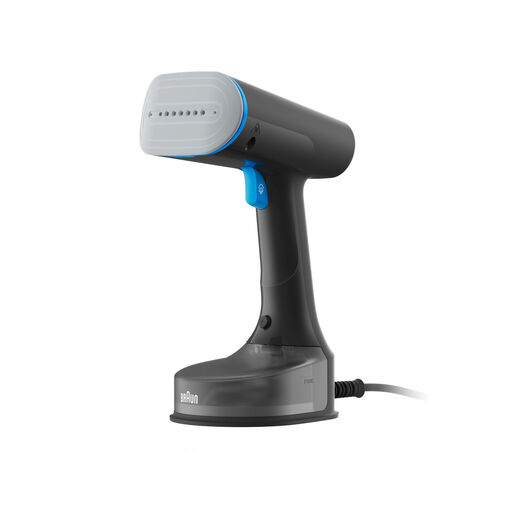
Why this choice suits this profile: It's aimed at those seeking greater comfort, with both vertical and horizontal use and features designed to protect your clothes.
The product sheet mentions anti-drip protection, automatic shut-off and a removable tank. With 150 ml, the runtime is better suited to a few garments rather than a large pile of laundry.
1200 W, 25 g/min continuous steam, 2.5 m cord and a soleplate claimed to stay cool to the touch.
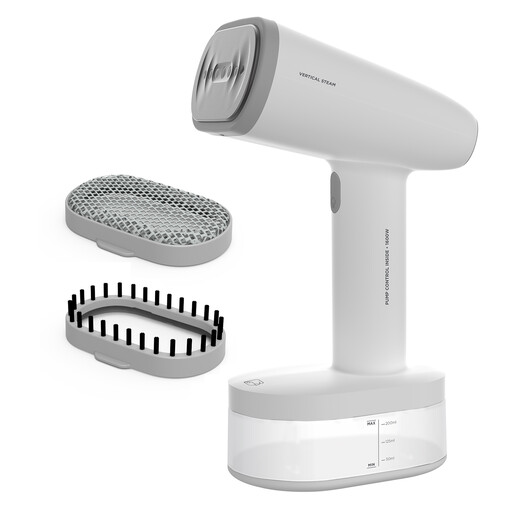
Why this choice suits this profile: Its 250 ml tank, stated flow rate of 25 g/min and self-cleaning function are suitable for multiple garments, curtains and certain upholstery fabrics.
The product sheet indicates anti-drip protection, a steam lock and a 220-240 V power supply. For upholstery fabrics, always test on a hidden area first.
1600 W, ceramic soleplate, indicator light and a claimed runtime of 15 to 20 minutes.
We've selected regularly updated products that meet these demanding criteria and European safety regulations.
Hang the garment on a sturdy hanger, then gently stretch the fabric with your free hand. Pass the steamer a few centimetres from the surface, moving from top to bottom without lingering in one spot. For delicate fabrics, start with a cautious temperature and distance, following the instructions in the manual.
A vertical steamer doesn't always replace a traditional iron when you need very sharp creases. Its main purpose is to quickly de-wrinkle shirts, jackets, dresses, trousers and curtains.
It depends on its power and how long you use it. A 1200 W appliance used for a few minutes will consume less than a steam generator running for a long time. To limit consumption, only fill the amount of water you need and unplug the appliance as soon as you've finished.
It depends on how often you use it, the quality of your water and how well you maintain it. Empty the tank after each session, follow the descaling procedures and avoid pulling on the cord. An appliance with a removable tank and a cleaning function is generally easier to maintain.
Yes, provided you check the electrical voltage of your destination country. For the UK and most European countries, choose a model compatible with 220-240 V. A foldable design, a weight under 1 kg and a heat-resistant pouch make it easier to transport.