
Livraison le jour même ou le lendemain

Qualité garantie

Débloquez vos offres de bienvenue: Livraison GRATUITE | Jusqu'à -80 % | 30 jours d'essai gratuits à JoyPlus
Téléchargez l'application
Gaming on the go, expanding your setup, or just firing up your console in another room can sometimes be a real challenge. Your laptop screen is too small, and let's be honest, nobody wants to move their desktop monitor. This is where the portable gaming monitor emerges as the ideal solution, combining flexibility and performance in an ultra-compact form factor.
But with an ever-growing selection on the market, how do you make the right choice? This guide gets straight to the point: giving you the keys to choosing the right monitor for your needs, without drowning you in marketing jargon. We'll then present a selection of our favourite models, suited for every need and budget.
Before you dive in, let's review the key technical specs that truly matter and will make all the difference in your gaming sessions.
For gaming, two criteria reign supreme: fluidity and sharpness.
For a portable device, being able to connect it simply and quickly is non-negotiable.
A word of advice: always check that the monitor's connectivity is compatible with your devices!
Diagonals generally range from 13 to 18 inches. A large screen guarantees immersion, but it also means more weight and bulk in your bag. A 15 or 16-inch model often strikes the perfect balance between viewing comfort and ease of transport, whether you use it as a second gaming screen at home or take it everywhere with you.
After the theory, comes the practice. Here are the models that caught our eye, each catering to a specific type of gamer.
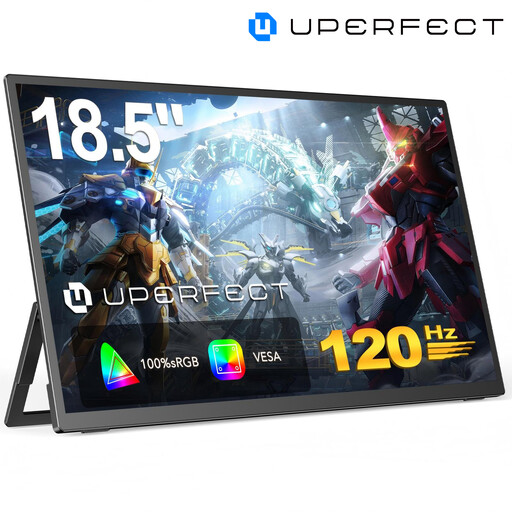
Its main advantage? A huge 18.5-inch panel that offers immersion worthy of a desktop monitor, but in a portable format. Paired with a 120?Hz refresh rate, it ensures a perfectly smooth and comfortable gaming experience on both PC and console. We appreciate its matte IPS panel, which is effective against reflections in bright environments, and its dedicated gaming menus (Gaming OSD) for optimising the display for different game types (FPS, RTS).
For gamers who want the comfort of a large screen for their mobile sessions or as a secondary monitor for their console, without compromising on fluidity.
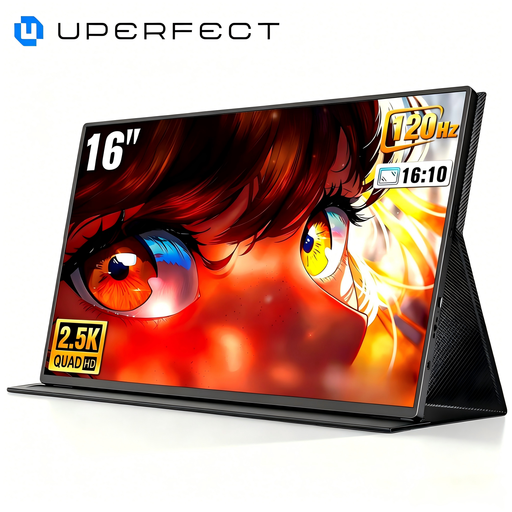
This UPERFECT model goes all-in on visual performance by combining the best of both worlds: a high 2K QHD (2560?x?1600) resolution and a refresh rate that climbs up to 144?Hz. Its 16-inch, 16:10 aspect ratio QLED panel delivers a razor-sharp image with vibrant colours and striking contrast. It's the choice for raw performance.
For the competitive gamer or tech enthusiast who demands maximum image quality in a portable format. Perfect for those whose PC has the power to run games in 2K at a high framerate.
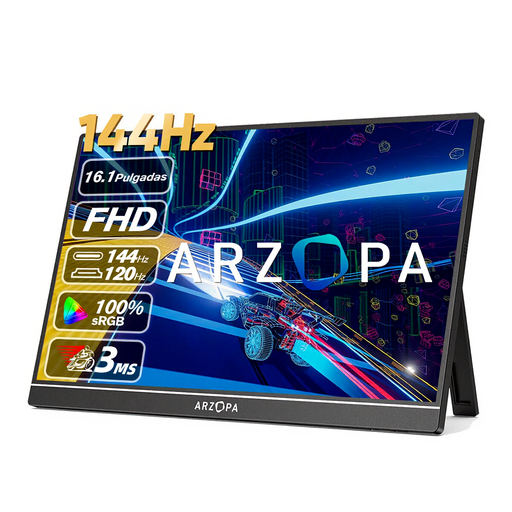
The ARZOPA Z1FC is the champion of portability. Weighing just 780?g and boasting a slim profile, it slips into any bag. But lightweight doesn't mean making sacrifices: it packs a 144?HzFull HD panel for flawless fluidity. Its generous connectivity (2 USB-C ports, 1 Mini HDMI port) makes it a perfect Swiss Army knife, equally at home as a second gaming screen or as a secondary monitor for work.
For the digital nomad, student, or frequent traveller who needs a monitor that is high-performance, ultra-light, and easy to take anywhere.
Our selection focuses on specific gamer profiles, but the portable monitor market is full of other hidden gems. Whether you're looking for a different size, a touchscreen feature, or a model more focused on productivity, there are plenty of alternatives.
To discover an even wider range, take a look at our complete category.
Discover All Our USB Portable Monitors
Yes, and it's an excellent combination! A portable monitor for PS5 or Xbox lets you play wherever you want, as soon as a power outlet is free, without hogging the living room TV. The 120?Hz models are especially recommended to take full advantage of the "Performance" modes that more and more games on these consoles offer.
It's a real game-changer. A USB-C monitor makes setup incredibly simple: on compatible devices (modern laptops, MacBooks, tablets, etc.), a single cable handles both display and power. No more tangled mess of cables! Setup is instant, which is a huge advantage for a device designed to be on the move.
Necessary? No. But for gaming, it's a level of comfort that changes everything. A 144?Hz portable monitor offers fluidity and responsiveness that are leagues beyond a standard 60?Hz screen, especially in fast-paced games. If you play competitively or are simply allergic to stuttering, the investment is well worth it. For more versatile use (some gaming, office work, videos), a good 60?Hz or 75?Hz monitor will do the job perfectly.