
Livraison le jour même ou le lendemain

Qualité garantie

Débloquez vos offres de bienvenue: Livraison GRATUITE | Jusqu'à -80 % | 30 jours d'essai gratuits à JoyPlus
Téléchargez l'application
Heatwaves on public transport, sweltering offices, festivals under the scorching sun... Every summer, heatwaves turn daily life into an ordeal. To get some relief, the portable fan has become an essential accessory. The problem? The market is a jungle of models with often-exaggerated claims. To avoid a gadget purchase that will end up in the back of a drawer, here are the pitfalls to avoid.
Beware of false promises! Disappointment often stems from three key areas:
To avoid being fooled by marketing, focus on these objective technical specifications.
For a portable device, battery life is the crucial factor. It directly depends on the battery's capacity, measured in milliampere-hours (mAh).
Editor's tip: If a manufacturer is transparent, they will provide the battery life for each power level. This is an excellent sign of reliability.
A good handheld fan must strike the right balance between effective airflow and quiet operation. Most models offer 3 to 5 speeds, allowing you to switch from a light, silent breeze at your desk to a more powerful gust outdoors. A good indicator of quality? The presence of a brushless motor. They are known to be quieter, more durable, and more energy-efficient.
When you think of a USB pocket fan, you think of portability. Its weight and dimensions are therefore key criteria. Anything over 250 grams might start to feel heavy in your backpack or handbag.
Some designs add welcome versatility:
Rather than an endless catalogue, we've selected three reliable models that meet specific needs.
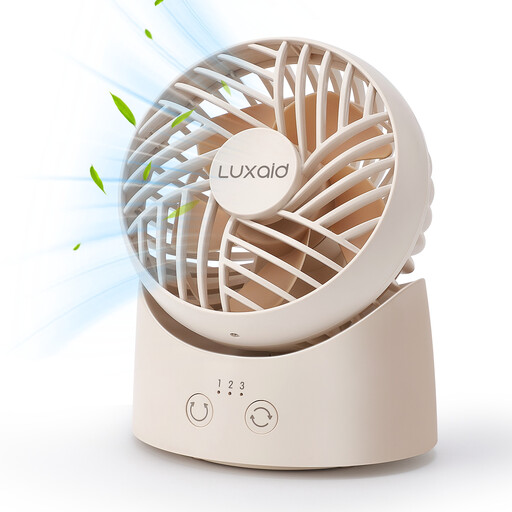
Why we recommend it: Perfect for a desk or nightstand, it effectively cools a specific area without taking up space. It's a simple, no-frills solution.
No false promises here. Its 1800 mAh battery provides up to 8 hours of operation at low speed. This battery life is consistent with its capacity, preventing any unpleasant surprises.
Its 60° oscillation feature, a rarity in entry-level models, allows it to cool a wider area than a simple fixed stream of air.
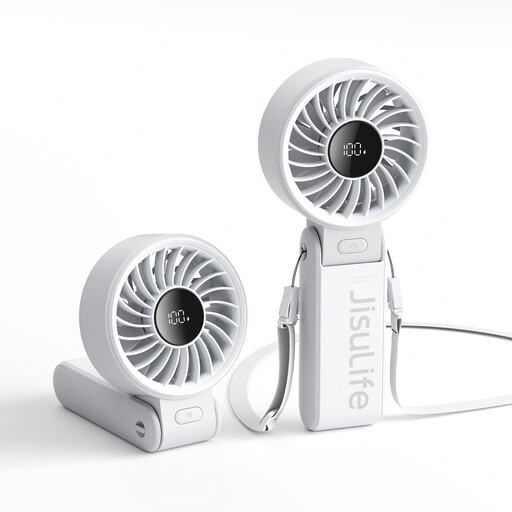
Why we recommend it: This is the Swiss Army knife of our selection. Designed for people on the go, its versatility (handheld, desktop, neck-worn) and its extra-large battery make it a powerful ally for long days.
Its massive 5000 mAh battery goes the distance. No more battery anxiety: its LED screen displays the remaining battery percentage, allowing you to plan recharges ahead of time.
Its 150° foldable design and the included lanyard give it unbeatable 3-in-1 versatility: use it handheld on the street, set it on a desk, or wear it around your neck to keep your hands free.

Why we recommend it: Because an everyday item can also be a beautiful object. With its refined finish and advanced features, this fan is for those who want more than just a simple cooling device.
It shatters the noise-to-power trade-off with its 100 speed levels. You get total control, letting you go from a virtually silent whisper to a veritable pocket-sized storm.
The touch of elegance: a magnetic aroma diffuser. Simply place a pad soaked in essential oil inside to gently scent the breeze. A much-appreciated little luxury.
The technology doesn't stop here. Some cutting-edge models integrate sensors to automatically adjust their speed based on the ambient temperature. We've gathered products that meet our selection criteria and safety standards.
The lifespan of a rechargeable mini fan depends on its two vital components: the motor and the battery. Just like a smartphone, the lithium-ion battery will start to lose capacity after 300 to 500 charge cycles. As for the motor, a brushless model is far more durable than a conventional brushed motor. With proper care, a quality device will easily last you for several summers.
No, its energy consumption is negligible. Most models charge via a standard USB-C or micro-USB port (5V), whether from a computer, a smartphone charger, or a power bank. The impact of a full charge on your electricity bill is completely insignificant.
Safety first! Make sure the device is turned off. A simple dry or slightly damp cloth is enough for the body. For dust on the blades, a can of compressed air or a small brush works best. On some models, the front grille can be removed for easier access—check the manual to be sure. And of course, never submerge the device in water.