
Livraison le jour même ou le lendemain

Qualité garantie

Débloquez vos offres de bienvenue: Livraison GRATUITE | Jusqu'à -80 % | 30 jours d'essai gratuits à JoyPlus
Téléchargez l'application
A portable fan can follow you to the office, the bedroom, on the go or out on the terrace. But not all models meet the same needs. A compact device may lack battery life, a rechargeable fan can prove bulky, while a model marketed as quiet may become irritating at top speed.
So before you buy, it's worth looking beyond the number of speeds and promises of power. Here are the main pitfalls to avoid, the features to examine and a selection of models suited to different needs.
The maximum battery life of a fan with a battery usually corresponds to the lowest speed, under favourable conditions. As soon as you increase the power, it can drop significantly. So check the battery capacity, expressed in mAh, but also the stated runtime for each fan speed.
A rechargeable fan with a 5,000 mAh battery can last through a long day, but its charging time may reach several hours. Conversely, a small desk model with a 1,800 or 2,000 mAh battery will be easier to carry, at the cost of more limited battery life.
Noise levels vary depending on speed, motor type and the design of the blades or grille. A quiet fan at the lowest setting can become noticeably louder at full power. For a bedroom or workspace, choose a model with a night mode, a gentle speed and, where available, a clearly stated acoustic measurement in decibels.
Bladeless models reduce certain risks associated with visible blades, but they are not silent. The shape of the air duct and the motor still play a decisive role.
A very lightweight device can tip over on a desk or vibrate on an uneven floor. For a desk fan, check the base, the tilt angle and whether you can direct the airflow towards your workspace. For a pedestal fan or tower fan, the dimensions and weight directly contribute to stability.
A grille covered in dust will eventually reduce airflow. A removable, washable filter makes maintenance easier, provided you let it dry completely before putting it back in place.
Size alone doesn't determine airflow. Check the speed levels, the width of the air distribution area and the different modes available.
A USB-C model can usually be charged without issue using a compatible power supply, but check whether the charger is included. The charging time should be weighed against the stated battery life. When you're on the move, a battery indicator or digital display helps you avoid unexpected shutdowns.
Also take the time to read the safety instructions for the lithium-ion battery. Avoid excessive heat, moisture and using a damaged cable. A fan with a battery should not be dismantled by the user.
Horizontal oscillation distributes the airflow over a wider area, while vertical tilt lets you aim at your face, upper body or a specific part of the room. A remote control, timer or app can be useful when the device is placed away from the sofa or bed.
For a connected model, check compatibility with your Wi-Fi network and the permissions requested by the app. Controls that are directly accessible on the device remain essential in case of connection issues.
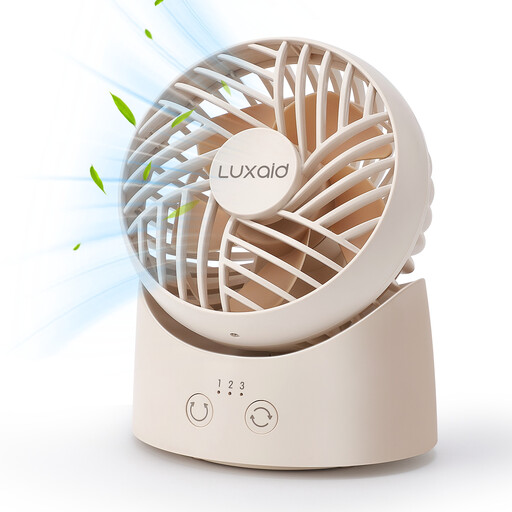
Why this choice suits this profile: its compact size fits easily on a desk, bedside table or in a small space. It offers three speeds and 60° oscillation.
The actual stated capacity is 1,800 mAh, despite a different mention on the packaging. This allows you to assess battery life more realistically.
Rechargeable battery, USB-C charging, compact size and up to 8 hours of use claimed depending on the setting.
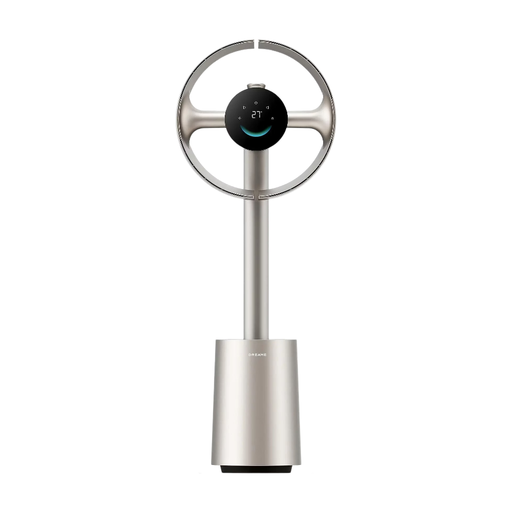
Why this choice suits this profile: this bladeless tower fan is aimed at those looking for wide air distribution and connected controls for an entire room.
The product page specifies the dimensions, 55 W power, the main washable filter and the oscillation angles, rather than relying on a simple promise of air circulation.
Oscillation claimed up to 180° horizontally and 90° vertically, touchscreen, magnetic remote control and app control.
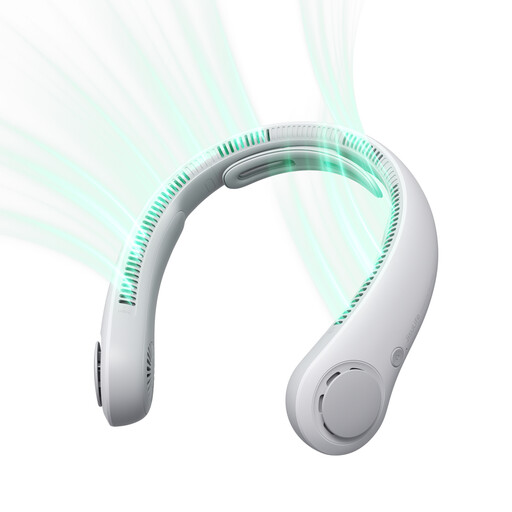
Why this choice suits this profile: this hands-free neck fan accompanies commutes, outdoor work and activities that require your hands to be free.
The product page distinguishes battery life by speed, from 2.5 to 16.5 hours. It also states a 5,000 mAh battery and a charging time of 3 to 4 hours.
Five speeds, bladeless design, claimed weight of approximately 282 g and USB-C charging. Follow the instructions regarding moisture and use while charging.
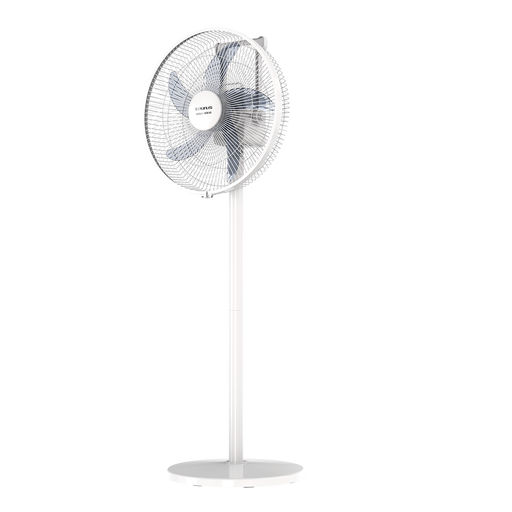
Why this choice suits this profile: its 40 cm size, battery and various installation options suit a home where the fan needs to move between rooms or change configuration regularly.
The product page separately states the 35 W power, claimed battery life of up to 8 hours, 4-hour charging time and the available modes.
Five speeds, three modes, automatic oscillation, 8-hour timer, remote control and installation possible on the floor, on a desk, at height or on the wall.
A small handheld or neck fan primarily produces a localised airflow. To cool a room, it's better to choose a tower fan, a pedestal model or a device with wide oscillation. The result also depends on air circulation, the ambient temperature and where the fan is placed.
The cost depends on the device's power and how long you use it. A 5 W fan consumes little when running from the mains, while a 35 or 55 W model requires more energy over the same period. With a battery-powered model, consumption occurs through charging cycles. Check the stated power and avoid leaving the device plugged in unnecessarily.
Regularly dust the air intakes and outlets, use the device on a stable surface and protect it from moisture, high temperatures and knocks. With a lithium-ion battery, use the cable and charger intended for it. Unplug the fan before cleaning it and never put a damp filter back in place.