
Livraison le jour même ou le lendemain

Qualité garantie

Débloquez vos offres de bienvenue: Livraison GRATUITE | Jusqu'à -80 % | 30 jours d'essai gratuits à JoyPlus
Téléchargez l'application
For any owner of an electric or plug-in hybrid vehicle, charging is the heart of the matter. While public stations can help in a pinch, nothing beats the freedom of a flexible charging solution, whether at home or on holiday. This is where the portable EV charger comes in. But between the different power levels, plug types, and smart features, navigating the options can quickly become a headache.
This guide is here to demystify the topic, decode the technical jargon, and present our selection of the best models to help you make the right choice with complete peace of mind.
Before diving into our selection, let's review the three essential criteria for finding the perfect charger for your car and your lifestyle.
The charging speed of your vehicle directly depends on the charger's power, expressed in kilowatts (kW).
Fortunately, the connector jungle has been simplified. In Europe, almost all new vehicles, both electric and plug-in hybrid, use the Type 2 connector (sometimes called Mennekes) for AC charging. All modern portable chargers are therefore equipped with a charging cable featuring a Type 2 plug on the vehicle side, ensuring near-universal compatibility. The real choice, then, lies with the wall socket: a standard domestic socket (Schuko), a reinforced socket (like Green'Up), or an industrial socket (P17/CEE).
A smart EV charger offers significant advantages. Via a mobile app, it allows you to:
These features transform a simple mobile charging station into a true energy management tool.
Here are three options we recommend, each catering to a specific user profile.
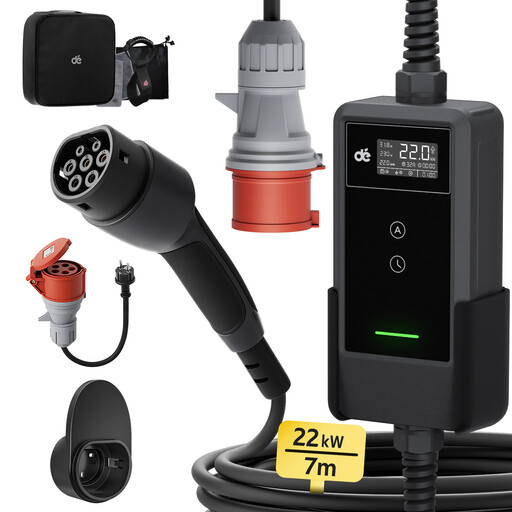
Key Feature: This model combines the maximum power of a 22kW charger with the flexibility of a portable charger and the control of a smart app.
Advantages:
Who is it for? For owners of electric vehicles capable of accepting 11 kW or 22 kW (like the Renault Zoe, Tesla Model S/X, Audi e-tron) who have a CEE 32A industrial socket (the well-known red socket) and are looking for the fastest possible charging speed at home or at their workplace.
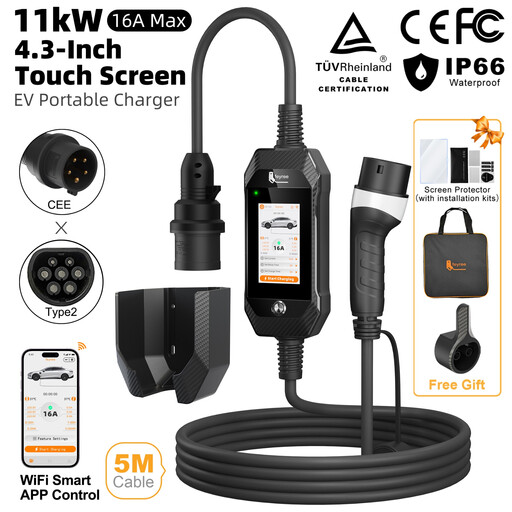
Key Feature: An excellent balance of power, smart features, and ease of use, thanks to its touchscreen and comprehensive app.
Advantages:
Who is it for? For the user with a three-phase setup who is looking for a high-performance and user-friendly smart charger. It's a versatile solution for fast and optimised home charging.

Key Feature: The ultimate simplicity of "Plug & Play". It plugs into any power outlet, making it the ideal travel companion or the easiest charging solution to implement.
Advantages:
Who is it for? For owners of plug-in hybrid vehicles (PHEVs) or drivers of 100% electric vehicles who don't need ultra-fast charging. It's the ideal solution for overnight charging, for those living in apartments, or as a portable charger to always keep in your trunk.
Our selection covers the most common needs, but the market for portable chargers is vast. If you're looking for a different cable length, specific adapters, or different features, feel free to explore our full range of car charging plugs.
Absolutely not. An 11 or 22 kW charger is a three-phase charger. It requires a specific industrial socket (CEE type, blue or red) connected to a suitable electrical circuit. Attempting to plug it into a single-phase domestic socket with an adapter is not only bound to fail but is also extremely dangerous for your installation and your safety. For a standard socket, you must use a dedicated charger, like the GONEO model in our selection (up to 3.7 kW).
Yes, provided you choose a quality product that complies with current European standards (CE). The portable chargers we recommend integrate multiple protections: against current leakage (Type A+DC or Type B RCD), overvoltage, undervoltage, and overheating. When used correctly, they are designed to ensure a charge that is just as safe as that from a fixed wallbox.
It's simple: almost all electric and plug-in hybrid vehicles sold in Europe since 2018 are equipped with a Type 2 socket for AC charging. If in doubt, a quick look at the vehicle's manual or directly at the charging port is enough: the Type 2 connector has a characteristic rounded shape with seven pins.