
Livraison le jour même ou le lendemain

Qualité garantie

Débloquez vos offres de bienvenue: Livraison GRATUITE | Jusqu'à -80 % | 30 jours d'essai gratuits à JoyPlus
Téléchargez l'application
Switching to an electric or plug-in hybrid vehicle is a great move. But to make the most of it day-to-day, home charging quickly becomes a key consideration. A portable EV charger emerges as the ideal solution: no complex installation, a cost-effective price point, and the freedom to take it anywhere. Be careful, though—the market is flooded with products whose tempting promises can hide deal-breaking flaws.
As the Head of Product Recommendations at Joybuy, my mission is to help you navigate the options. Together, we'll break down the 3 most common traps and identify the essential criteria for a safe, durable purchase that’s perfectly suited to your needs.
Faced with a jungle of options, it's easy to feel lost. Too many buyers end up with an unsuitable, or even dangerous, product by falling into these classic traps.
To make the right choice, focus on these three fundamentals. They are your guarantee of safety, versatility, and compatibility for your portable EV charger.
The safety of your electrical system and your vehicle is the top priority. Remember: charging an EV can generate DC leakage currents.
Checking for 6?mA DC protection is the simple step that will save you a lot of trouble.
Not all outlets are created equal. An old socket in a garage or a heavily loaded circuit may not be able to handle a continuous 16?A draw. The ability to adjust the charging current isn't a gimmick—it's an essential feature.
A good portable charger should offer an adjustable current, often in steps: 8?A / 10?A / 13?A / 16?A. This flexibility allows you to:
In Europe, the standard vehicle-side connector is the Type 2 (IEC 62196-2 standard). This is a must-have to ensure compatibility with almost all electric and hybrid cars on the market.
On the wall side, the Schuko plug (your standard household outlet) is what's used on portable chargers. For regular use at 16?A, having a heavy-duty socket installed by an electrician is highly recommended to eliminate any risk of overheating.
Instead of an endless list, we've matched user profiles with products that precisely meet their needs, all while adhering to the safety and practicality criteria we've just outlined.
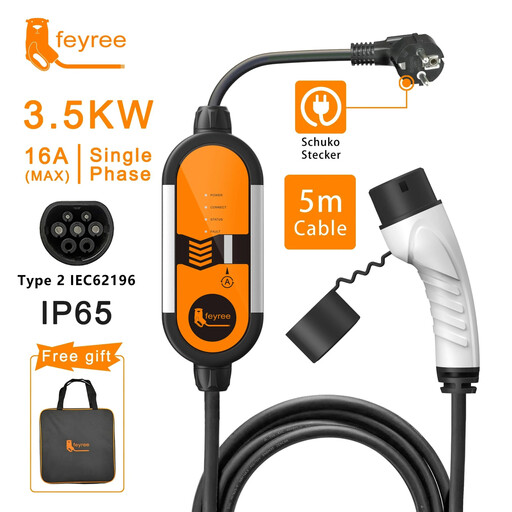
Why we chose it: Ideal for a first-time buyer, this charger gets straight to the point: simplicity and safety for charging your EV at home. Perfect for a hassle-free, overnight charge.
No unrealistic power claims. Its 3.5 kW power is clearly stated, and its adjustable current (from 8 A to 16 A) allows it to adapt to any outlet without risk.
Its current memory function: it remembers the last setting used. Convenient, so you don't have to reconfigure it every time you plug it in.
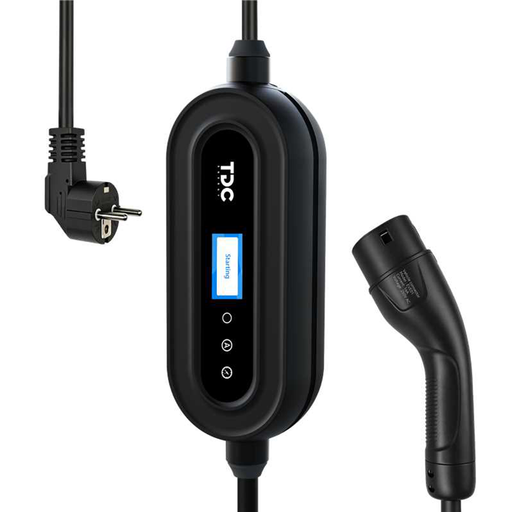
Why we chose it: For those who want to optimise their bills and stay in control, this smart Wi-Fi charger is the perfect ally. It lets you schedule charging during off-peak hours and track your consumption right from your smartphone.
It checks the most important safety box by integrating Type A + DC 6 mA leakage protection, for absolute peace of mind.
Its dual Wi-Fi and Bluetooth connectivity ensures you can control it via the app, even if your garage's Wi-Fi is unreliable. Its LCD screen also provides all key info at a glance.
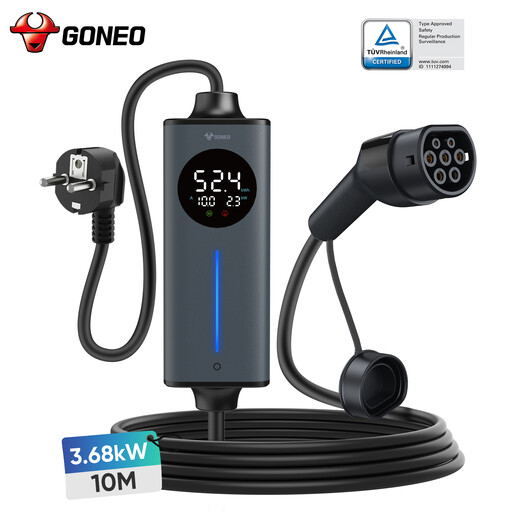
Why we chose it: When the outlet is far from your parking spot, a standard 5m cable becomes a daily frustration. This model's 10m cable offers maximum freedom, whether in a large garage, a driveway, or a shared parking area.
It sidesteps the "too-short cable" trap by offering a very generous length. Better yet, it integrates comprehensive protection (30 mA AC + 6 mA DC RCD) for foolproof safety.
Its extra-long 10-metre cable and its NTC temperature monitoring, which automatically reduces the current if the plug overheats. Smart and safe.
We've compiled a complete, up-to-date selection of chargers that meet our strict selection criteria and current safety standards.
1. Can I leave a portable charger permanently plugged into a household outlet? For daily use at full power (16?A), it is highly recommended to have a heavy-duty socket installed by a professional. A standard Schuko outlet is not designed to handle such a high load for extended periods and could overheat. On a regular outlet, it's safer to set the charger's adjustable current to 10?A or 13?A.
2. What is the cost difference between home charging and public charging stations? Home charging is unbeatable on price. In Europe, you can expect to pay around €2 to €4 per 100 km when charging at home (especially during off-peak hours), compared to €8 to €15 or more at public fast-charging stations. A smart Wi-Fi charger with scheduling is the best way to maximise these savings.
3. Is a 5-metre cable long enough for home charging? It all depends on the layout of your garage or parking space. The best practice: before you buy, measure the distance between your outlet and your car's charging port. A 5m cable is often sufficient, but if the outlet is inconveniently located, models with 7m, 8m, or even 10m cables will be a daily game-changer.