
Livraison le jour même ou le lendemain

Qualité garantie

Débloquez vos offres de bienvenue: Livraison GRATUITE | Jusqu'à -80 % | 30 jours d'essai gratuits à JoyPlus
Téléchargez l'application
When you drive an electric or plug-in hybrid vehicle, being able to plug in anywhere is essential. Whether you're a renter without a wallbox, frequently on the road, or simply looking to save money by charging overnight, the portable EV charger stands out as the simplest and most versatile solution.
As the Head of Product Curation at Joybuy, my goal is to help you navigate the many options on the market. This guide is designed to give you clear selection criteria and present a curated list of models suited for real-world needs, all without any unnecessary marketing jargon.
Choosing a mobile charger, sometimes called a portable EVSE in technical terms, shouldn't be left to chance. To find the model that truly fits your car and your daily life, here are three essential criteria to consider.
Power, measured in kilowatts (kW), directly determines charging speed. It depends as much on the charger itself as on the electrical system you plug it into.
Warning: The actual charging speed will always be limited by the weakest link in the chain, whether it's the outlet, the portable charger, or your car's onboard charger.
A "smart" charger connected via Wi-Fi is a game-changer. Through a dedicated mobile app, you can:
Ultimately, these features give you complete control for a safer and, most importantly, more cost-effective charge.
A detail that is anything but minor: cable length. Aim for 5 to 7 meters to have comfortable reach and access your car's charging port, even if you aren't parked right next to the outlet.
For the connector, make sure it's a Type 2 charging cable, the near-universal standard in Europe for new cars. Finally, don't overlook the built-in protections: leakage current protection (Type B or A+DC), overvoltage and overheat protection, and a good waterproof rating (e.g., IP66) are essential to ensure your safety and the device's longevity.
Let's get practical with three portable chargers that caught our eye, each tailored to a specific need.
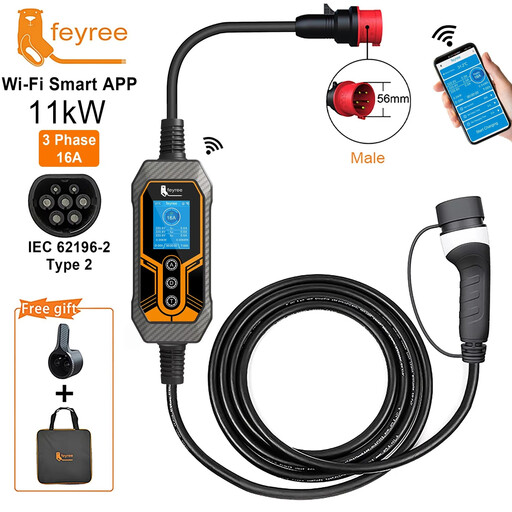
Why we chose it: This model checks all the boxes: a solid 11?kW of three-phase power and comprehensive Wi-Fi/Bluetooth connectivity. Its mobile app allows for fine-tuned charge management, especially for scheduling during off-peak hours to save money.
Pros:
Who is it for? For EV owners with a three-phase installation (and the corresponding CEE socket) who want a fast, smart charger that's perfect for optimizing their charging budget.
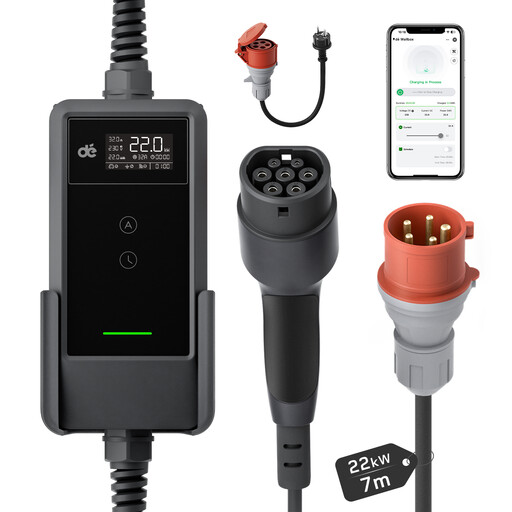
Why we chose it: With its 22?kW of power, this mobile station is for those who want the fastest possible speed on the go. Its wide adjustment range (from 6?A to 32?A) via the app also makes it highly versatile.
Pros:
Who is it for? For drivers in a hurry whose car supports 22?kW charging and who have access to a CEE 32A socket. It's the portable solution that comes closest to the performance of a fixed wallbox.
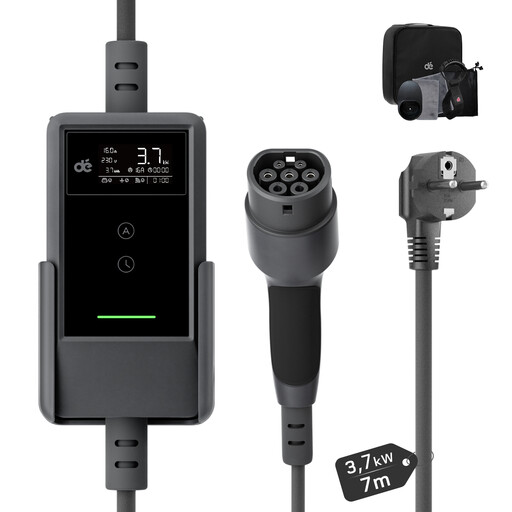
Why we chose it: Simplicity above all. This charger is the ultimate "plug-and-play" solution: plug it into any household outlet, and it starts charging. No installation required.
Pros:
Who is it for? For renters, plug-in hybrid owners, or simply as an emergency charger to keep in the trunk. Ideal for a slow and safe overnight charge, at home or on vacation.
If our selection doesn't meet your needs or if you're looking for accessories (adapters, mounts, etc.), feel free to explore our full range.
Discover our full range of power cord adapters
It all depends on your car, your electrical system, and your patience! To sum up: a 3.7?kW single-phase charger is sufficient for an overnight or backup charge. An 11?kW three-phase charger is the best compromise for fast charging at home, if you have the setup. The 22?kW option is reserved for those who can and want maximum speed.
Yes, absolutely. Portable chargers up to 3.7?kW (16?A) are designed for this. As a precaution, especially for regular use at full power (16?A), it is highly recommended to have your outlet and its circuit checked by an electrician to rule out any risk of overheating.
It's simple: the Type 2 connector is the near-universal standard in Europe. Most new cars are equipped with it. The Type 1 connector is mostly found on older models or imported vehicles (from North America, Asia). All the chargers in our selection are Type 2, ensuring maximum compatibility in France and across Europe.