
Livraison le jour même ou le lendemain

Qualité garantie

Débloquez vos offres de bienvenue: Livraison GRATUITE | Jusqu'à -80 % | 30 jours d'essai gratuits à JoyPlus
Téléchargez l'application
By the Joybuy Experts
Switching to an electric car also means adopting new charging habits. While installing a wallbox is the most well-known solution, it isn't always possible, or even desirable. Are you renting, don't have a dedicated garage, or are you simply looking for a backup solution for when you travel? The portable electric car charger emerges as a prime alternative, offering both flexibility and performance.
This guide breaks down the essential points to check before you buy and presents a selection of standout models, without the marketing fluff.
Choosing a mobile EV charger goes far beyond just picking a plug type. Here are the three key points to examine to make the right choice.
Power, measured in kilowatts (kW), determines how quickly your battery will recharge.
A smart charging station offers features that go well beyond simple power delivery. A smart Wi-Fi charger allows you, via a mobile app, to:
Safety is paramount. Ensure the charger includes multiple protections: overvoltage, overheating, lightning, and current leakage. On this last point, Type B protection (AC 30mA + DC 6mA) represents the highest level of safety.
In Europe, the vast majority of electric cars use a Type 2 connector (also known as Mennekes). This is the absolute standard to look for. Portability should never come at the expense of the safety of your vehicle and your home.
Our editors have scoured the market and selected three standout models. Each one caters to a specific user profile.
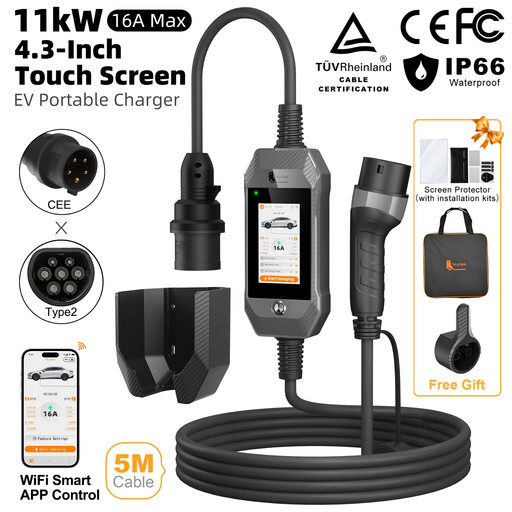
What sets it apart
This model stands out with its 11?kW three-phase power and its large 4.3-inch colour touchscreen. The interface is intuitive and allows for direct control, while also offering full management via the Tuya Smart app. It incorporates dual temperature monitoring (at the plug and the control box) for enhanced safety.
Key features
Who is it for?
For EV owners with a three-phase power supply at home who are looking for a fast, connected, and data-rich charging solution. It's an excellent alternative to a fixed wallbox.
See product details on Joybuy.fr
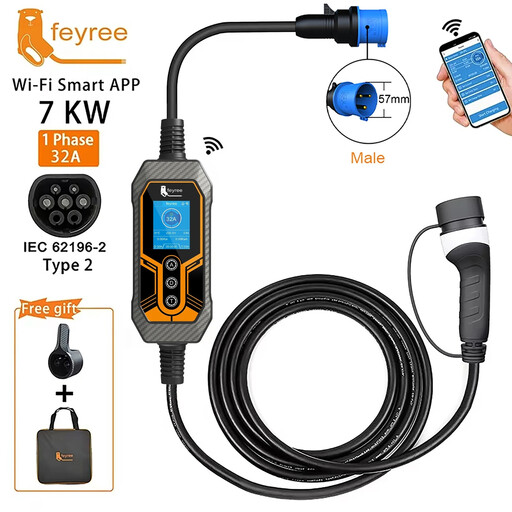
What sets it apart
This charger offers an excellent balance of power and versatility. With its 7?kW on a single-phase installation, it meets the needs of most users. Its key advantage: an adjustable current over a very wide range (from 8?A to 32?A), allowing it to adapt to nearly any electrical setup, from a simple domestic socket to a dedicated line.
Key features
Who is it for?
For the user looking for a versatile portable charging station. Ideal as a primary home solution on a heavy-duty socket (like a CEE type), while remaining portable enough to take on the road.
See product details on Joybuy.fr
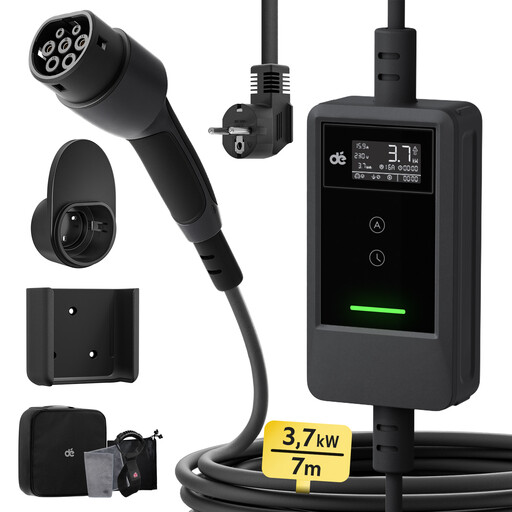
What sets it apart
This model focuses on simplicity and convenience. Designed to plug into a standard domestic socket (Schuko), it delivers a maximum power of 3.7?kW. Its major asset is its 7-meter cable, which offers plenty of comfortable leeway when the outlet is far from the vehicle. The LCD screen provides essential information without needing an app.
Key features
Who is it for?
For drivers of plug-in hybrids, those who need a top-up charger for holidays, or EV owners who are happy with a slow overnight charge from a standard socket. It's the ultimate plug-and-play solution.
See product details on Joybuy.fr
Don't see a model that fits your needs? Want to explore other power ratings or features? Feel free to browse our full range.
Discover our entire Portable EV Charger category
A 7?kW charger runs on a single-phase electrical installation (the most common residential setup) and requires a 32?A line. An 11?kW charger requires a three-phase installation (16?A per phase). It charges about 1.5 times faster, but your home must be equipped for it.
Yes, but with caution. You can use a portable charger with a standard domestic socket (Schuko), provided you limit the charging current to 8 or 10?A to prevent overheating. For faster and safer charging (up to 16?A / 3.7?kW), having a heavy-duty socket installed by an electrician is highly recommended.
Yes, as long as you choose a quality, certified product. Good portable chargers integrate the same protection systems as a wallbox (overvoltage, overheating, current leakage, etc.). The main difference lies in the connection to the grid: a wallbox is permanently hardwired, while a portable charger uses a socket. Therefore, it's crucial to ensure the outlet is in good condition.