
Livraison le jour même ou le lendemain

Qualité garantie

Débloquez vos offres de bienvenue: Livraison GRATUITE | Jusqu'à -80 % | 30 jours d'essai gratuits à JoyPlus
Téléchargez l'application
A drop in tyre pressure can happen before a long journey, after several weeks without driving, or due to a change in temperature. A portable electric tyre inflator lets you quickly bring a car, motorbike or bicycle tyre back to the correct pressure, without having to stop at the nearest petrol station.
However, product specifications often focus on an impressive maximum pressure or theoretical power, without mentioning the device's real-world limitations. To avoid a disappointing purchase, look instead at the power source, airflow rate, battery life and the compressor's ability to dissipate heat.
A device advertised at 150 PSI or 160 PSI won't necessarily inflate a car tyre faster. This figure refers to a theoretical maximum pressure, which is usually far higher than what's recommended for a particular vehicle.
For a car, SUV or motorhome, pay attention instead to the airflow rate, motor power and the recommended continuous running time. A compact cordless tyre pump will be perfectly fine for top-ups, but may struggle when you need to inflate several completely flat tyres.
A rechargeable air pump is especially handy when you're on the move, particularly for a motorbike or bicycle. However, its battery life depends on the battery capacity, ambient temperature and the pressure you need to reach.
A 12 V tyre inflator that plugs into the cigarette lighter socket removes this limitation, provided you have a long enough cable and a vehicle with a healthy electrical system. For extended use, it's best to start the engine so you don't drain the battery unnecessarily, as per the manufacturer's instructions.
A digital tyre inflator with auto-stop makes pressure setting easier, but its screen doesn't replace basic checks. Before you start, refer to the recommended pressure in your vehicle's manual or on the sticker located, depending on the model, inside the door frame or near the fuel filler cap.
The value printed on the tyre sidewall is generally a technical limit for the tyre itself, not its normal operating pressure.
For urban or occasional use, a cordless model that recharges via USB-C may be sufficient. In particular, check:
For a family car, SUV or motorhome, a wired portable car air compressor often offers more consistent running time. The cable and hose must be able to reach all four wheels without being stretched too tightly.
Expressed in L/min, the airflow rate lets you compare the relative speed of different models. A high flow rate is useful for large tyres, but it can also mean more noise and faster heat build-up.
Follow the rest periods stated in the instruction manual. A mini air compressor isn't necessarily designed to inflate several SUV or motorhome tyres one after another.
For a motorbike and bicycle tyre compressor, having a Presta adapter is useful if your bike has narrow valves. A needle will let you inflate balls, while a cone-shaped nozzle may suit certain inflatable accessories.
A tyre inflator with LED light can make a roadside job at night more comfortable, but it doesn't replace hazard warning lights or the essential safety equipment you need by the roadside.
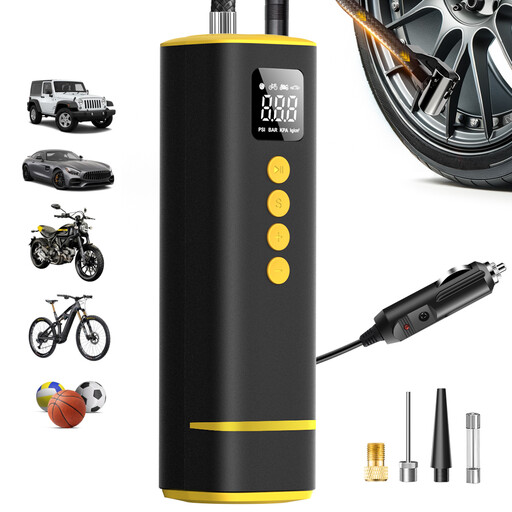
Why this choice suits this profile: Its 12 V connection and long cable make it ideal for motorists who want a simple device that's always ready to use in the boot.
It doesn't rely on a built-in battery for top-ups, and the instructions recommend letting the device cool down after use.
12 V power supply, long cable, suitable for cars, motorbikes, bicycles and balls, with a maximum pressure of 150 PSI.
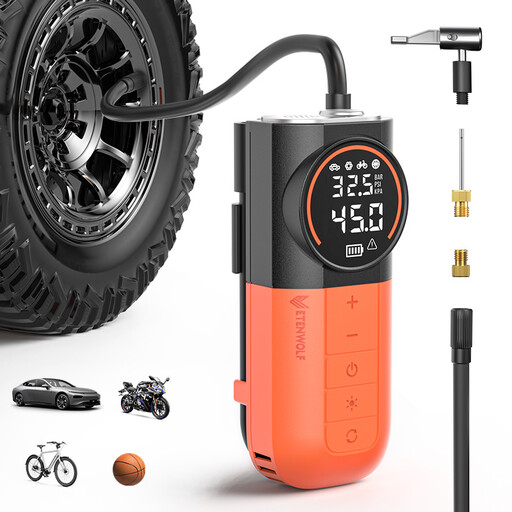
Why this choice suits this profile: Its cordless design, digital screen and numerous accessories appeal to those who want a versatile and pleasant-to-use device.
Its spec sheet clearly distinguishes the maximum pressure of 160 PSI from the flow rate of 20 L/min, allowing for a more realistic comparison between models.
Built-in battery, auto-stop, LED light, digital screen, Presta valve adapter and inflation needle.
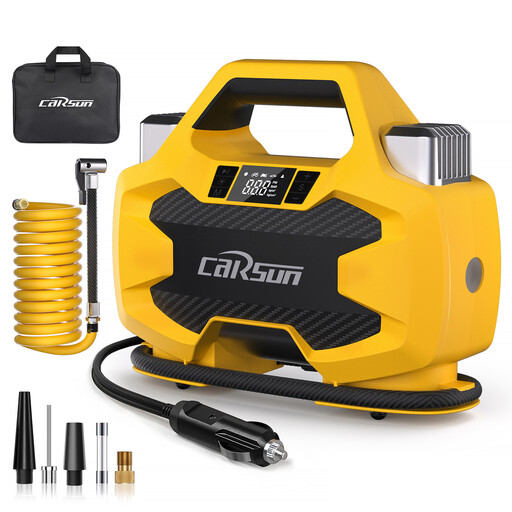
Why this choice suits this profile: Its dual-pump, 30-cylinder design is aimed at owners of SUVs or motorhomes with larger tyres.
The instructions recommend starting the engine when using 12 V and letting the device cool down after prolonged inflation.
Dual pump, 30-cylinder architecture, designed for cars, motorbikes, bicycles, SUVs and leisure vehicles.
For a mattress, inflatable boat or paddleboard, choose a pump designed for high volume and low pressure. A tyre inflator isn't automatically suitable for all inflatable items. Some dedicated paddleboard pumps, for example, have a 20 PSI limit and use specific nozzles.
Yes, some models can, but the time it takes depends on the tyre's volume, the target pressure and the device's power. Compact models are generally better suited to regular top-ups than repeatedly inflating completely deflated tyres.
The cordless version gives you more freedom to move around the vehicle and works well for motorbikes, bicycles and occasional needs. The 12 V model is a better choice if you prefer a continuous power supply and have a compatible socket. For an SUV or motorhome, pay particular attention to cable length and the required cooling times.
For a simple top-up, the electricity consumption is generally modest. However, it does vary depending on the device's power and how long it runs. The main cost to consider is the regular recharging of the battery and its eventual wear. To prolong its life, avoid storing it completely discharged and follow the temperature conditions stated in the manual.