
Livraison le jour même ou le lendemain

Qualité garantie

Débloquez vos offres de bienvenue: Livraison GRATUITE | Jusqu'à -80 % | 30 jours d'essai gratuits à JoyPlus
Téléchargez l'application
A pressure check before a long journey, a bike tyre to reinflate after a puncture, or an airbed to prepare for camping – a portable electric tyre inflator can quickly become indispensable. But you still need to know how to read the spec sheets. A high maximum pressure doesn't guarantee fast inflation, just as a large battery doesn't necessarily mean enough power for several tyres.
Here are the criteria to examine to avoid nasty surprises and choose an electric air pump suited to your vehicle, your activities and how often you use it.
The mention 150 PSI is certainly eye-catching, but it mainly corresponds to a theoretical limit. To inflate a car tyre in a reasonable time, the airflow, expressed in L/min, matters just as much. A device capable of reaching 150 PSI but with limited airflow can take several minutes per tyre.
For a simple top-up, a small portable air compressor will usually do the job. However, to reinflate a very flat tyre, pay close attention to the stated inflation time, the airflow and the maximum continuous running time.
A rechargeable cordless inflator is particularly handy by the roadside, in a garage or on a hiking trail. However, you do need to remember to charge it before you set off. The actual battery life varies depending on the starting pressure, the ambient temperature and the tyre volume.
Some models claim to be able to reinflate around two car tyres on a single charge, taking several minutes per tyre. This indication is far more meaningful than a capacity expressed in mAh taken in isolation.
A pump designed for airbeds and inflatables won't be suitable for tyres that need high pressure. Conversely, a compressor built for tyres will rarely be the most practical for moving large volumes of air quickly into a paddleboard or airbed.
Check the nozzles supplied, the type of valve compatible, the power source and whether there is a deflation function. For water sports equipment, airflow and nozzle compatibility are often the priority criteria.
For a car tyre inflator, the recommended pressure is in your vehicle's manual or on a sticker usually located in the door frame. It can also be found near the fuel filler cap. The value printed on the tyre sidewall doesn't necessarily replace the manufacturer's recommendations.
Depending on the model, the pressure is displayed in PSI, bar or kPa. A digital screen with unit switching makes reading easier, but always check the pressure when the tyres are cold. If in doubt, a reliable pressure gauge lets you verify the reading.
A 12 V compressor usually plugs into the 12 V socket, formerly called the cigarette lighter socket. This avoids having to monitor a built-in battery, but the cable must be long enough to reach all four wheels. According to the manufacturer's recommendations, it may be better to start the engine to limit battery drain.
Rechargeable models offer more freedom when you're on the move. However, corded versions remain a good option for motorists who want to keep a device in the boot that's always ready to use.
Auto-stop at the programmed pressure prevents you from over-inflating by accident. Thermal protection is also welcome – the motor and hose can heat up during prolonged use.
Always respect the running time stated in the instructions. If the device gets hot, let it cool down before continuing. Never exceed the maximum pressure allowed for the item being inflated.
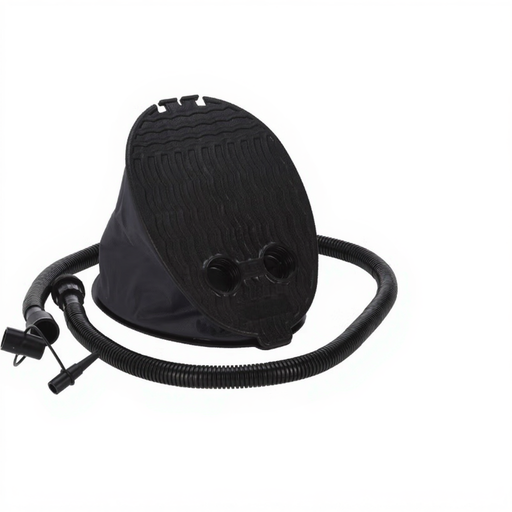
Why this choice suits this profile: This 3-litre foot pump is ideal for users who occasionally inflate an airbed, pool accessories or a small boat, without wanting to manage a battery.
Its mechanical operation depends on neither a power socket nor a stated battery life. However, it is not suitable for car tyres.
Compact design, 3-litre capacity, inflation and deflation functions.
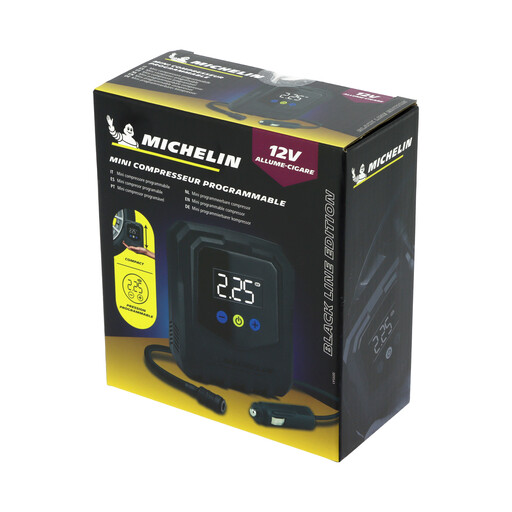
Why this choice suits this profile: This 12 V compressor is aimed at motorists who want a clear display and programmable pressure for routine maintenance.
The spec sheet mentions auto-stop, a 2.3-inch screen and 12 V power supply with a 3-metre cable.
Stated maximum pressure of 8.3 bar, free airflow of 20 L/min and three adaptors.
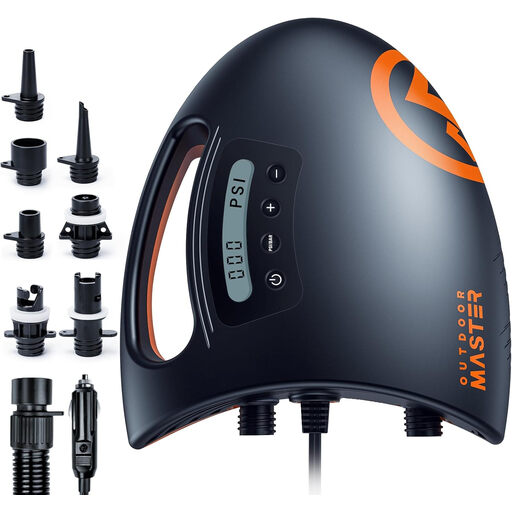
Why this choice suits this profile: This pump, designed for inflatables and airbeds, is aimed at paddleboarding, inflatable boat or camping trips where a high airflow is needed.
Its two airflow levels and deflation function prevent you from mistaking a high-volume pump for a tyre inflator.
Stated airflow of 350 L/min, then 70 L/min, adjustable pressure from 0.5 to 20 PSI, sand filter and three nozzles.
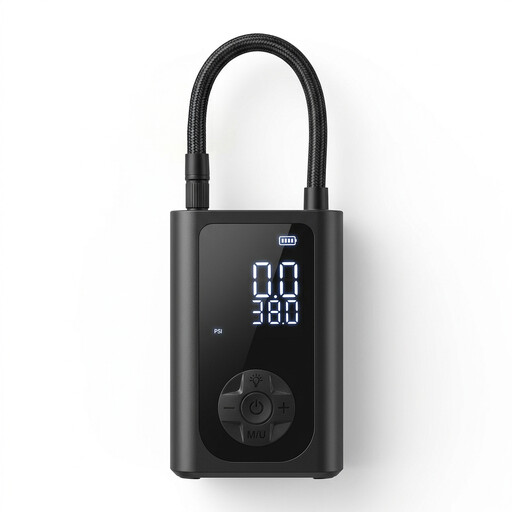
Why this choice suits this profile: Its rechargeable design slips easily into daily commutes, bike rides and pressure checks on the go.
The spec sheet specifies a 4,000 mAh battery, around 25 minutes of use and five modes, rather than just highlighting a maximum pressure.
Stated maximum pressure of 150 PSI, airflow of 26 L/min, pressure screen, LED light and USB-C port.
Yes, some models are designed for this, but the time needed depends on the tyre volume, the battery capacity and the pump's airflow. In the event of a puncture, inflation obviously doesn't replace repairing or replacing the tyre.
Always set the pressure recommended by the vehicle manufacturer or stated for the equipment in question. The 150 PSI refers to the maximum pressure stated for the inflator, not the value to apply every time.
Its running cost is generally limited to the electricity needed to charge it. However, you should consider the battery lifespan, the charging time and the possible need to keep a cable or backup solution to hand.