
Livraison le jour même ou le lendemain

Qualité garantie

Débloquez vos offres de bienvenue: Livraison GRATUITE | Jusqu'à -80 % | 30 jours d'essai gratuits à JoyPlus
Téléchargez l'application
A portable electric cool box for your car can make a huge difference when you’re heading off on holiday, spending a day fishing, or staying in a campervan. But not all models are designed for the same purpose. A small thermoelectric cool box is fine for keeping drinks and a meal chilled, whereas a compressor cool box can keep food at low temperatures for several hours.
Before you place your order, there are three pitfalls worth watching out for.
Models with thermoelectric cooling are often compact and sometimes offer a warming function. They’re suitable for carrying drinks, fruit, sandwiches, or a pre-prepared meal. However, their effectiveness depends heavily on the outside temperature.
A compressor cool box works on a different principle. It can maintain a precise temperature, sometimes below freezing, and can therefore serve as a car fridge freezer. This system is generally better suited to long journeys, camping trips, and storing items that need a stable temperature.
So take the time to read the spec sheet: a label saying “portable cooler and warmer” doesn’t mean “freezer”.
For one person or a short trip, a capacity of 6 to 10 litres may be enough. This size fits more easily on a seat and can usually be carried with a strap. For a family, van, or campervan, a volume of 20 to 50 litres gives you much more flexibility.
A dual-zone cool box lets you separate fresh food from frozen items when both compartments have independent controls. Telescopic handles, wheels, interior lighting, and removable compartments can also make a real difference in a tight space.
Also measure the space you have in your car. A large cool box needs to stay stable, must not obstruct your view, and should be properly secured during the journey.
A 12V 24V electric cool box is handy in a car, lorry, boat, or campervan. Some models also accept 100–240V, which means you can use them at home or on a campsite hook-up. Always check whether the mains adapter is included or sold separately.
For extended use, choose an appliance with battery discharge protection and an economy mode. Compressor models sometimes offer a fast mode and an eco mode. A mobile app can make it easier to monitor the temperature, but it will never replace proper ventilation or a stable installation.
The models below are presented based on the features stated in their product listings. Actual performance may vary depending on ambient temperature, loading, and the power source used.
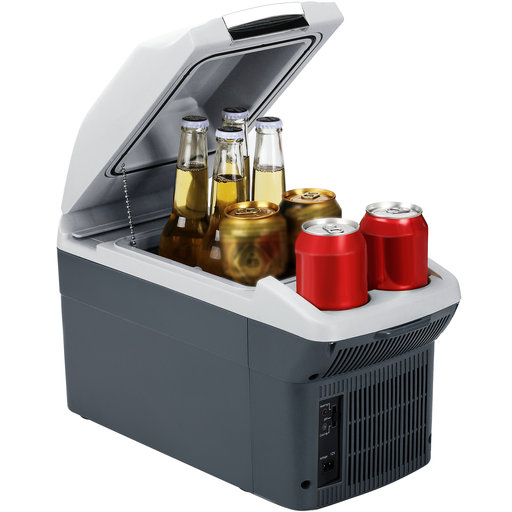
Why this suits this profile: its 9 L size is ideal for daily commutes, picnics, and short car trips.
The listing clearly states 12V operation and a temperature that depends on usage conditions, so you won’t mistake it for a compressor freezer.
A carry strap, two cup holders, insulated seal, and a noise level of around 40 dB.

Why this suits this profile: its capacity and settings are ideal for long trips, families, and campervan users.
Its compressor and two adjustable zones prevent you from mistaking simple cooling for genuine sub-zero storage.
A temperature range of −20 °C to 20 °C, control via screen or app, 12/24V and 100–240V power supply, plus wheels and a handle.

Why this suits this profile: it’s aimed at campers, anglers, lorry drivers, and van users who want to switch between refrigeration and freezing.
Its temperature range of −18 °C to 15 °C sets it apart from a simple thermoelectric cool box. The listing also recommends leaving 10 cm of free space around the vents.
A 22 L capacity, 12/24V and 100–240V power supply, installation error protection to check for your vehicle, and an easy-to-clean interior.
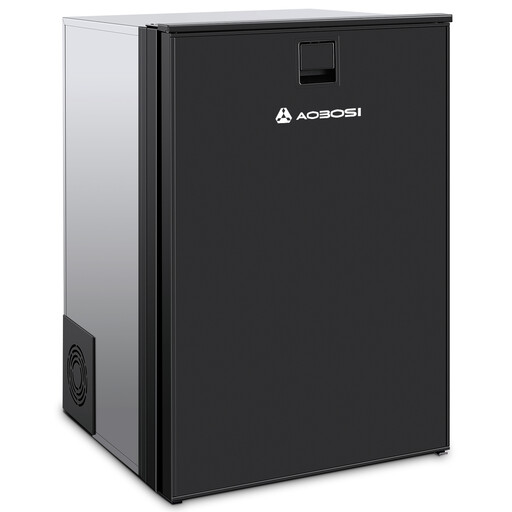
Why this suits this profile: its stated 110 L capacity is designed for leisure vehicles, boats, and installations where storage space matters more than compactness.
With a unit this size, you need to check the dimensions, fixing, and ventilation before buying, rather than relying on the stated capacity alone.
A dual-zone design, LED lighting, and 12/24V power supply as stated in the product listing.
We’ve put together a comprehensive, real-time list of products that fully meet these strict selection criteria and European safety regulations.
To keep performance consistent, get into these good habits:
It depends on the model, the battery, and the built-in protection. A compressor cool box with a protection system can reduce the risk of draining the battery, but an auxiliary battery or power station is still better for extended use. Check the manual before leaving the appliance plugged in with the engine off.
A thermoelectric cool box is generally lighter and can sometimes warm its contents. Its effectiveness depends more on the outside temperature. A compressor, on the other hand, maintains a set temperature and can reach below-freezing levels, depending on the model’s specifications. If you need to freeze food or go away for several days, compare the temperature range, power consumption, and noise level.
The cost depends on the power, the selected mode, how long it runs, and the price of electricity. When used on a 12V socket, the appliance draws from your vehicle’s battery. On mains power, you need to base it on the wattage consumption stated and your electricity tariff. “Eco” functions can reduce power consumption, but they don’t replace the need for good ventilation and sufficient energy to maintain the cold.