
Livraison le jour même ou le lendemain

Qualité garantie

Débloquez vos offres de bienvenue: Livraison GRATUITE | Jusqu'à -80 % | 30 jours d'essai gratuits à JoyPlus
Téléchargez l'application
So, you've made the switch to an electric car. But charging remains a headache. Installing a wall-mounted charger (wallbox) is often expensive, complicated, and sometimes simply impossible in a condo or rental property. The solution? The portable electric car charger. Flexible, cost-effective, and mobile, it lets you top up your battery anywhere: at home, on holiday, or at a friend's house.
This guide outlines the essential criteria for making the right choice and presents our selection of the best 2026 models for drivers of electric vehicles (EVs) and plug-in hybrids (PHEVs).
Intimidated by the technical jargon? Don't worry. To choose the right mobile charging station for you, there are three essential criteria to keep in mind.
Power, measured in kilowatts (kW), determines the charging speed. For efficient home charging, a 7?kW Type 2 charger (which is 32A single-phase) is often the sweet spot. It provides fast charging, provided you have a reinforced socket (like a P17 type) to support it.
Also, ensure the charger is equipped with a Type 2 charging cable, the European standard for almost all electric and plug-in hybrid vehicles on the market.
A smart EV charger goes far beyond simply supplying power. Connected via Wi-Fi or Bluetooth to a mobile app, it unlocks a world of optimised charging:
These features turn your portable EVSE into a true energy management tool.
On this point, there is no room for compromise. A good charger acts as a bodyguard for your car, your electrical system, and yourself. Make sure it includes the following protections:
As a product expert for Joybuy, I've sifted through numerous models to select only the most relevant ones, each tailored to a specific need.
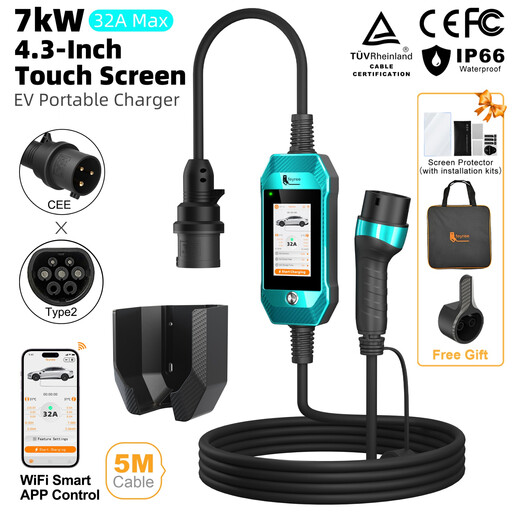
Why it stands out?: Its trump card? A large 4.3-inch colour touchscreen. No more squinting at a tiny display! It allows you to control everything—stats, settings, history—with a single touch, directly on the unit, without even taking out your smartphone.
Advantages?:
Who is it for? For tech enthusiasts who love to stay in control and view their charging data at a glance, with the convenience of an interface as intuitive as a smartphone's.
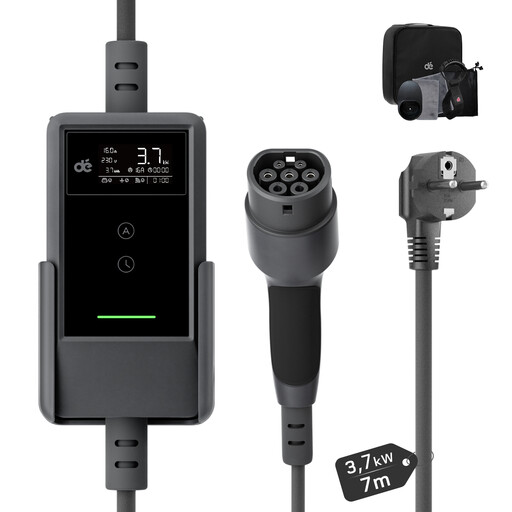
Why it stands out?: The essentials, with no frills. This charger prioritises simplicity and safety above all. With its 3.7?kW power and adjustable current (from 6A to 16A), it plugs into any standard domestic socket with complete peace of mind. It's the simplest and most accessible home charging solution.
Advantages?:
Who is it for? For those looking for a simple and reliable overnight charging solution, or a backup charger to keep in the boot for unexpected situations. Ideal if apps and Wi-Fi aren't your priority.
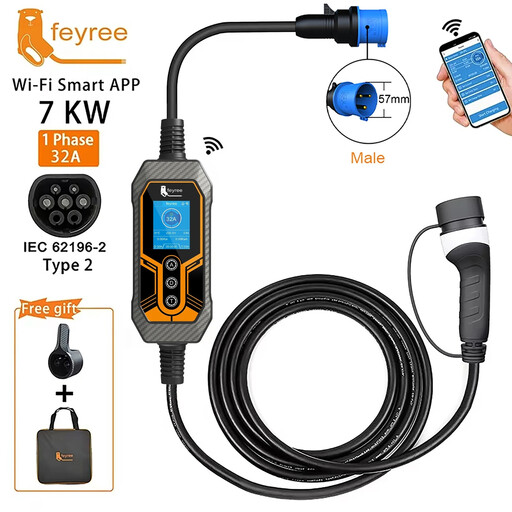
Why it stands out?: This is the champion of optimisation. This smart EV charger is fully controlled by its mobile app via Wi-Fi. Its goal? To help you achieve maximum savings through ultra-precise charging management.
Advantages?:
Who is it for? For budget-conscious drivers who want to automate their charging to take advantage of off-peak hours and reduce their electricity bill, all from their smartphone.
Our selection covers the most common needs, but the portable charger market is brimming with options. Power, cable length, specific features... To explore further, feel free to browse our complete catalogue.
Discover all our portable electric vehicle chargers
Absolutely. A portable electric car charger is perfectly designed for daily use, just like a wallbox. It's a reliable alternative for your everyday charging needs. One piece of advice, however: for intensive use at high power (16A or 32A), have your socket and electrical installation checked by an electrician. Safety first!
It's primarily a matter of speed. A 7?kW charger cuts the charging time roughly in half compared to a 3.7?kW model. In return, a 3.7?kW (16A) charger plugs into a simple domestic socket, whereas a 7?kW (32A) model requires a reinforced, industrial-type socket (like a P17) to operate safely at full power.
Yes, but with a few precautions. The connector that you plug into the car is typically IP66-rated, which protects it from heavy rain. You can therefore use it in wet weather without worry. However, be careful: the control box and especially the wall plug are not designed to be submerged. They must be kept sheltered from water. When in doubt, always consult the manufacturer's manual.