
Livraison le jour même ou le lendemain

Qualité garantie

Débloquez vos offres de bienvenue: Livraison GRATUITE | Jusqu'à -80 % | 30 jours d'essai gratuits à JoyPlus
Téléchargez l'application
Do you drive an electric or plug-in hybrid vehicle, but can't install a wall-mounted charger (wallbox) at home??Whether you're a renter, live in a condo, or are simply looking for a portable solution for home and on the road, the portable electric car charger is the ideal alternative.
This guide breaks down the essential criteria and presents our selection of the best models to help you find the right home charging solution without a wallbox for your needs and your electrical setup.
Technical jargon can be confusing. To help you make sense of it all, here are the key points to check before making your choice.
Your vehicle's charging speed depends directly on two factors:?the charger's power output and the type of socket it's plugged into.
But power isn't everything. Certain features can truly simplify your life and lower your electricity bill.
A portable Type 2 charger handles high electrical power, so safety is paramount. Ensure it includes all essential protections:?overcurrent, overvoltage, overheating, and, most importantly, a residual current device (Type A + 6mA DC or, ideally, Type B) to prevent any risk of current leakage. The CE mark, which certifies compliance with European standards, is a minimum requirement.
To guide you, we've selected three models that each cater to a specific use case.
Highlights
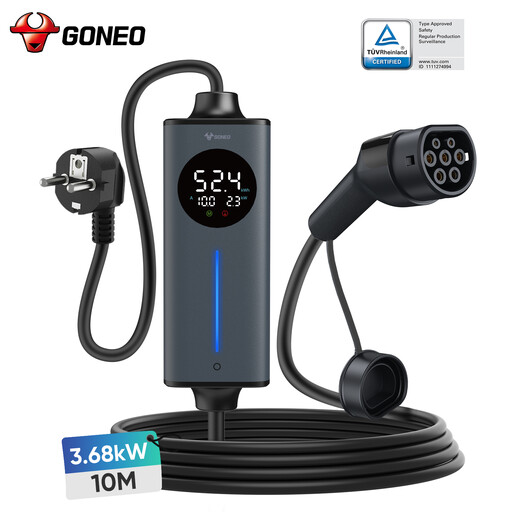
The GONEO charger is the go-to solution for simple and safe charging from a standard domestic socket. Its standout feature is undoubtedly its safety, with a full suite of protections, including ground fault detection and a residual current device. Its timer function is a real bonus for scheduling charges and optimising your electricity bill.
Advantages
Best for? Perfect for owners of plug-in hybrids (PHEVs) or all-electric vehicles who have a short daily commute and can plug in their car overnight. It's also the ideal portable charger to keep in your boot as a backup.
Highlights
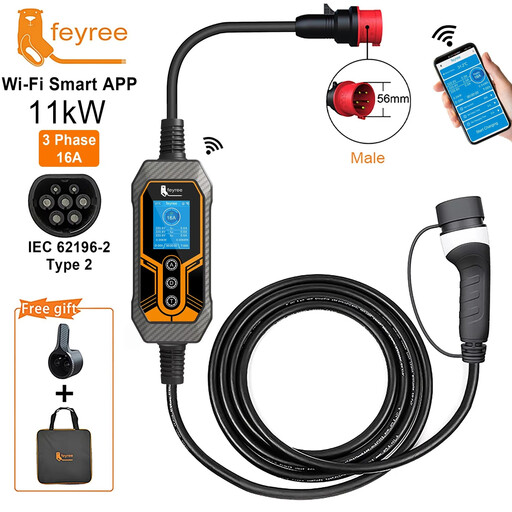
This feyree model offers an excellent balance of power and smart features. Capable of delivering up to 11?kW on a three-phase supply, it significantly speeds up charging. Its real advantage is its Wi-Fi mobile app, which gives you complete control over the charging session:?scheduling, real-time monitoring, and current adjustment are all included.
Advantages
Best for? For those who have a three-phase industrial socket (CEE 16A) and want faster, smarter charging. It's ideal for electric cars that accept 11?kW AC charging and for owners who like to manage their energy consumption with precision.
Highlights
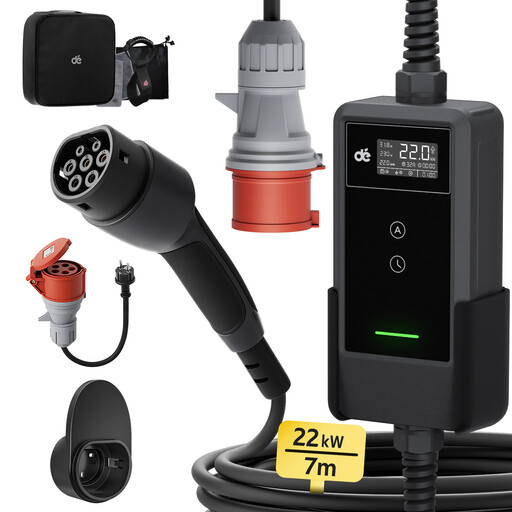
With its 22?kW output, this mobile charging station is aimed at those seeking maximum performance from an AC charger. This level of power can cut charging time in half for compatible vehicles. App-based control and a generous 7-metre cable make it a solution that is as powerful as it is versatile.
Advantages
Best for? For drivers in a hurry whose vehicle accepts a 22?kW charge (like some Renault Zoé or Tesla models). Be aware:?to take full advantage of it, a robust three-phase electrical system equipped with a CEE 32A socket is essential.
Our selection focuses on specific use cases, but the market is full of other solutions. If you have different needs or simply want to explore other power levels and features, feel free to browse our complete catalogue.
? Explore our range of socket chargers
Yes, provided you choose a quality model that complies with European standards (CE marking). Good portable chargers integrate the same safety features as a wallbox (RCD, temperature sensors, etc.), offering an equivalent level of safety. Of course, safety also depends on your installation:?your wall socket must be in perfect condition and properly earthed.
It's all about speed. In theory, a 22?kW charger will charge a battery twice as fast as an 11?kW model. However, to benefit from this, two conditions must be met:?your car must be able to accept that charging power, and your home must be equipped with a 32A three-phase line. This is why the 11?kW charger remains an excellent compromise, as it's compatible with 16A three-phase installations, which are much more common.
This is strongly discouraged by manufacturers, and for good reason. Plugging a high-power charger (11 or 22?kW) into a simple domestic socket using an adapter creates a significant risk of overheating and fire. It is always best to use the charger's native plug. For greater versatility, some models are sold with official, secure adapters designed specifically by the brand.