
Livraison le jour même ou le lendemain

Qualité garantie

Débloquez vos offres de bienvenue: Livraison GRATUITE | Jusqu'à -80 % | 30 jours d'essai gratuits à JoyPlus
Téléchargez l'application
When you drive an electric or plug-in hybrid vehicle, charging is a top priority. But what if installing a fixed wall-mounted station isn't an option—whether you're renting, living in a shared property, or simply want more flexibility?? The portable electric car charger emerges as the ideal alternative. It gives you the freedom to top up your battery at home, at a friend's house, or on holiday, as long as a compatible socket is within reach.
This guide is designed to break down the essential criteria to consider before making a purchase and to present our selection of the best models, tailored to every need and electrical setup.
Choosing a mobile charging station isn't something to be taken lightly. There are three main criteria to evaluate to find the model that will perfectly match your usage and your electrical system.
Power, expressed in kilowatts (kW), directly determines your vehicle's charging speed.
The Type 2 charging cable has become the standard in Europe on the vehicle side. The real choice, therefore, lies with the wall socket.
A smart EVSE charger can truly simplify your daily routine. Models equipped with a station with a mobile app (Wi-Fi or Bluetooth) unlock very practical features:
We have selected a few models that stand out for their features and suitability for specific needs.
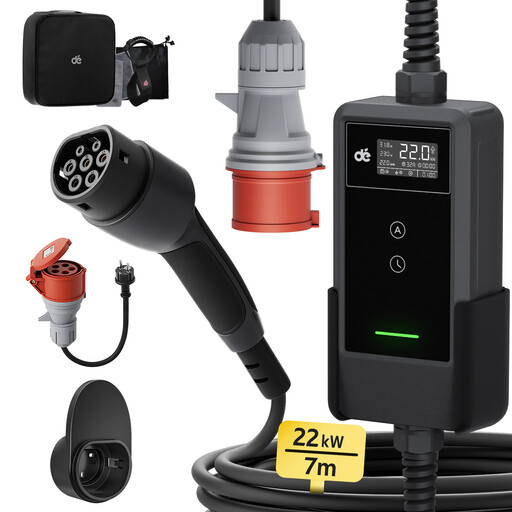
Why it stands out: This model combines the power of a wall-mounted station with the flexibility of a portable charger. Its 22?kW capacity makes it a formidably effective primary charging solution.
Advantages:
Who is it for? For users with a three-phase system and a CEE 32A socket, who own a vehicle compatible with 11?kW or 22?kW charging (such as a Renault Zoe or Tesla Model S/X). It's the perfect alternative for those who want the speed of a Wallbox without the installation constraints.
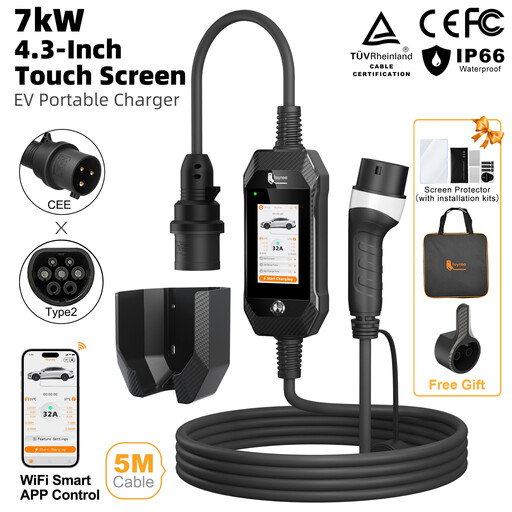
Why it stands out: This 7kW charger stands out with its large 4.3-inch colour touchscreen. It allows you to control and view everything at a glance, in addition to its app connectivity.
Advantages:
Who is it for? For drivers looking for the best balance of charging speed, smart features, and ease of use. Ideal for daily use at home on a reinforced socket or a single-phase CEE 16A/32A socket.
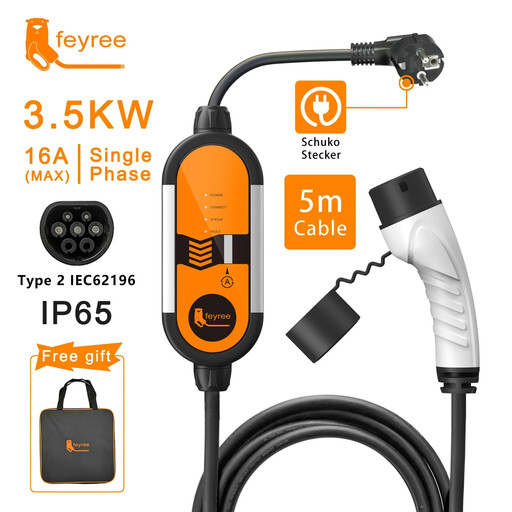
Why it stands out: Its key features are simplicity and universality. This charger plugs into any domestic socket, making it the ideal travel companion or the perfect backup solution.
Advantages:
Who is it for? For owners of plug-in hybrid vehicles (PHEVs) or EV drivers for whom speed is not the top priority. It is the ultimate easy solution for overnight charging at home or as a backup charger on the go.
Sometimes, the real headache isn't the charger itself, but the socket you need to plug it into. When travelling, or when faced with different types of industrial or domestic sockets, a good adapter becomes your best ally. To plug in safely anywhere, discover our selection of power plug adapters.
1. Can I leave a portable charger plugged in permanently? Yes, these chargers are designed for prolonged use and include multiple protections (overheating, overvoltage). For fixed daily use, however, it is strongly recommended to use a high-quality socket (ideally reinforced or industrial) and to ensure that the electrical system is up to code.
2. What is the difference between a portable charger and a fixed Wallbox? As the name suggests, it's primarily a matter of mobility. A portable charger can be taken with you and used wherever a compatible socket is available. A Wallbox, on the other hand, is fixed to a wall: it is stationary but often offers deeper integration with the home's electrical system (load balancing, etc.). In terms of power, the best portable chargers can now hold their own against Wallboxes, with some models reaching up to 22?kW.
3. Is adjustable current really useful? It's more than useful—it's essential! This feature allows you to adapt the charging power to the system you are plugging into. On an old or shared circuit, you can reduce the current (e.g., to 10?A) to avoid tripping the circuit breaker. On a dedicated and robust socket, you can increase the current to its maximum to speed up charging. It's a guarantee of both safety and versatility.