
Livraison le jour même ou le lendemain

Qualité garantie

Débloquez vos offres de bienvenue: Livraison GRATUITE | Jusqu'à -80 % | 30 jours d'essai gratuits à JoyPlus
Téléchargez l'application
Whether you're outfitting your van for a winter road trip, working in a freezing garage, or looking for a reliable heat source for your base camp, the cold is often the one guest that ruins everything. Faced with a jungle of available models, it's hard to know where to start. This guide breaks down the essential criteria for making an informed choice and introduces a solution that stands out from the crowd—all in a no-nonsense way.
Before you buy a model, let's review the features that will truly make a difference in day-to-day use. Here are the key points to keep in mind to avoid making a mistake.
Expressed in kilowatts (kW), power output is the number one criterion. It must be perfectly suited to the volume you want to heat.
A common mistake? Choosing an oversized unit, which will run in short cycles and consume too much fuel. Conversely, an undersized model will run continuously without ever managing to reach the target temperature.
The type of electrical supply directly determines your heater's flexibility.
It's often the details that make all the difference. A quiet diesel heater is non-negotiable for a good night's sleep, especially in an auxiliary heater for a camper van. The presence of a discreet fuel pump is therefore a point to check.
Modern controls also add a highly appreciated level of comfort. With a Bluetooth parking heater, you can start, stop, and adjust the temperature from your smartphone. Ideal for not having to get out from under the covers or cross a freezing workshop.
At the intersection of versatility, power, and comfort, one all-in-one model clearly stands out.
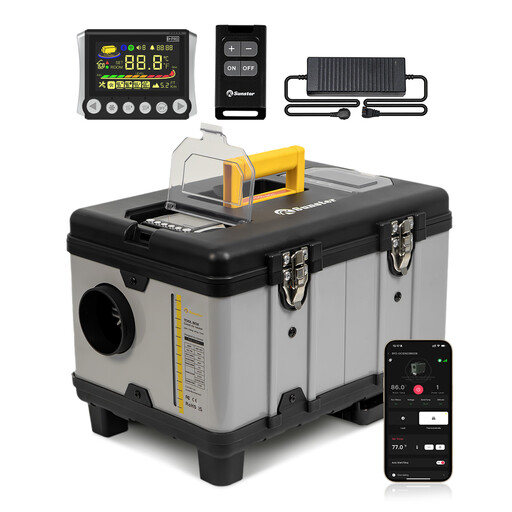
Why does it stand out?
This model integrates all components (6L tank, pump, heating unit) into a single, compact, and robust case that resembles a toolbox with its carrying handle. This "plug-and-play" design makes installation and transport incredibly easy. Its dual AC 230V and DC 12V/24V power supply gives it outstanding versatility, making it equally at home in mobile use or as a fixed unit in a garage.
Key Strengths
Who is it for?
It's aimed at those looking for a powerful, portable, and hassle-free heating solution. It is therefore perfect for owners of large vans, craftsmen in workshops, or for heating a marquee or a construction site shelter.
A conversion project doesn't stop at heating. To complete your setup, organise your workspace, or find that missing tool, feel free to explore our other selections.
To get your tools and accessories in order, for example, take a look at our selection of tool trays and other workshop storage solutions.
For most standard-sized vans and camper vans, a power output of 2?kW to 5?kW is more than sufficient. This ensures you can maintain a comfortable temperature without over-consuming fuel. An 8?kW model like the one we feature becomes relevant for very large vehicles (converted buses, heavy-duty trucks) or for those facing extreme cold and wanting a near-instantaneous temperature rise.
Safety is a non-negotiable point. Any combustion heater, without exception, releases carbon monoxide (CO): an invisible, odourless, and deadly gas. It must therefore never be used in a poorly ventilated, enclosed living space (bedroom, bathroom, etc.). For use in a garage, workshop, or tent, sufficient ventilation is imperative, and the exhaust gases must be scrupulously directed outside. Follow the manufacturer's instructions to the letter and keep the unit at a safe distance from any flammable materials.
Consumption is directly linked to the power level used. To give you an idea, the TB10 model consumes between 0.11?L/h at low power and 0.45?L/h at its maximum output of 8?kW. In practice, when you use the thermostat mode to maintain a temperature, the average consumption overnight remains very low and is most often in the lower part of this range.