
Livraison le jour même ou le lendemain

Qualité garantie

Débloquez vos offres de bienvenue: Livraison GRATUITE | Jusqu'à -80 % | 30 jours d'essai gratuits à JoyPlus
Téléchargez l'application
Whether you're looking to extend your camper van getaways, work comfortably in your garage during winter, or simply have a reliable auxiliary heat source, the portable diesel air heater has become the go-to solution. However, the market is flooded with models making tempting promises that sometimes hide deal-breaking flaws. Before you invest, it's crucial to know how to spot these pitfalls to make the right choice.
As a product expert at Joybuy, my mission is to help you get a clearer picture. Let's review the key points to watch out for and the essential criteria for finding the unit that will truly meet your needs, without any nasty surprises.
Marketing materials often highlight impressive numbers, but the real user experience hinges on technical details that are frequently overlooked. Here are three pitfalls to avoid at all costs:
To avoid these disappointments, focus on a few key parameters that make all the difference in the quality and usability of a diesel air heater.
Power, expressed in kilowatts (kW), determines the unit's ability to heat a given space. An 8kW diesel heater is generally suitable for areas of 20 to 25 m? (approx. 215-270 sq ft), like a large converted van or a garage. But fuel consumption is an equally important criterion. A good unit should offer an adjustable consumption rate, typically between 0.1 and 0.5 L/h. This flexibility allows you to maintain a comfortable temperature without emptying the tank overnight. Make sure it includes a parking heater with a built-in thermostat: it automatically regulates the power to optimise both consumption and comfort.
The ability to run on different power sources is a decisive advantage. A 12V / 220V diesel heater offers maximum flexibility.
This dual compatibility transforms a simple vehicle heater into a versatile backup solution, ready to serve in multiple contexts.
Recent models integrate features that are real game-changers for daily use:
Rather than an exhaustive list, we've matched products to user profiles to better illustrate their real-world relevance.
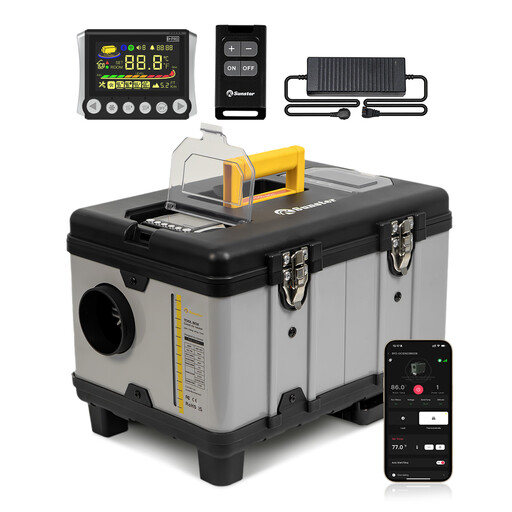
Why it's the perfect match: Designed for mobility, its all-in-one compact design with an integrated handle and tank makes it incredibly easy to transport and set up. Ideal for those who are always on the move and need a fast, effective, and portable heating solution.
It directly tackles the noise issue by integrating a silent fuel pump (≤ 35 dB), putting an end to the annoying "ticking." The Bluetooth app control lets you manage everything without even getting out of your sleeping bag.
Versatile Power Supply: Compatible with 12V DC and 110-240V AC. Adaptive High-Altitude Mode: Effective up to 5,500 m (18,000 ft). Fan-Only Mode: Can also be used to circulate air in the summer.
Why it's the perfect match: For those working in a garage, warehouse, or on a job site, its 8kW power and ability to quickly heat spaces up to 25 m? (270 sq ft) are decisive advantages. The ability to plug it into a 220V outlet makes it ready to use out of the box.
It avoids the "theoretical" power trap with a "Turbo" mode for rapid heat-up and a thermostat that maintains consistent, stable warmth. The result is reliable performance all day long.
Dual 12V/220V Power: Adapts to workshop use (AC power) or an off-grid job site (battery). Remote Control Panel: Its 4m extension cable lets you place the controls within easy reach.
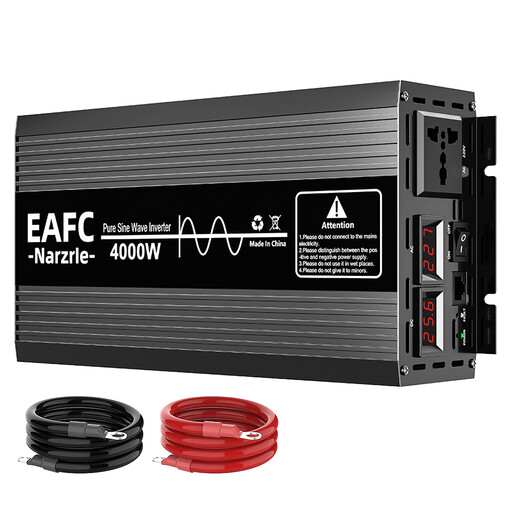
Why this accessory is relevant: This is the essential companion for any diesel heater user aiming for complete off-grid autonomy. It converts your battery's 12V DC power into stable 220V AC, allowing you to run tools, a laptop, or a coffee maker in addition to your heater.
Unlike cheap, modified sine wave inverters that can damage electronics, its "Pure Sine Wave" technology produces power as clean as the utility grid, protecting your most sensitive equipment.
High Capacity: 2000W of continuous power to run multiple devices simultaneously. Dual Digital Display: Allows you to monitor input and output voltage in real-time for precise battery management.
Heating is essential in winter, but vehicle comfort is a year-round concern. Discover our solutions for tackling the summer heat as well.
1. What is the actual fuel consumption of an 8kW portable diesel heater? Consumption depends on the power level being used. For an 8kW model, expect between 0.11 L/h on low (to maintain temperature) and about 0.45 L/h at full power. With a 6-liter tank, this provides over 13 hours of runtime at maximum output, and much longer if the thermostat is managing the heat.
2. Can I install a portable diesel heater in a van myself? Absolutely. All-in-one portable models like the TB10 are specifically designed for simple installation. You just need to position the unit, safely route the exhaust pipe to the outside, and connect it to a 12V or 220V power source. Strict adherence to the manufacturer's instructions is mandatory, especially for venting the exhaust gases, to eliminate any risk of carbon monoxide poisoning.
3. Are portable diesel heaters noisy? Noise is indeed a point of concern, mainly due to the fuel pump. Entry-level models can produce an audible and very annoying "ticking" sound at night. For use in a living space like a van, it's crucial to choose a unit equipped with a "silent" or "low-noise" pump, which significantly reduces this nuisance. The fan noise itself is generally comparable to that of a standard space heater.