What should you check before buying?
Start by measuring humidity after the immediate spike has passed, and check that the room is well ventilated. If an appliance would still be useful, compare its features with the room’s main use in mind.
| What matters |
What to check |
Who it suits |
| Measuring humidity and ventilation |
Measure relative humidity with a hygrometer; check the air inlets and ventilation. Qualitel generally puts the recommended range at between 40 and 60%. |
When condensation appears after a shower, I want to know whether it clears with normal ventilation before buying an appliance. Around 40% of consumers prioritise checking whether they need one. |
| Capacity and drainage |
Compare the L/24 h figures and the conditions they were measured under, then check the tank capacity and whether continuous drainage is possible. |
If I often dry laundry in the room, I want to manage repeated sources of humidity without stopping each cycle to empty the tank. This is the priority for around 30% of consumers. |
| Noise and operation |
Check the dB(A) rating at the setting you’ll use, the power in W and whether it can maintain a target humidity. |
In a bedroom or home office, I want to use the appliance without overlooking its noise or how long it runs for. Around 30% of consumers put quiet operation and control over how it runs first. |
Portable dehumidifiers on Joybuy
These electric models are intended for occasional use in a room, particularly when humidity spikes keep happening or laundry is dried indoors. First, measure the need and check ventilation: choosing an appliance won’t fix a leak or faulty ventilation.
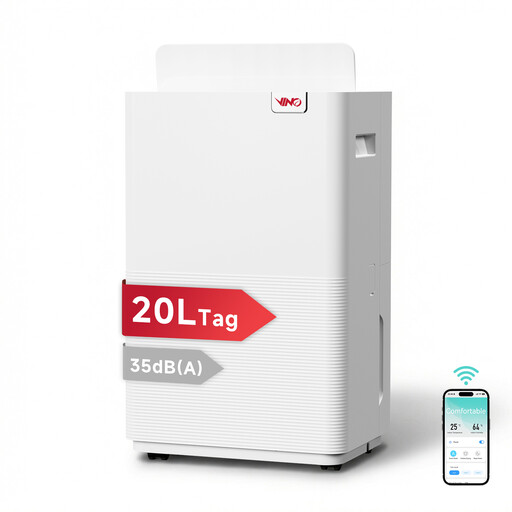 Image unavailable
VINO 20 L, WiFi control, 2.5 L tank
Worth considering for a room stated to be up to 40 m² and recurring humidity spikes. The product details list automatic, laundry and sleep modes. The 20 L/day capacity is stated at 30 °C and 80% relative humidity. Check the noise level in the mode you’ll use, and whether the hose needed for continuous drainage is included.
View on Joybuy
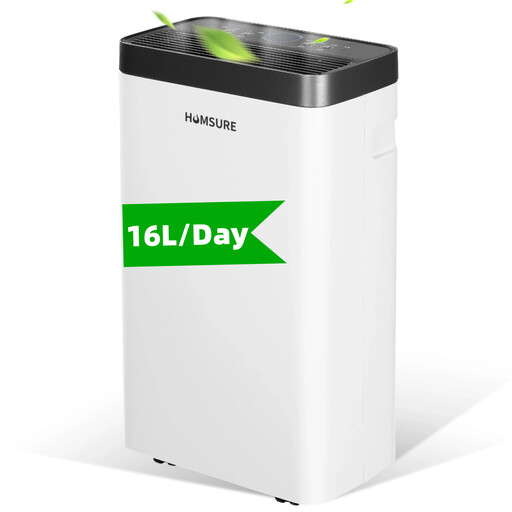 Image unavailable
HUMSURE 16 L/day, 1.4 L tank
Worth considering for a room stated to be up to 25 m², bearing in mind that the 1.4 L tank will need emptying. The capacity is stated at 95 °F and 90% relative humidity. If you plan to use continuous drainage, check that the hose is long enough for your setup.
View on Joybuy
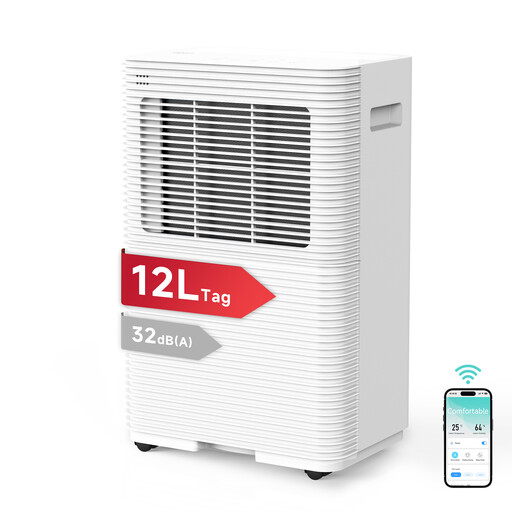 Image unavailable
VINO 12 L, WiFi control, 1.8 L tank
Worth considering for a room stated to be up to 24 m², particularly if you’d like a laundry mode. The 12 L/day capacity is stated at 30 °C and 80% relative humidity. For a bedroom, check the noise level at the setting you plan to use. If you want to set a target humidity, check the adjustment range.
View on Joybuy
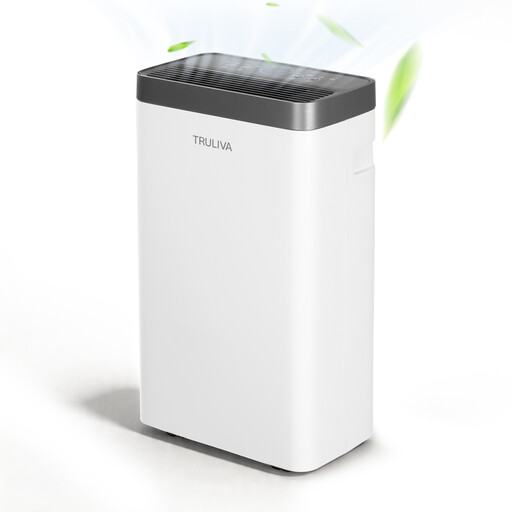 Image unavailable
TRULIVA AP10-2012EE, around 32 m²
Worth considering for recurring humidity spikes, particularly when drying laundry: the product title mentions a 24-hour timer and continuous drainage. Before using it in an occupied room, check the operating noise and the adjustable humidity range for the exact model.
View on Joybuy
 Image unavailable
TRULIVA 25 L/day, 2.8 L tank and hose
Worth considering if drying laundry leads to recurring humidity spikes and continuous drainage is practical. The stated capacity is based on 95 °F and 90% relative humidity. Check that the model is suitable for your room size and see how noisy it is at the setting you plan to use.
View on Joybuy
Frequently asked questions
What humidity level should I check before buying?
Measure relative humidity with a hygrometer and see whether it remains high after the room’s activity-related spike has passed. Qualitel generally puts the recommended range at between 40 and 60%, says that 60 to 70% calls for monitoring, and links levels above 70% with a higher risk of condensation and mould. Interpret the reading alongside the temperature and ventilation.
Can a dehumidifier replace airing a room or using an extractor fan?
No. It can provide extra support, but it won’t fix faulty ventilation. Anses recommends airing the room after a shower or bath and keeping air inlets clear. ADEME also advises checking the vents and ventilation system if your home remains too humid.
How can I avoid having to empty the tank too often?
Compare the tank capacity and check whether the model supports continuous drainage. Before relying on this option, check the instructions for the exact model to confirm that a hose is included, how long it is and what setup is needed to drain water where you plan to use the appliance.
How can I estimate electricity use?
Multiply the power rating in kW by the number of hours the appliance runs, as Rowenta explains. For example, using 300 W for 6 hours uses 1.8 kWh. When estimating usage, allow for the appliance stopping when it reaches the target humidity.
If I rent, is an appliance enough if there’s a problem with the property’s ventilation?
No. A dehumidifier won’t fix a ventilation fault in your home. For a rented main residence in France, ANIL notes that the openings and any ventilation systems in a decent home must allow moisture to be removed in a way that’s appropriate for normal occupancy.


