
Livraison le jour même ou le lendemain

Qualité garantie

Débloquez vos offres de bienvenue: Livraison GRATUITE | Jusqu'à -80 % | 30 jours d'essai gratuits à JoyPlus
Téléchargez l'application
Wash your car in a driveway with no power socket, rinse your bike after a ride or clean your patio without trailing metres of cable: a portable cordless pressure washer gives you real freedom of movement. The key is choosing a model that’s up to the job.
Some product specifications quote a high pressure without giving the flow rate, while others advertise a powerful battery but don’t include the charger. Before you place your order, there are three potential pitfalls to watch out for.
Be wary of overly broad claims, too. A cordless washer designed for cleaning a car, bike or garden furniture won’t necessarily have the power or flow rate needed to tackle a large, heavily soiled surface.
Pressure is measured in bar or PSI. For reference, the models featured here are rated at between 24 and 45 bar; the Yard Force also specifies 665 PSI. Flow rate, measured in litres per hour, completes the picture: 180 l/h is enough for targeted cleaning, while 360 l/h will generally let you rinse more quickly, depending on the water source and conditions.
For a car, motorbike, bike, patio or outdoor furniture, adjustable pressure is a better choice than a single, highly concentrated jet. When cleaning bodywork, seals, wood or any delicate surface, start at a safe distance and use the gentlest setting.
When assessing a battery-powered pressure washer, check the battery voltage and capacity, as well as the availability of replacement parts. 20 V and 24 V models aren’t interchangeable: only use the battery specified by the manufacturer.
A 4 Ah battery gives you a decent reserve, but runtime depends on the pressure setting, flow rate, breaks and temperature. Always check whether the battery and charger are included. The Greenworks 24 V featured below is explicitly sold without a battery or charger, so factor this into your budget from the outset.
For a portable pressure washer with a tank or external water intake, check the following:
A foam lance makes it easier to apply cleaning product to bodywork or furniture, but you’ll still need to rinse afterwards. If you’re washing your car while out and about, a brush and a foldable bucket can also come in very handy.
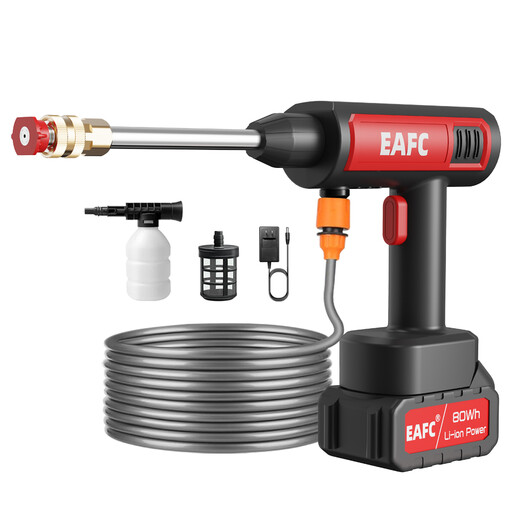
Why it suits this profile: Cordless and able to draw water from a bucket, it’s ideal for occasional cleaning of a car, bike, balcony or furniture, without the need for a permanent installation.
The product information specifies the different possible water sources — a bucket, tap or suction — and provides troubleshooting advice if there’s air in the system or a connection hasn’t been properly secured.
Portable design, cordless lithium power and stated suitability for cars, motorbikes, bikes, floors, walls and watering tasks.
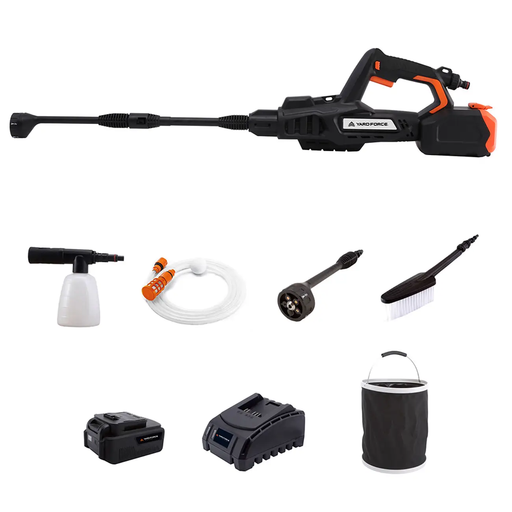
Why it suits this profile: With a stated pressure of up to 45 bar, a flow rate of 360 l/h and several accessories, it’s designed for people who want to tackle a range of outdoor cleaning jobs regularly.
The product information clearly distinguishes between the 45 bar pressure and the 360 l/h flow rate. It also includes a hose, a 5-in-1 nozzle, a foam bottle, a brush and a foldable bucket.
Advertised 20 V 4,000 mAh battery, water intake from a fresh water source, and protection against overload, overheating and overpressure.
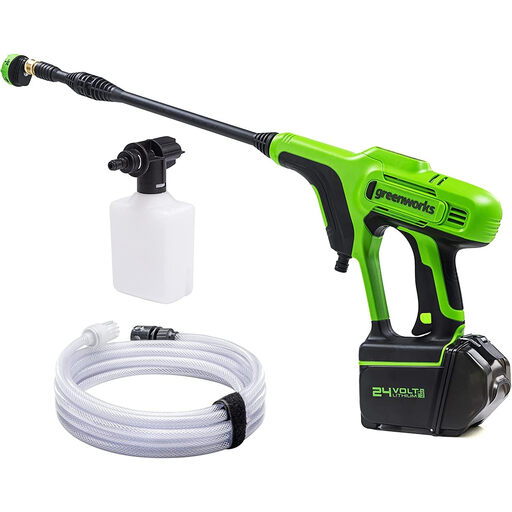
Why it suits this profile: Compatible with Greenworks 24 V batteries and supplied with a 6 m suction hose, it’s a good fit for existing owners and for mobile use around the home.
The product information clearly states 24 bar, 180 l/h, a 5-in-1 adjustable nozzle and a 6 m hose. However, the product title specifies that the battery and charger aren’t included, so check what’s in the pack before ordering.
Advertised 300 W motor, clip-on foam bottle and water intake from a bucket, water butt or any other clean source.
We’ve put together a comprehensive, regularly updated selection of products that meet these demanding criteria and European safety standards.
Before using the washer for the first time, fill a bucket with clean water and fully submerge the suction hose. Priming can take a few seconds. Keep the hose as straight as possible, check the connections and remove the battery before cleaning or carrying out any maintenance.
Never point the jet at a person, animal, electrical equipment or the washer itself. When cleaning bodywork, start with a wide nozzle and keep a safe distance. After each use, rinse the hose and nozzle, dry the washer, then store the battery away from damp and frost.
Yes. Some models are self-priming and draw water from a bucket, water butt or another clean source. Check that this feature is explicitly mentioned in the product information and follow the priming instructions.
Adjustable pressure is generally more practical than a fixed jet. For bodywork, choose a moderate setting and a suitable nozzle. The bar ratings quoted are theoretical maximums: results also depend on the flow rate, nozzle and working distance.
Your costs include the electricity needed to recharge the battery, water and, potentially, detergent. However, the biggest expense may be the initial purchase of a battery and charger if they aren’t included. Also check that a compatible replacement battery is available for the model you choose.