
Livraison le jour même ou le lendemain

Qualité garantie

Débloquez vos offres de bienvenue: Livraison GRATUITE | Jusqu'à -80 % | 30 jours d'essai gratuits à JoyPlus
Téléchargez l'application
Your car still runs perfectly well, but its stereo lacks modern navigation and wireless smartphone connectivity? A portable CarPlay screen for your car lets you add Apple CarPlay, Android Auto, hands-free calling and music without touching your original dashboard.
The challenge is picking the right model. Behind a large display or a camera advertised as 4K, there are sometimes details that seriously complicate everyday use. Here are the points to check before you place your order.
A wireless Apple CarPlay screen attaches to your dashboard and has its own display. It’s ideal for older cars that don’t have CarPlay built in.
A wireless CarPlay adapter, on the other hand, converts an existing wired CarPlay connection into a cable-free one. It doesn’t add a screen. Buying this type of adapter for a car without built-in CarPlay won’t solve anything.
With a diagonal of 10.26 inches (around 26 cm), a car touchscreen offers a comfortable area for viewing a map. But it still needs to fit in your cabin. Measure the width of your dashboard, check visibility from the driver’s seat, and make sure the mount stays perfectly stable.
Resolution also affects comfort. A panel with 1,600 × 600 pixels or 1,920 × 720 pixels displays maps and menus with greater clarity. However, brightness, day/night adjustment and the mounting angle all play a part in readability.
A reversing camera usually needs to be connected to the reversing light’s power supply. A front dashcam is simpler to install, but its cable must be hidden without obstructing driving or interfering with airbag deployment.
The term “plug-and-play” often means the screen plugs into a 12–24 V cigarette lighter socket. It doesn’t mean the rear camera will definitely be installed in a few minutes.
Before ordering, check the minimum operating system version stated by the manufacturer. Depending on the model, compatibility may start at iOS 10 or iOS 12 and Android 11.
To use Android Auto wirelessly, your smartphone must also support wireless projection. The connection typically uses Bluetooth for pairing, then Wi-Fi to transmit the interface. Dual-band 2.4 GHz/5 GHz Wi-Fi can reduce some interference, but it doesn’t guarantee an identical experience with every phone.
The screen must be able to send sound to your car’s speakers. The most common solutions are:
Check for an AUX input and the FM frequencies available in your area. Voice control then depends on Siri or Google Assistant, as well as compatible apps.
GPS navigation, hands-free calling and music playback are the core of the CarPlay and Android Auto experience. Extra features are worth examining separately:
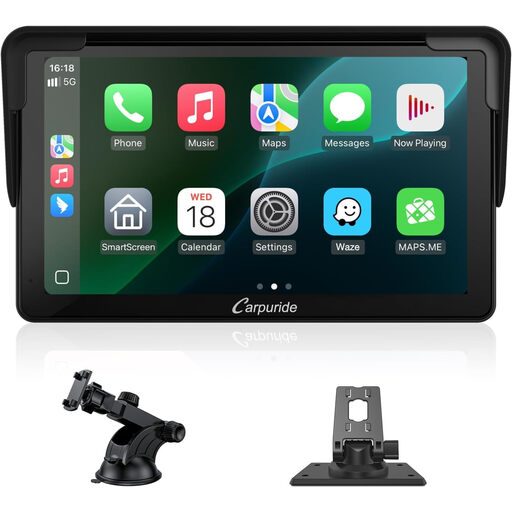
Why this choice suits this profile: At 7 inches (around 17.8 cm), it’s ideal for drivers who want to add CarPlay and Android Auto without fitting a bulky screen.
It’s a complete portable screen, not just an adapter for a stereo that’s already compatible.
1080p touchscreen, Bluetooth 5.0, wireless CarPlay, wireless Android Auto and MirrorLink.
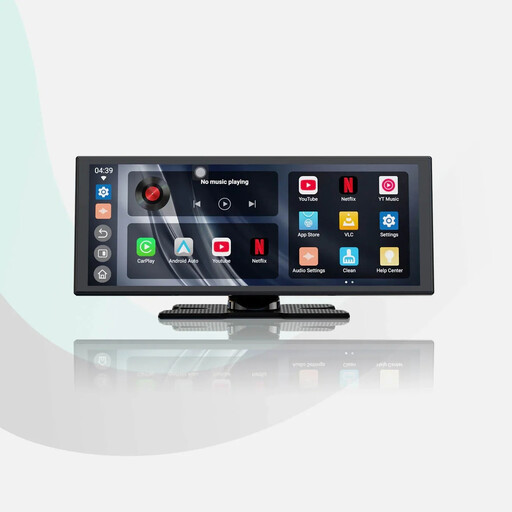
Why this choice suits this profile: Its large display and built-in apps target drivers who prioritise visual comfort and multimedia features when stationary.
The spec sheet states the 1,920 × 720 resolution, the 1080p rear camera and the conditions needed for Wi-Fi app connectivity.
11.4-inch screen, Android 13, built-in apps, 1080p reversing camera and claimed audio mixing.
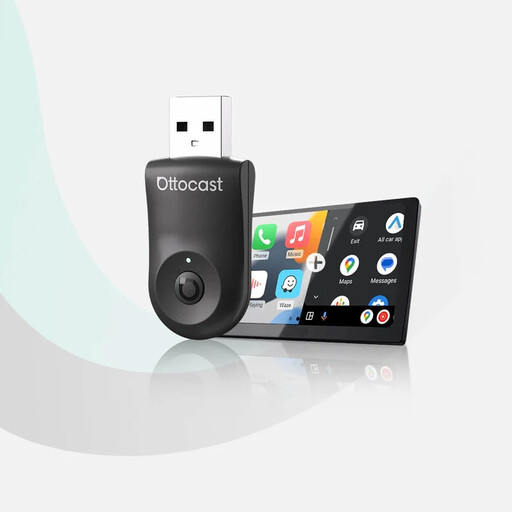
Why this choice suits this profile: Its compact size suits vehicles that already have wired CarPlay or Android Auto.
Its compatibility must be checked before purchase: it doesn’t replace the stereo and won’t work with some vehicles.
Compact unit, Bluetooth pairing, 5 GHz Wi-Fi and USB-A and USB-C adapters supplied.
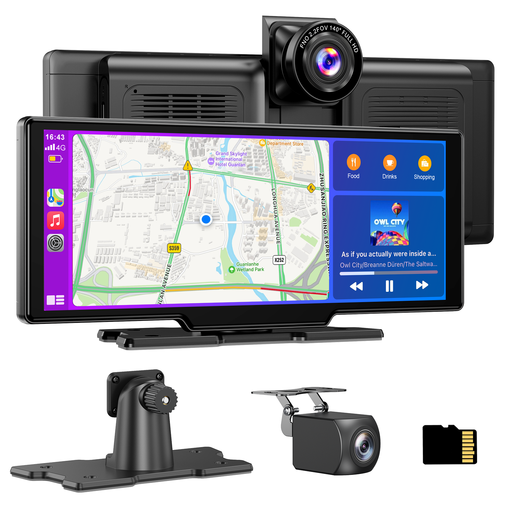
Why this choice suits this profile: It combines screen, front recording and rear camera in one solution, handy for frequent journeys.
The 64 GB TF card is included and loop recording is designed to run continuously.
Front camera advertised as 4K, AHD 1080p rear camera, 140-degree angle and 12–24 V power supply.
We’ve compiled a complete, real-time updated selection of products that meet these demanding criteria, while also taking European safety regulations into account.
To install the screen without permanent modification:
Videos and entertainment apps should only be used when the vehicle is parked. With a reversing camera, check the image and guide lines after any wiring changes.
Yes, as long as it has its own display and a suitable power supply. The original stereo doesn’t need to support CarPlay. Sound transmission, however, depends on the connections available in your vehicle.
Downloaded maps can work offline, depending on the app you use. Traffic information, music streaming and some voice commands usually require your phone’s data connection.
The screen doesn’t necessarily require an additional subscription. Any ongoing costs mainly relate to mobile data usage, replacing the memory card or installing a rear camera. Also check whether the camera and accessories advertised are included or sold separately.