
Livraison le jour même ou le lendemain

Qualité garantie

Débloquez vos offres de bienvenue: Livraison GRATUITE | Jusqu'à -80 % | 30 jours d'essai gratuits à JoyPlus
Téléchargez l'application
A coffee stain on the sofa, muddy marks in the hallway or a small pet accident on a rug can quickly become embedded in the fibres. A portable carpet cleaner lets you tackle these areas locally, provided you choose a machine that is genuinely suited to your needs.
Marketing claims alone are not enough to distinguish between a carpet cleaner, sofa cleaner and portable spot cleaner. Some models boast high power but come with small tanks, an overly short hose or time-consuming maintenance. Here are the key points to consider before you buy.
Wattage indicates power consumption or motor output, but it is not enough to assess how effectively the appliance can extract dirty water. Suction pressure, measured in kPa, gives a more direct indication of suction performance. However, the design of the nozzle, hose and airflow system remains crucial.
A 1 300 W model is therefore not automatically more effective than a 600 W appliance. Instead, compare the wattage, the stated suction rating and how well the extraction system performs in real use.
A clean-water tank that is too small means you will have to interrupt cleaning regularly. Conversely, a dirty-water tank that is difficult to remove can turn maintenance into a chore. For cleaning a sofa, car seats or a small area of carpet, a smaller capacity may be sufficient. For several rugs or a large corner sofa, larger tanks reduce the number of trips to the tap.
Keeping clean water and waste water separate remains essential for cleaning textiles more conveniently and hygienically.
A textile cleaner sprays water or a cleaning solution onto the surface, then vacuums it back up. It therefore cannot remove all moisture instantly. Thorough suction, slow passes and good ventilation are essential.
Before every use, check the fabric care label and test the appliance on a hidden area. Avoid materials that cannot tolerate water, delicate fabrics and surfaces that may run or transfer colour. Even a machine marketed as a steam carpet cleaner must not be used with boiling water or on an incompatible material.
For treating a localised stain, choose a machine that combines spraying followed by suction. The solution penetrates the fibres while the nozzle collects the dirt-laden water. This method is particularly suitable for deep cleaning rugs, stairs, cushions and car seats.
Some models are limited to wet extraction. Others also offer hot water or steam. These functions can help tackle certain types of dirt, but they require extra care with regard to the fabrics and temperatures they can withstand.
Check the clean-water tank and dirty-water tank capacities separately. A two-tank system prevents fresh water from mixing with recovered water. Also check how easy the tanks are to remove, how the filters can be rinsed and whether removable parts can be left to dry properly.
When cleaning a car, stairs or a large sofa, the hose and power-cord lengths are just as important as the appliance’s weight. A 1.1 m hose may be sufficient for an armchair or small area, while a longer reach makes it easier to move around a vehicle.
Noise levels also deserve your attention. A stated level of between 75 and 80 dB is clearly audible in an occupied room. For occasional cleaning, sessions are generally short, but this becomes a more important consideration when pets or young children are nearby.
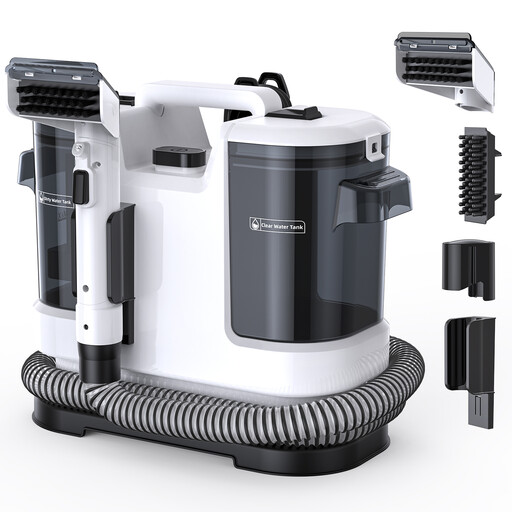
Why it suits this user profile: Its compact design and stated suction power of 13 500 Pa make it suitable for everyday stains on rugs, sofas and car seats.
Its separate tanks and sufficiently long power cord mean you do not have to work with a single tank or keep changing sockets.
450 W motor, spray extraction, two tanks and a carry handle.
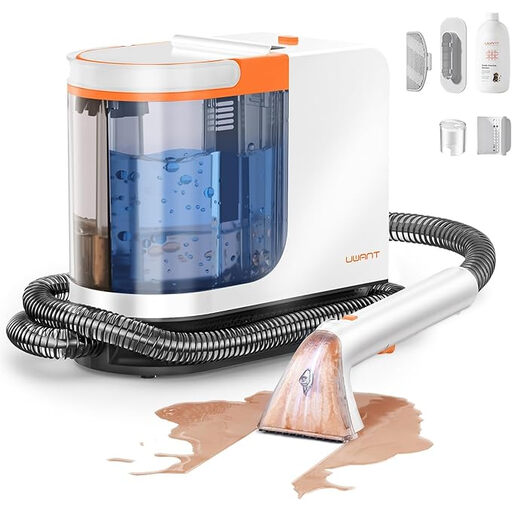
Why it suits this user profile: It is designed for households looking for stated suction power of 18 kPa and a machine capable of handling repeated cleaning jobs on rugs, sofas and car interiors.
The stated self-cleaning function can reduce the amount of work after use, provided you rinse and dry the components in accordance with the instructions.
600 W motor, 14 cm brush, stated suction power of 18 kPa and stated noise level of 75 dB.
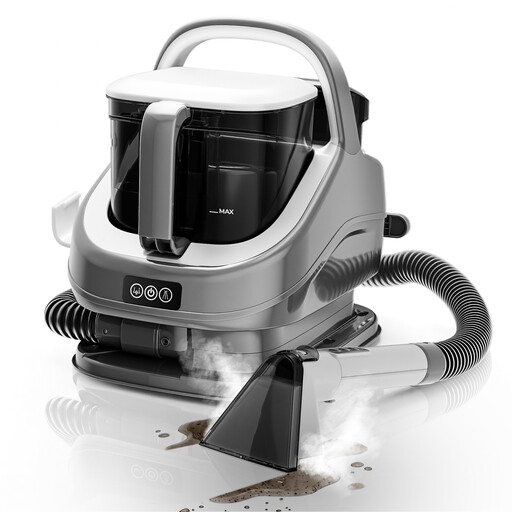
Why it suits this user profile: Its three stated modes allow you to adapt cleaning to different needs, from everyday dirt to more greasy areas.
The cold-water, hot-water and steam modes are clearly differentiated; nevertheless, check the fabric’s compatibility before use.
Stated power of 1 300 W, 13 kPa suction, 1 400 ml and 1 200 ml tanks, and a 1.1 m hose.
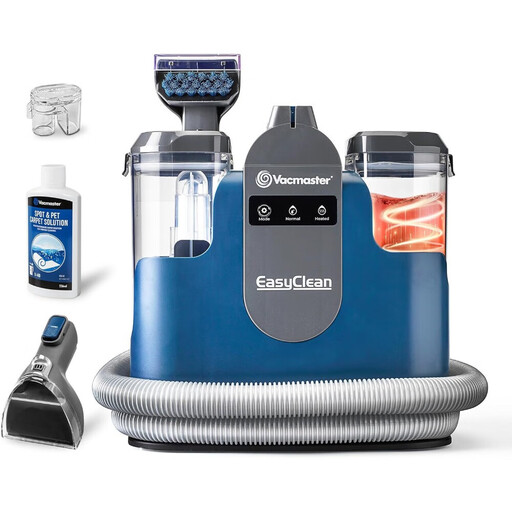
Why it suits this user profile: Its hot-water function and 1.6 L and 0.95 L tanks are suitable for repeated cleaning of rugs, sofas and seats.
The tank capacity limits interruptions during a cleaning session, while the 1.8 m hose makes it easier to reach areas further away.
500 W motor, stated suction pressure of 17 kPa, hot-water function and stated operating radius of 5 m.
We have put together a complete, real-time updated selection of products that meet these demanding criteria while complying with European safety regulations.
Yes, provided the fabric is washable with water. Carefully measure the amount of liquid, avoid saturating the foam and air the car interior or room. In a car, protect electrical components and consult the manufacturer’s recommendations.
It depends on how often you use it, how well you maintain it and whether you follow the limits specified in the instructions. Rinsing the tanks after every use, clearing the hose and drying the accessories help prevent odours and the build-up of deposits. Also check the warranty period and the availability of spare parts before buying.
The cost depends on the wattage, how long you use the appliance and the price of electricity. As these machines generally operate in short sessions, focus mainly on the time needed to clean your surface, the tank capacity and the maintenance requirements. A more powerful machine is not necessarily more economical if it uses more water or requires more passes.