
Livraison le jour même ou le lendemain

Qualité garantie

Débloquez vos offres de bienvenue: Livraison GRATUITE | Jusqu'à -80 % | 30 jours d'essai gratuits à JoyPlus
Téléchargez l'application
Every driver's nightmare? A slowly deflating tyre or, worse, a sudden puncture. Having a portable car air compressor in your boot transforms this source of anxiety into a mere inconvenience. However, the market is saturated with models making tempting promises that often fall flat.
As Head of Product Recommendations at Joybuy, my role is to help you navigate the options. We've identified the 3 most common pitfalls that lead to buyer's remorse, so you can invest in a reliable and genuinely useful device.
To make an informed choice, focus on these three fundamental parameters. They will determine if the product is truly suited to your vehicle and your needs.
Choosing the power source is the first criterion to define.
As we've seen, airflow rate takes precedence over maximum pressure. A good airflow rate is around 25-35 L/min for a passenger car. For an SUV or a campervan with larger tyres, a higher rate is strongly recommended.
Smart features add real user convenience:
Some models go far beyond simple inflation. A jump starter with an air compressor is a particularly clever multi-function device. It can not only reinflate a tyre but also restart your car if the battery dies. These devices often include extra features like an LED torch (with an SOS mode) and a USB port to serve as a power bank.
Here are a few options that cater to distinct user profiles, taking into account performance and reliability criteria.
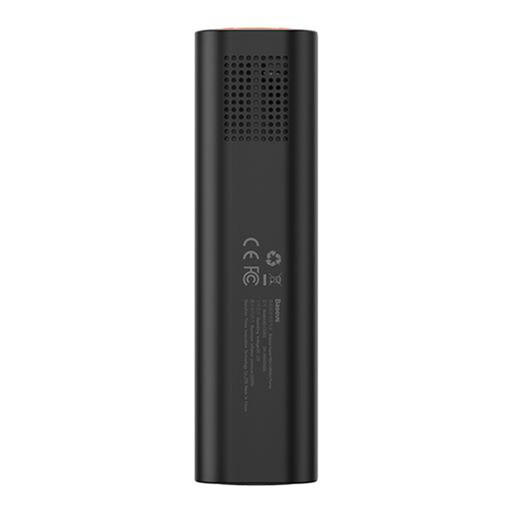
Why we chose it: For the driver who wants a simple, compact, and always-ready solution. This 12V mini-compressor fits easily in the glove box and plugs into the cigarette lighter, guaranteeing it will work when needed.
As a corded model, it completely eliminates the risk of a dead battery at the crucial moment (pitfall #2). Its design focuses on a single function, ensuring reliability.
Direct power from the vehicle's 12V socket for foolproof availability. Ultra-compact design and integrated LED light for nighttime use.

Why we chose it: The all-in-one solution for owners of SUVs, campervans, or anyone who travels frequently. It combines a powerful battery jump starter and an efficient compressor, offering complete peace of mind on the road.
As a jump starter with an air compressor, it prevents the need to buy two separate, lower-quality devices. Its 4500A starting power is suitable for large engines (up to 9.0L petrol / 8.0L diesel).
5-in-1 device (jump starter, 150 PSI compressor, power bank, 4-mode lamp). Smart safety protections for risk-free jump-starting, even with reverse polarity.

Why we chose it: For the user who wants to make zero compromises on reliability and technology. This device uses a sodium-ion battery, allowing it to stay charged and ready for years, even if forgotten in the car.
It radically solves the self-discharge pitfall (pitfall #2). According to the manufacturer, a single charge provides up to 5 years of standby time, compared to 2-3 months for conventional lithium batteries.
Sodium-ion battery technology with a lifespan of 6000 cycles and an operating range of -40°C to 80°C. PD60W fast charging and cordless air compressor function.
If these models don't quite meet your needs and you're looking for more robust tools for mechanical work, our selection of impact wrenches might interest you.
1. What is the lifespan of a portable air compressor? Its lifespan depends on the build quality and maintenance. A robust corded model can last for many years. For a cordless air compressor, the battery's longevity is the crucial factor. To preserve lithium batteries, it's advisable to recharge them every 3 to 6 months. Sodium-ion battery models, like the GOKKCL GK01, offer a much longer lifespan.
2. Can a 12V compressor drain my car battery? Using a 12V mini-compressor consumes energy. To inflate one or more tyres, especially on a large vehicle, it is highly recommended to keep the car's engine running during the process. This prevents putting excessive strain on the battery and ensures the compressor receives a stable and powerful supply.
3. How long does it take to inflate a car tyre? This varies greatly. Topping up a few PSI will only take 30 to 60 seconds. Inflating a completely flat passenger car tyre (from 0 to 35 PSI) can take between 4 and 8 minutes with a good quality compressor (airflow rate of about 25-35 L/min). For an SUV tyre, this time may be longer. Be wary of models that promise record-breaking times without specifying their airflow rate.