
Livraison le jour même ou le lendemain

Qualité garantie

Débloquez vos offres de bienvenue: Livraison GRATUITE | Jusqu'à -80 % | 30 jours d'essai gratuits à JoyPlus
Téléchargez l'application
A portable car fridge can make long journeys, camping weekends or fishing trips so much easier. But you need to pick the right appliance. Capacity that's too small, incompatible power supply, or cooling that struggles as soon as the temperature rises – some purchases prove disappointing within days. To avoid nasty surprises, don't just look at the litre capacity or the promises on the box.
A thermoelectric cool box can generally only maintain a limited temperature difference from the surrounding air. It's fine for keeping already-chilled drinks cool, but its performance drops quickly when it's hot. If you want to keep food for several days or freeze it, you're better off with a compressor cool box or a portable freezer.
Start by checking the stated temperature range. An appliance that can go down to -20 °C is clearly in a different league from a basic 12 V electric cool box.
A 12 V or 24 V car fridge must be compatible with your vehicle. 12 V is standard in the vast majority of cars, while 24 V is found in certain vans, lorries and boats. If you plan to use it at home, make sure you also have a 100–240 V adapter.
Battery protection also deserves your full attention. Without a cut-off system or appropriate setting, an appliance left running for several hours while the engine is off can drain enough power to make restarting the vehicle difficult.
A 49-litre model can be very practical for a family or a long trip, but it will also take up a lot more room in the boot. Measure the available width, height and depth, and don't forget the space needed to open the lid or doors. In a motorhome, boat or small car, the space around the appliance matters just as much as its internal volume.
For versatile use, a 12 V compressor cool box works in a similar way to a standard fridge. It can chill drinks and food, but can also serve as a 12 V portable freezer if its temperature range allows.
A dual-zone model becomes particularly useful if you want to keep fresh produce on one side and frozen food on the other. However, check that each compartment has its own separate control – a simple internal divider isn't enough.
The stated capacity doesn't always match the actual usable space. Walls, baskets and dividers eat into the volume. For a few drinks and individual meals, a model around 20 litres may be sufficient. For several days of travel, a larger capacity gives you more leeway – provided your vehicle can accommodate it.
Certain features can also make a real difference day to day: interior lighting, handles, wheels or a reversible door all make the appliance easier to transport and use.
Many appliances offer a fast mode, often called 'MAX', as well as an economy mode, usually labelled 'ECO'. Compare the power consumption, the type of plug and whether battery protection is included. The energy class shown on the product spec sheet doesn't tell the whole story, though – dimensions, outside temperature and how often you open the door all affect real-world consumption.
To organise your provisions better, you can complement the fridge with an airtight food storage container. Stackable models prevent leaks and help you make more efficient use of the space in a compact appliance.
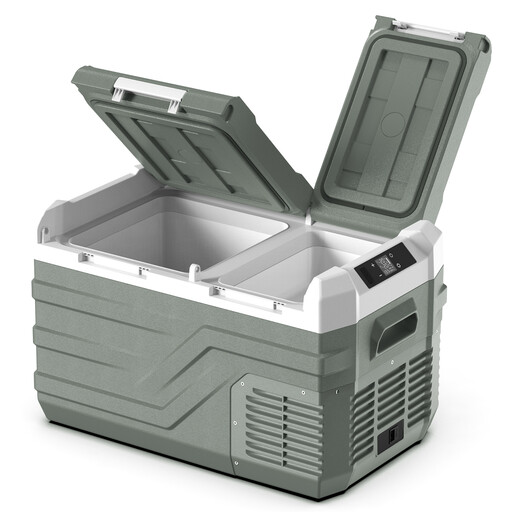
Why this choice suits this profile: With its 20 litres, this model is ideal for daily commutes, picnics and short trips. It plugs into 12 V or 24 V in a vehicle and can also run on mains power using the included 100–240 V adapter.
Its compressor and stated range of -20 °C to 20 °C prevent it from being mistaken for a simple thermoelectric cool box. The battery protection, adjustable to three levels, gives extra control when using it with the engine off.
Two compartments with independent temperature control, MAX mode at 60 W and ECO mode at 45 W, USB port and stated noise level of 45 dB.

Why this choice suits this profile: Its 49 litres are aimed at long trips, families, motorhome owners and anyone who wants to manage fresh and frozen items separately.
The large volume remains easy to organise thanks to the two independent zones. The wheels, telescopic handle and reversible door make handling and installation less of a chore.
Control via screen or app, interior lighting, stated range of -20 °C to 20 °C and power supply in 12/24 V or 100–240 V.
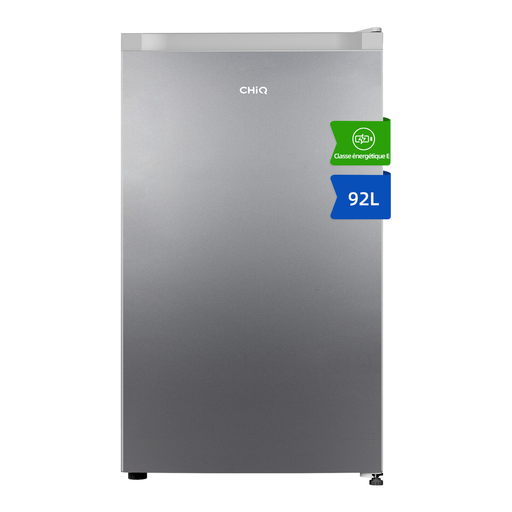
Why this choice suits this profile: This compact fridge is better suited to an office, small kitchen, spare room or fixed motorhome location than to a car boot.
Its format is clearly designed for fixed mains installation. This means you avoid choosing a portable cool box when what you actually need is a larger everyday storage space.
Stated capacity of 92 litres, width of 47 cm, seven-position mechanical thermostat, reversible door and integrated freezer compartment.
We've selected a full range, updated in real time, of products that meet these exacting criteria as well as European safety standards.
A good fridge doesn't let you off the hook when it comes to basic organisation. Place the most perishable items in the coldest zone and avoid filling the appliance to the point where air circulation is blocked. Airtight containers prevent spills on corners and make cleaning much easier.
For individual portions, 450 ml or 760 ml containers are particularly handy. A 2.3 litre or 3.2 litre size is better suited to leftovers and family-sized meals. Always follow the manufacturer's recommendations regarding microwave, freezer, dishwasher use and removing the lid before reheating.
Yes, provided the installation supplies a stable power source and the battery protection is correctly set. When the vehicle is stationary, keep an eye on the charge level. For extended use, an auxiliary battery or a power station is still the better option.
A standard electric cool box often uses a thermoelectric system. It keeps the temperature lower than the surrounding air, but only within a limited range. Fitted with a compressor, a 12 V portable freezer can reach sub-zero temperatures, depending on the stated specifications, and is therefore much better suited to freezing food.
It all depends on its power, the mode selected, the outside temperature, how full it is and the price of electricity. Economy mode can reduce consumption, but only the technical specifications, combined with your actual usage, will give you a reliable estimate.