
Livraison le jour même ou le lendemain

Qualité garantie

Débloquez vos offres de bienvenue: Livraison GRATUITE | Jusqu'à -80 % | 30 jours d'essai gratuits à JoyPlus
Téléchargez l'application
An under-inflated tire isn't just an inconvenience? it's a genuine safety hazard and a cause of increased fuel consumption. And trying to find a gas station with a working air pump, especially in an emergency, often feels like an uphill battle. A portable car compressor is the ideal solution for topping up your tires, wherever and whenever you need to.
With an overwhelming number of options on the market, it's hard to know where to start. This guide is here to help you see things more clearly, covering the essential criteria to consider and our selection of the best models to help you make the right choice, whether you're looking for a simple tire inflator or a multifunctional device.
Before diving into our top picks, let's review the key points to find the device that perfectly suits your needs and your vehicle.
The power source directly impacts your compressor's versatility.
Pressure (expressed in BAR or PSI) is the force of the injected air. Most car tires require a pressure between 2.1 and 2.8 BAR (30 to 40 PSI). Rest assured, most models on the market go well beyond that, often up to 150 PSI (about 10 BAR), which is more than enough for any passenger vehicle.
Airflow (in liters per minute, or L/min) determines the inflation speed. The higher it is, the less time you'll spend on the side of the road.
The small features that make all the difference and turn a chore into a simple task?:
We have selected three models that cater to very different needs, all chosen for their excellent value for money and relevance.
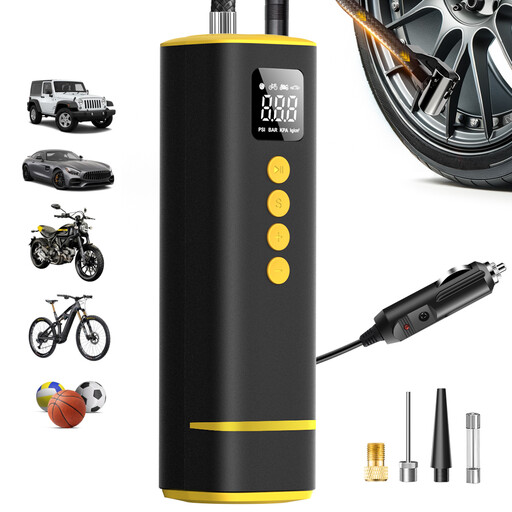
Why We Love It
This CARSUN model gets straight to the point?: it's an efficient, no-frills 12V inflator. Its mission is simple?: reinflate your tires, period. Its long power cord plugs into the cigarette lighter and easily reaches all four wheels, even on an SUV. Compact, it slips easily into the trunk or under a seat.
Key Strengths
Who Is It For?
For the driver who wants a reliable, simple, and economical backup tool. If your only need is to be able to top up your tires when a dashboard warning appears, without ever worrying about battery status, this is the sensible choice.
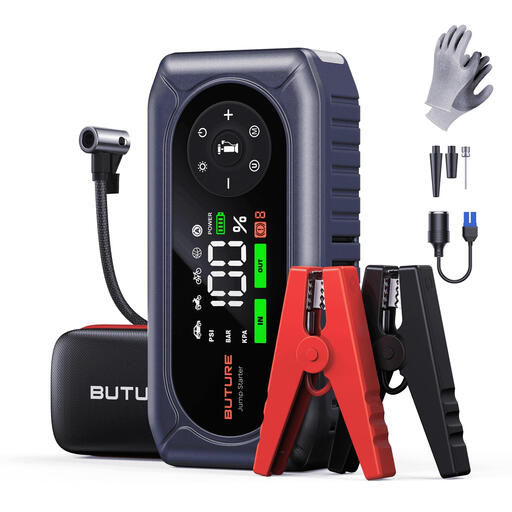
Why We Love It
The BUTURE BC02 is much more than just an inflator. It's a true all-risk insurance policy for the road. It combines a powerful battery booster and a 150 PSI compressor. Capable of jump-starting large gasoline (up to 9.0L) and diesel (up to 8.0L) engines, it also takes care of your tires with its preset and auto-shutoff function.
Key Strengths
Who Is It For?
For prepared drivers, families on vacation, and anyone who wants to tackle the two most common breakdowns (dead battery, flat tire) with a single device. It's the ultimate peace-of-mind investment.

Why We Love It
The GOOLOO GT160 is the perfect example of the flexibility offered by a modern cordless compressor. Its 7500?mAh battery provides excellent autonomy for multiple uses. With a stated airflow of 35?L/min, it promises fast inflation. Its large LED screen and preset modes make it very intuitive, even for beginners.
Key Strengths
Who Is It For?
For those seeking maximum versatility. If you juggle between bike and motorcycle tires, the kids' balls, and topping up the car's tires, its cordless design and power will make it a valuable daily ally.
Our selection is just a glimpse. To discover an even wider range of portable compressors, from the simplest to the most comprehensive and for all budgets, explore our dedicated category.
? Discover More Portable Tire Inflators
1. What is the ideal pressure for my tires?? This information is specific to each vehicle. You can find it on a sticker located on the driver's side doorjamb, inside the fuel door, or, of course, in your car's owner's manual. The pressure is indicated in BAR and/or PSI. For a typical city car or sedan, it is usually between 2.2 and 2.5?bars.
2. Can I leave a 12V compressor plugged in permanently?? No, this is not recommended. A portable car compressor is a tool for occasional use, to be used when needed. It is best to unplug it after each use to avoid draining the car's battery and to preserve the longevity of the compressor itself.