Joybuy Insights

Portable Car Air Compressor: A Guide to Avoiding Common Pitfalls

Driving on an under-inflated tire isn't just an inconvenience: it's a real safety hazard and a drain on your fuel. The portable car air compressor has become an essential accessory to keep in your trunk. The problem? The market is flooded with models making tempting promises that often fall flat. Before you pull out your credit card, it's crucial to know how to spot the marketing traps so you don't invest in a gadget that will fail you when you need it most.

Here are the 3 classic mistakes to avoid when buying:

  1. Being blinded by on-paper battery capacity (mAh): A 4000 or 6000?mAh battery looks impressive on the spec sheet, but it's no guarantee of real-world runtime. True endurance depends on the motor's efficiency and the size of your tires. Some models run out of power before they can even inflate a single car tire.
  2. Underestimating the importance of airflow (L/min): Brands always highlight the maximum pressure (PSI/Bar). However, without sufficient airflow, inflation can turn into an ordeal. A device boasting 150?PSI but with a meager 10?L/min flow rate will be excruciatingly slow compared to a 30?L/min model, especially on an SUV tire.
  3. Overlooking hidden incompatibilities: Many mini-compressors are primarily designed for bicycles, motorcycles, or small city cars. They are simply underpowered for the larger tires of SUVs, RVs, or vans. This information is often buried in the fine print of the description.

The Technical Specs That Really Matter

To make the right choice, rely on objective data that defines the performance and reliability of a portable car compressor.

Pressure (Bar/PSI) and Airflow (L/min): The Dynamic Duo

Pressure and airflow are the two pillars that determine a compressor's true effectiveness.

  • Maximum pressure, expressed in Bars or PSI (Pound-force per Square Inch), indicates the force the compressor can generate. A value of 150?PSI (about 10.3?Bars) is now a standard that covers almost all needs for cars, motorcycles, and bicycles.
  • Airflow, measured in liters per minute (L/min), represents the volume of air the device can deliver. This is the spec that dictates inflation speed. For a standard car tire, aim for an airflow greater than 20?L/min for a quick top-up. Below that, the process can be long and tedious.

A good tire inflator with a digital pressure gauge will allow you to monitor the pressure in real-time and ensure inflation is accurate to the Bar.

Power Source: Cordless on Battery or Corded on 12V?

The choice of power source will depend on your habits and priorities.

  • The cordless tire inflator (battery-powered): Its key advantage is freedom. No cable to unroll, you can use it anywhere: for the car, the bike in the garage, or the kids' balls. The flip side? Limited runtime. It's therefore essential to check how many tires it can inflate on a single charge and, most importantly, to remember to keep it charged.
  • The 12V mini-compressor (corded): It plugs directly into the vehicle's cigarette lighter socket. Its strong point: an inexhaustible power supply as long as the engine is running. No stress about a dead battery. In return, its mobility is obviously limited by the length of its cable.

The Little Extras That Make a Difference: Auto-Shutoff, LED Light…

Beyond raw performance, certain features can be a real game-changer in daily use:

  • Auto-shutoff (preset): You program the target pressure, and the compressor stops on its own once it's reached. A brilliant feature to prevent over-inflation and keep your hands free.
  • Integrated LED light: Essential for a nighttime issue, it illuminates the valve area so you can work safely. Some models even offer a flashing SOS mode.
  • Power Bank function: A USB port on the compressor to charge your smartphone in an emergency? It's the little extra that can make all the difference.

Our Portable Air Compressor Picks

Rather than an endless list, we've selected models tailored to specific profiles to help you find the one that truly meets your needs.
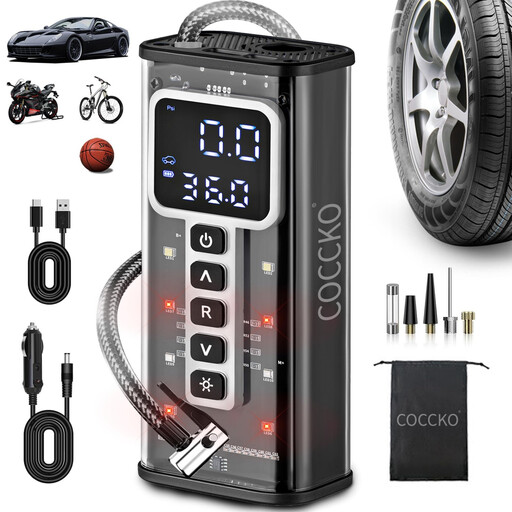
THE PROFILE: THE PREPARED DRIVER
COCCKO 150 PSI Cordless Car Tire Inflator

COCCKO 150 PSI Cordless Compressor

Our take: For those who want to make no compromises on performance and runtime in an emergency. Ideal for long trips and families with multiple types of vehicles.

The Pitfall-Proof Verdict

Its 6000 mAh battery and 35 L/min airflow deliver real, fast performance, a far cry from empty promises. It's built for car tires, including larger ones.

Key Strengths

Long runtime, fast inflation, power bank function, and comprehensive emergency lighting modes.
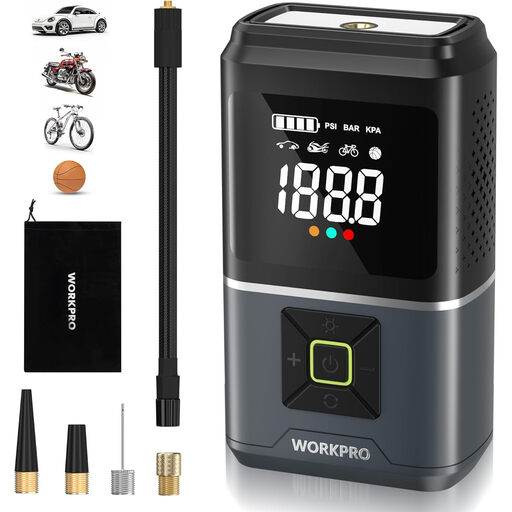
THE PROFILE: THE VERSATILE USER
WORKPRO Electric Air Pump 150 PSI

WORKPRO 150 PSI Electric Air Pump

Our take: Perfect for those who need a single device for their car, motorcycle, bike, and balls. Its compact size and preset modes simplify everyday use.

The Pitfall-Proof Verdict

Its 3 inflation modes (PSI, BAR, KPA) and presets for different objects minimize the risk of error. Its compatibility with car tires is clearly stated, with no unpleasant surprises.

Key Strengths

Versatile modes, a readable digital screen, and a compact design that's easy to store.
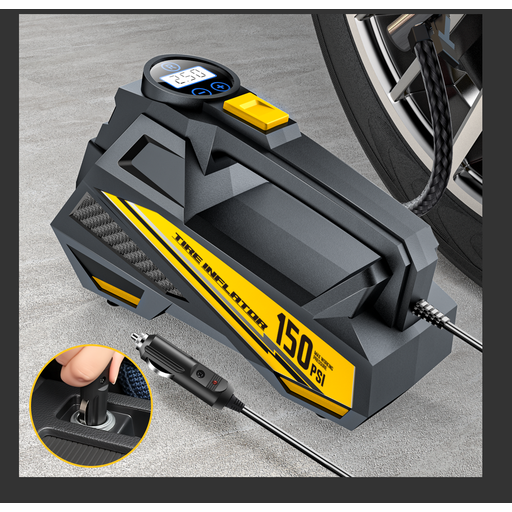
THE PROFILE: THE 12V PRAGMATIST
CARSUN Corded Portable Car Air Pump

CARSUN 12V Corded Car Air Pump

Our take: For the driver who prioritizes reliability and never wants to worry about a battery's charge level. It stays in the car, always ready for use.

The Pitfall-Proof Verdict

By plugging into the 12V socket, it completely bypasses the battery life trap. Its performance is consistent as long as the engine is running.

Key Strengths

Unlimited power supply, dead-simple operation, and an excellent reliability-to-price ratio.

Want to Explore More Models?

We have put together a complete and up-to-date collection of products that meet our strict selection criteria and current safety standards.

Portable Car Air Compressor: Your Questions, Our Answers

What is the battery life of a cordless tire inflator?

A lithium-ion battery's life is measured in charge/discharge cycles. Quality models can handle several hundred cycles. The trick to preserving it: never let it discharge completely and recharge it at least once every 3 to 6 months, even if you don't use it. Also, remember to store the device in a cool, dry place, away from extreme temperatures (don't leave it in the car in direct sunlight or during a deep freeze).

Can a mini-compressor really inflate a completely flat car tire?

Yes, most models designed for automotive use are capable of it, but you'll need some patience. A simple pressure top-up (e.g., going from 2.0 to 2.5?Bars) only takes 1 to 3 minutes. However, re-inflating a completely flat tire can take 8 to 15 minutes, depending on the device's airflow and the tire's size. Be aware: on a battery-powered model, this operation is very energy-intensive and can drain a significant portion of the charge.

Battery or 12V: Which one to choose?

It all depends on your use case.

  • Choose a battery-powered model (cordless) if you're looking for absolute versatility: for the car, but also for bikes, scooters, balls... In short, if you want a portable device you can use far from your vehicle.
  • Choose a 12V model (corded) if your only priority is maintaining your car's tires. It's the "no-fuss" solution: it stays in the trunk and is always ready to go, without ever worrying about the battery level.