
Livraison le jour même ou le lendemain

Qualité garantie

Débloquez vos offres de bienvenue: Livraison GRATUITE | Jusqu'à -80 % | 30 jours d'essai gratuits à JoyPlus
Téléchargez l'application
A tire that's slowly losing air, the pressure warning light flashing at the worst possible moment, far from any service station... These are all-too-familiar scenarios for drivers. The portable car air compressor has become the essential accessory for taking back control and driving with peace of mind. However, the market is flooded with models making tempting promises that don't always hold up.
Before you make a decision, it's crucial to know how to spot the most common marketing traps. Otherwise, a purchase meant to provide reassurance can turn into a real headache.
To make the right choice, focus on the few technical specifications that truly make a difference in performance and reliability.
The choice of power source is fundamental and depends on your primary use case.
Don't be impressed by the maximum pressure displayed, often 150 PSI (about 10.3 bars). This is massive overkill for a car tire, which typically requires around 2.5 bars (≈36 PSI). The number that really matters is the airflow, expressed in liters per minute (L/min).
A high flow rate (e.g., over 25 L/min) means fast inflation. Conversely, a model with a low flow rate will be frustratingly slow, even if it promises a dazzling maximum pressure.
Beyond inflation, certain features transform a simple inflator into a true Swiss Army knife for drivers.
To help guide you, here is our selection of models that stand out for their reliability and are suited for specific use cases.
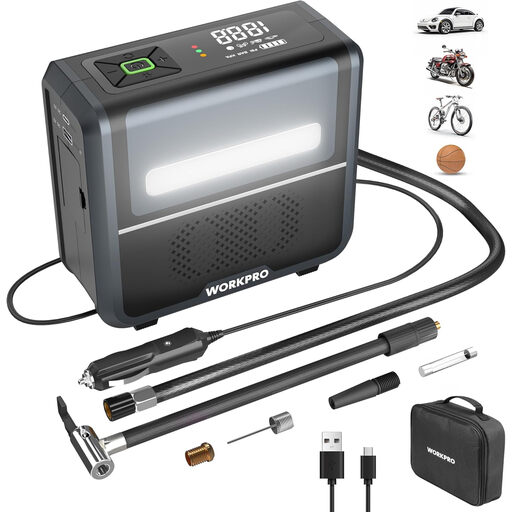
Why we chose it: Designed for those who leave nothing to chance, this device is the definition of peace of mind. Thanks to its dual power supply, it's always ready to go, whether the battery is charged or not. Essential for long trips and true emergencies.
It beats the dead-battery trap with its included 12V compressor cable. In an emergency, just plug it into the cigarette lighter for continuous power.
Its dual power supply (battery + 12V) ensures unbeatable reliability. A true 3-in-1: inflator, power bank, and emergency LED light.

Why we chose it: The perfect companion for active families and sports enthusiasts. It does it all: cars, motorcycles, bikes, balls... Its compact size and smart modes make it the Swiss Army knife of inflation, easy to use and stash anywhere.
It solves the problem of inaccurate gauges. AstroAI highlights its "TrueGauge" technology, which uses enhanced sensors to ensure a reliable pressure reading—a non-negotiable point for safety.
Its 5 smart inflation modes (car, motorcycle, bike, ball, manual) make it incredibly simple to use. Its compact form factor and feather-light weight (460g) make it a portability champion.
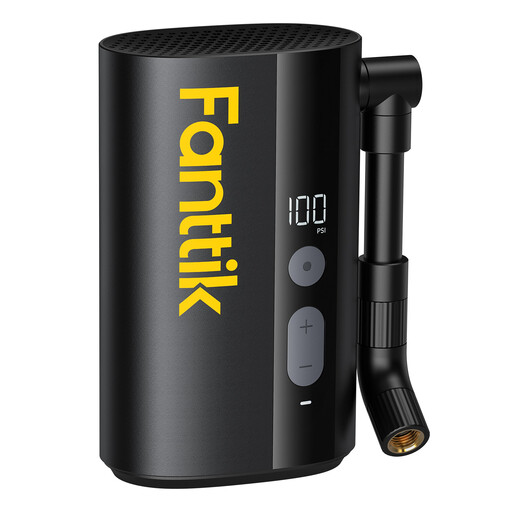
Why we chose it: For two-wheel enthusiasts, weight and bulk are the enemy. This mini air compressor was designed for them: it slips into a backpack or saddlebag and is optimized for bike and motorcycle tires, which often require high pressure.
It avoids the trap of misleading inflation speeds by clearly stating its specialty: it's first and foremost an electric bike pump. The brand is transparent, providing specific times for bike tires (e.g., 32s for a 700x23C).
Ultra-compact, all-in-one design with an integrated hose and nozzles. Efficient and fast for bike tires, it's compatible with both Presta and Schrader valves.
We have curated a full range of products that meet our performance criteria and current safety standards.
Actual battery life depends on capacity (mAh), usage, and storage. As a general rule, a good battery (4000 mAh and up) can top off all four tires on a car or fully inflate at least one flat tire on a single charge. To preserve its lifespan, remember to recharge it every 2-3 months, even when not in use.
The risk is minimal, especially for a simple top-up that only takes a few minutes. However, as a precaution, it's recommended to leave the engine running while the compressor is in use. This prevents drawing power solely from the battery, especially if it's getting old or if the inflation will take a long time (over 10 minutes).
Be careful: the correct pressure is NOT the one indicated on the tire's sidewall (which is the maximum pressure the tire itself can handle). The correct pressure, recommended by the manufacturer, is found on a sticker inside the driver's side door jamb, in the fuel door, or in the vehicle's owner's manual. It is imperative to follow these values to ensure your safety and maximize the life of your tires.