
Livraison le jour même ou le lendemain

Qualité garantie

Débloquez vos offres de bienvenue: Livraison GRATUITE | Jusqu'à -80 % | 30 jours d'essai gratuits à JoyPlus
Téléchargez l'application
An underinflated tire is more than just an inconvenience—it's a safety hazard and a drain on your fuel economy. The portable car air compressor has become the essential smart accessory to keep in your trunk. However, faced with a sea of models all making tempting marketing claims, it's easy to make the wrong choice.
As product experts at Joybuy, our mission is to cut through the noise for you. Let's skip the jargon and focus on what really matters. Here are the pitfalls to avoid and the objective criteria for choosing a reliable device that won't let you down.
Too many buyers regret their purchase due to flaws that only become apparent with use. Keep a close eye on these three points:
To ensure you make the right decision, focus on these three fundamental technical parameters.
This is the first decision you'll need to make, and each option has its pros.
As we've just discussed, don't be mesmerized by maximum pressure. For a car tire, the most important criterion is airflow, measured in litres per minute (L/min).
The auto-shutoff feature, which stops at a preset pressure, is a mark of convenience and safety, preventing any risk of over-inflation.
A good compressor should be a Swiss Army knife. Make sure it comes with several nozzles (or adapters) to fit all your needs:
An integrated LED light is the small detail that makes all the difference during a nighttime emergency.
To help you see more clearly, here are a few models that meet very specific needs.
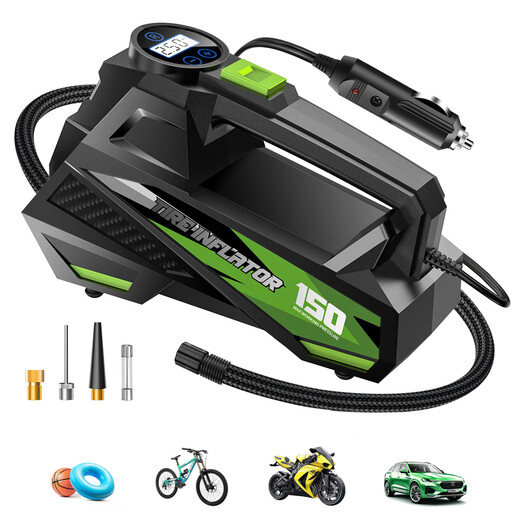
Editor's Take: The "no-fuss" solution to leave in the trunk for unexpected situations. Its 12V power source ensures it's always ready to go, without ever worrying about a dead battery.
This corded model completely eliminates the risk of a dead battery at the worst possible moment. Its design is straight to the point: it inflates, and that's it.
Reliability and simplicity. Plug it into the 12V socket, and it just works. Its long power cord is designed to easily reach all four tires.
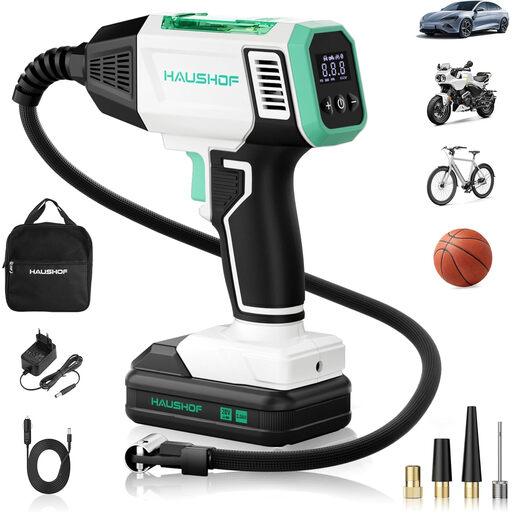
Editor's Take: The versatile everyday companion. Its cordless design and preset modes (car, motorcycle, bike, ball) make it incredibly practical for maintaining the whole family's tires and for outdoor activities.
It sidesteps the dead-battery trap thanks to its dual power supply: use it cordlessly for convenience, or plug it in with its 4-meter 12V cable for continuous power.
Versatility and intelligence. The 4 preset modes and auto-shutoff feature simplify your life, while the digital display and LED light provide a genuinely comfortable user experience.
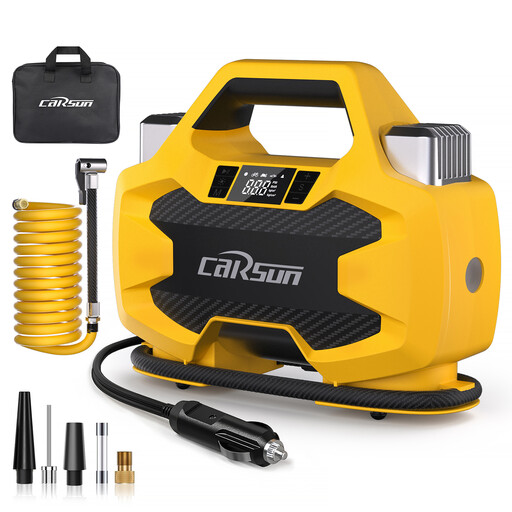
Editor's Take: SUVs, RVs, and vans: these vehicles demand more power. This dual-cylinder model is built to deliver high airflow and drastically reduce inflation time for large tires.
It tackles the problem of overheating and lack of power for large volumes head-on. Its robust design allows it to work faster and longer without faltering.
Power and speed. The dual-cylinder architecture ensures a robust airflow, which is essential for quickly and effectively reinflating high-volume tires.
Discover other models tested and approved by our experts, all meeting our strict selection criteria and current safety standards.
Pressure is the force of the air. It must be high enough to reach the recommended value for your tire. Airflow is the amount of air the compressor delivers each minute. For a car tire, good airflow means speed; excessive pressure, on the other hand, is useless.
It all depends on the battery capacity and the state of your tires. A good model (with a 4000-5000 mAh battery or more) can easily top up four tires (e.g., going from 32 to 36 PSI). However, reinflating four completely flat tires on a single charge remains a near-impossible task for most consumer-grade models.
With a quality compressor (airflow > 20 L/min), topping up the pressure by a few PSI (e.g., from 32 to 36 PSI) takes only one to two minutes. For a completely flat tire, expect it to take between 5 and 10 minutes, depending on the tire's size and the device's power.