
Livraison le jour même ou le lendemain

Qualité garantie

Débloquez vos offres de bienvenue: Livraison GRATUITE | Jusqu'à -80 % | 30 jours d'essai gratuits à JoyPlus
Téléchargez l'application
A portable Bluetooth speaker can follow you around the house, on a picnic, during a workout or at a party with friends. But between the advertised power, the theoretical battery life and the water resistance, the spec sheets can sometimes be confusing. The result? A model that's not powerful enough outdoors, a battery that doesn't last as long as expected, or a speaker damaged after a few splashes.
Before buying a portable wireless speaker, it's best to match the features to how you'll actually use it. Here are the criteria to check, the pitfalls to avoid and a selection of models suited to different needs.
A high wattage doesn't guarantee balanced sound on its own. Power needs to be considered alongside the number of drivers, the cabinet size and your listening environment. A small, powerful Bluetooth speaker may go louder, but it can lose clarity when you push it to its limits.
To compare two models, check whether the spec sheet lists RMS power, the type of drivers used, and whether there's a passive radiator or bass adjustment.
IP ratings don't all cover the same level of protection. A Bluetooth speaker certified IPX4 mainly resists splashes, while an IPX7 model can handle temporary immersion under the conditions set by the standard. IP6X certification, on the other hand, covers dust, not water.
A speaker intended for outdoor use should be used within the limits of its certification. Even with a high IP rating, avoid salt water, high-pressure jets and charging while the port is still damp.
The advertised battery life is usually measured under specific conditions, often at moderate volume. A speaker used at full volume during a party, with its built-in lighting switched on, will naturally consume more power. The battery capacity, expressed in mAh, gives a useful indication but doesn't allow you to calculate listening time precisely on its own.
For a bedroom, an office or a small patio, moderate power can be perfectly adequate. To fill a garden or entertain a larger group, go for a powerful Bluetooth speaker with wide sound dispersion. Two full-range drivers can create a more open stereo image, while a passive radiator generally helps to enhance the perception of bass.
True stereo – often called TWS – sometimes lets you pair two compatible speakers to separate the left and right channels. This is a useful option for a party or an outdoor film, provided you check whether it only works with two identical units.
Here's how to interpret the most common ratings:
A waterproof speaker isn't necessarily designed to float or stay underwater. Always check the manual and close the protective covers properly.
A Bluetooth speaker with a rechargeable battery should offer a charging method that suits your habits, such as USB-C or a dedicated power supply. For travel, also consider the weight, whether there's a handle or wrist strap, and the advertised Bluetooth range.
At home, an auxiliary input, a USB port or multipoint connection can be more useful than a few extra watts. For a computer, a wired or Bluetooth PC speaker also needs low enough latency, especially for gaming.
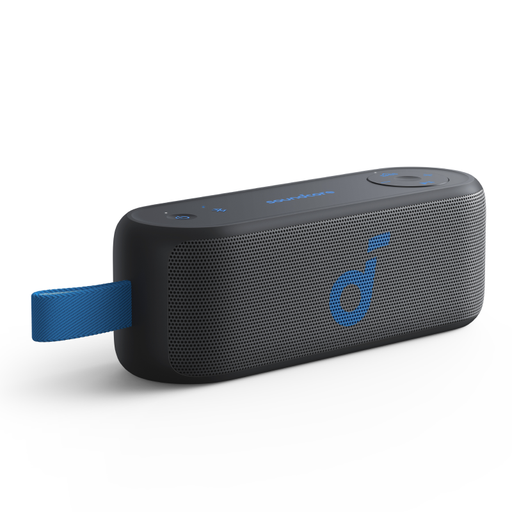
Why this choice suits this profile: At 575 grams, this model is ideal for a first purchase or daily travel. Its advertised 20-hour battery life means you can go for several days without having to recharge constantly.
The spec sheet states 16 W in stereo, two full-range drivers and IPX7 certification. These details are more meaningful than a simple promise of volume.
BassUp processing, the compact weight, the advertised 20-hour listening time and IPX7 resistance are all clearly documented.
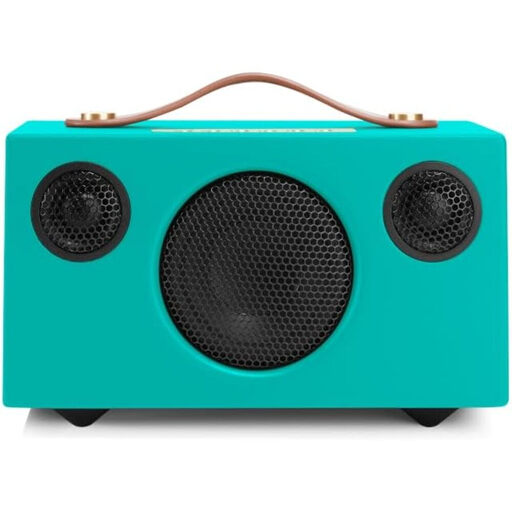
Why this choice suits this profile: At 2.1 kg, this model is aimed at those who want a more ambitious home listening experience and long battery life, rather than an ultra-compact speaker.
The advertised battery life distinguishes between 30 hours at moderate volume and 12 hours at maximum volume. This welcome detail helps avoid confusion between theoretical duration and heavy use.
25 W amplification, an 89 mm bass driver, two tweeters and a 3.5 mm auxiliary input.
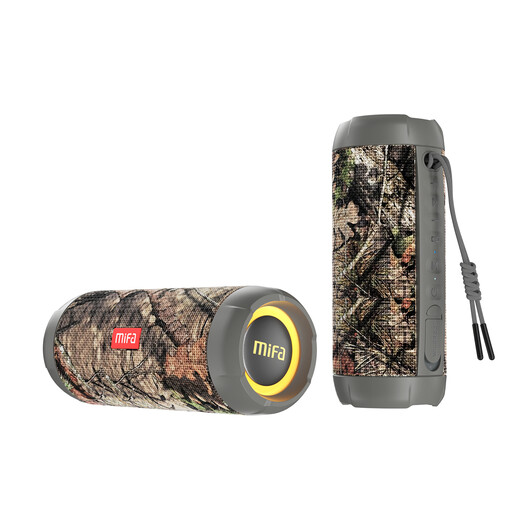
Why this choice suits this profile: Its IP67 certification, advertised 12-hour battery life and 30 W of power make it an appealing option for camping, the beach or the garden.
The spec sheet distinguishes IP67 dust protection from water resistance. It also mentions a floating design, to be used in accordance with the instructions.
Bluetooth 5.3, dual-device connection, Micro SD card reader, RGB lighting and the ability to pair multiple compatible speakers.
We've put together a comprehensive, real-time updated list of products that meet these demanding selection criteria and European safety regulations.
To improve the sound of a television, a Bluetooth soundbar with an HDMI ARC port or optical input will generally be more practical than a portable speaker. The Bose Smart Soundbar, for example, offers Dolby Atmos, Bluetooth, Wi-Fi, HDMI and a dedicated dialogue clarity mode. However, check its compatibility with your TV before ordering.
On a desk, the Edifier G1000 II offers Bluetooth 5.4, USB-C, USB-A and auxiliary connections, along with dedicated modes for music, films and gaming. With its 66 W RMS, USB-C and auxiliary inputs and LDAC compatibility, the Edifier M60 is more suited to a fixed setup.
It depends on the battery, how often you use it, heat and the number of charge cycles. Avoid high temperatures, moisture while charging and repeated full discharges. With a lithium-ion battery, a gradual decrease in battery life is normal.
Yes, but only if its IP rating is suitable for that use. An IPX4 speaker resists splashes, while an IPX6 model can handle water jets, without being submersible. Close the covers carefully and never charge the device when it's damp.
Its power consumption is generally moderate, but it increases with volume, lighting and the features activated. To space out recharges, turn off unnecessary light effects and adjust the volume to the room.