
Livraison le jour même ou le lendemain

Qualité garantie

Débloquez vos offres de bienvenue: Livraison GRATUITE | Jusqu'à -80 % | 30 jours d'essai gratuits à JoyPlus
Téléchargez l'application
A portable Bluetooth karaoke machine with a wireless microphone can turn a living room, patio or campsite into a proper music stage. But you need to read between the lines on product specs, which often mix up peak power, theoretical battery life and included accessories. To avoid ending up with a speaker that’s impractical for everyday use, it’s worth checking the connections, battery and real-world performance first.
A 200 W Bluetooth speaker naturally catches the eye, but that figure alone won’t tell you about sound quality or loudness. It might be peak power, while the actual output also depends on the driver size, frequency response, cabinet design and volume management.
For a night in at home, a very powerful speaker can actually be hard to control in a small room. Outdoors, by contrast, the sound disperses more. So also check the dimensions, weight, driver type and battery life measured at moderate volume.
Some speakers are sold as karaoke machines when the microphone is actually an optional extra. Also check for an instrument input, an auxiliary socket or USB playback.
A speaker with a wireless microphone is quicker to set up for a party, but the range, microphone power supply and number of microphones included can vary from model to model. So the product page deserves a careful read before you order.
Portability depends on weight, handle design, size and battery capacity. A rechargeable outdoor speaker might be easy to move but still bulky if you need to carry it regularly. Also distinguish between a sturdy casing and genuine water or dust protection: without a clearly stated IP rating, there’s no guarantee the speaker is waterproof.
For family use or a party, a rechargeable lithium-ion battery is especially handy. However, the stated duration should be taken with a pinch of salt, as it depends on volume, any lighting effects and microphone use.
The MLOVE Rangers S1 claims a battery life of 10 to 13 hours at medium volume, thanks to two 3.7 V, 4,500 mAh lithium batteries. It charges via USB-C. The spec also mentions fast charging compatible with PD2.0/3.0, giving a charge time of around 2.5 hours under the stated conditions. At high volume, battery life will naturally drop.
Bluetooth 5.4 lets you stream music easily from a phone or tablet. But that doesn’t make physical connections redundant – they’re still useful when the wireless link is temperamental or when you need to plug in an instrument.
Before buying, look for:
A speaker with EQ sound effects lets you tailor the output for vocals, backing tracks or an instrument. These settings won’t rival a professional PA system, but they can noticeably improve the experience during a home karaoke session.
For beginners, an interface with direct access to volume, play, pause and mode switching is often more useful than a long list of rarely used features. Musicians, meanwhile, should check the connector type and input level compatible with their instrument.
The MLOVE Rangers S1 is the karaoke reference in this selection. The cards below detail the uses it can suit for different profiles, without attributing any performance not listed in its spec sheet.
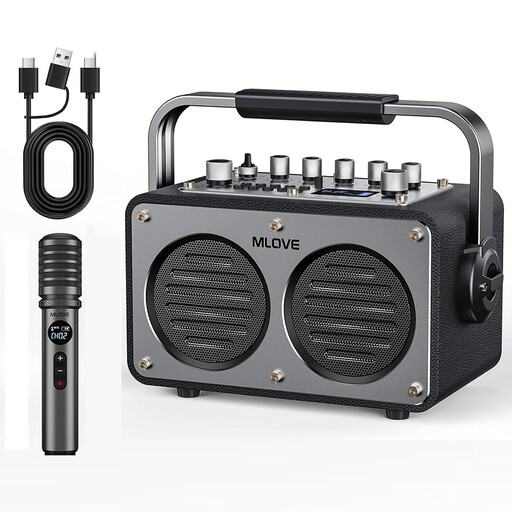
Why this choice suits this profile: At around 3.75 kg and with easy-to-use controls, it’s ideal for a first home setup, family gatherings and occasional parties.
The wireless microphone is included in the box, so there’s no last-minute extra purchase. Bluetooth, AUX and USB playback also give you several ways to play your music.
Bluetooth 5.4, USB-C rechargeable battery and claimed battery life of 10 to 13 hours at medium volume.
Why this choice suits this profile: If you want to combine music, karaoke and sound adjustments, this is a versatile option for the living room, patio or a small gathering.
The spec sheet distinguishes several functions, including EQ effects, music and karaoke modes, plus instrument connection. So you can judge the device’s real-world use rather than relying solely on its advertised power.
Two 8.9 cm full-range drivers, a claimed frequency response of 60 Hz to 20 kHz and EQ adjustments.
Why this choice suits this profile: Singers, guitarists and hosts of small music activities can make use of the instrument inputs, recording and live-streaming functions.
The spec includes a wired instrument or microphone input, a recording function and OTG live streaming. However, check the cabling needed for your instrument before buying.
Inputs for guitar, keyboard or electronic instrument, REC function and reverse charging capability.
For a hassle-free start, fully charge the speaker and microphone, then turn on Bluetooth on your phone. Set the volume to a moderate level first to limit feedback. Place the microphone behind or to the side of the speaker, never directly in front of the drivers.
Outdoors, protect the device from rain and moisture if no waterproof rating is stated. Also store the USB-C cable and supplied adapter in a dry place. Finally, check the compliance information, applicable markings, the presence of instructions in English and the contact details of the responsible party established in the European Union where these details are required.
Charge the speaker and microphone, enable Bluetooth on your phone, then select the speaker name from the list of available devices. For a guitar or keyboard, use the appropriate instrument input and turn the volume down before plugging in the cable.
Battery life varies depending on volume, the source used and the microphone. A claimed 10 to 13 hours at medium volume doesn’t guarantee the same endurance at high volume. For a long evening, charge the device before you start and keep a wired option or compatible power bank handy.
It can be used to save a rehearsal, a melody idea or an informal performance, depending on the file format and available connections. For more ambitious music production, check the recording quality, required storage space and compatibility with your equipment before relying on this feature.