
Livraison le jour même ou le lendemain

Qualité garantie

Débloquez vos offres de bienvenue: Livraison GRATUITE | Jusqu'à -80 % | 30 jours d'essai gratuits à JoyPlus
Téléchargez l'application
A portable blender can make it easier to prepare a smoothie at work, after exercise or while travelling. But an attractive photo of a travel cup and a few watts printed on the box are not enough to help you make the right choice. Some models are rechargeable, while others need to remain connected to the mains. Some can handle ice cubes, whereas others are limited to soft fruit.
Before buying a portable mixer, take the time to check three points that are often overlooked in product descriptions.
High power alone does not guarantee a perfectly smooth texture. You also need to consider the maximum capacity, cycle duration and permitted ingredients. A 300 W appliance may be perfectly suitable for a banana-based drink with added liquid, without being designed to crush ice or blend frozen fruit.
Conversely, a powerful blender for ice will generally be heavier, bulkier and sometimes less convenient to carry. Power should therefore match your intended use, rather than being viewed as an isolated selling point.
A USB-C rechargeable blender is quite different from a mini blender fitted with a cord. If you plan to use it at the gym, while travelling or in the car, battery life and charging time are essential. If you intend to use it at work, with a socket nearby, a corded model may be perfectly adequate and could prove simpler.
Remember to check what is included in the box too: a cable, mains adapter, travel lid and additional cup are not always supplied.
Fruit residue can collect around the seal or blade. A personal blender should therefore be easy to take apart, with parts that can be washed in accordance with the manufacturer’s instructions. The motor base must never be immersed in water.
For carrying the blender around, check for a leakproof lid and a sturdy locking system. A cup designed for blending is not necessarily intended to be transported as it is: you may need to replace the blade assembly with a suitable lid.
Sizes from 475 to 590 ml are generally suitable for a single serving. A 710 ml model allows you to prepare a more generous drink, provided you respect the filling limit specified by the manufacturer. The Ninja BlendBoss, for example, has a capacity of 710 ml, but its maximum blending capacity is limited to 650 ml.
A blender with a travel cup holding 500 to 570 ml will fit more easily into a bag. A larger container is better suited to people who want to prepare a substantial drink after training.
For a travel blender, check the following:
The nutribullet Portable NBP003B claims to charge fully in around 90 minutes and offers more than 15 20-second cycles, according to its product information. The NUTRIBULLET Flip promises up to 14 30-second uses and comes with a USB-C cable and mains adapter.
These figures do not guarantee the same battery life in every situation. Temperature, ingredient density and frequency of use can affect the results.
When preparing a smoothie blender, you should generally pour in the liquid before the fruit to help the ingredients circulate. Do not exceed the maximum line, and never insert your fingers or a utensil while the appliance is running.
Removable parts that are dishwasher-safe can reduce the time spent on cleaning, but always consult the instructions before placing them in the dishwasher. Stainless steel blades are sharp and must be handled with care. Some appliances must also not be used with hot ingredients, nuts, coffee or ice cubes.
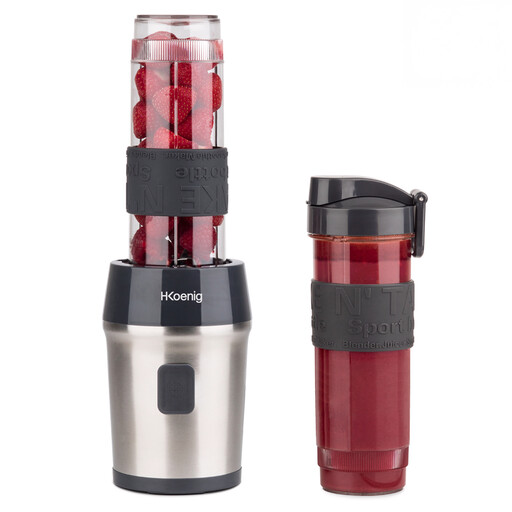
Why this choice suits this profile : Its 570 ml capacity and two bottles are ideal for breakfast, breaks at work or post-workout drinks.
The product information clearly states that it must not be used to blend ice cubes or frozen fruit. This clearly stated limitation helps you avoid choosing this model for a use it was not designed for.
300 W power, 570 ml capacity and two bottles, according to the listed specifications.
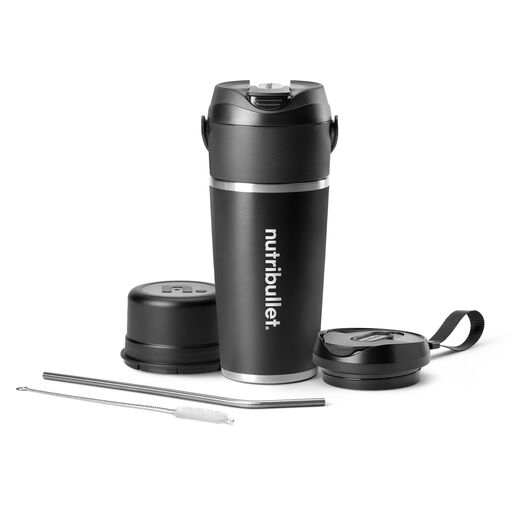
Why this choice suits this profile : Its 590 ml insulated stainless steel cup and handle are well suited to longer journeys.
USB-C charging, the included adapter and the advertised battery life make it easy to use, even without a socket nearby.
Advertised 120 W motor, insulated steel cup and up to 14 30-second cycles per charge.
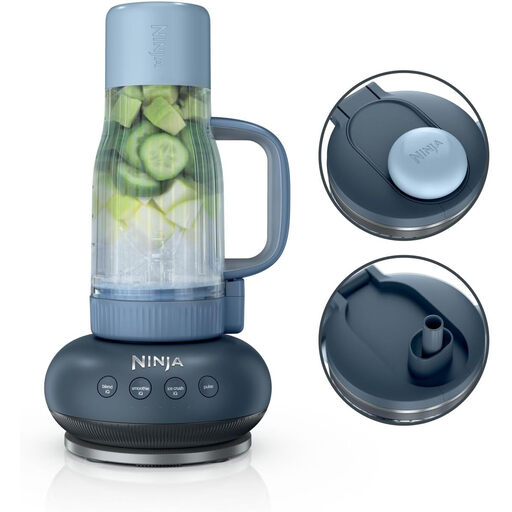
Why this choice suits this profile : Its 710 ml capacity and dedicated programmes are suitable for thicker preparations, particularly those containing ice cubes or frozen fruit.
The 650 ml blending limit is clearly stated, helping you avoid confusing total volume with the volume that can actually be used.
Advertised 1100 W motor, three automatic programmes, pulse mode and dishwasher-safe removable parts.
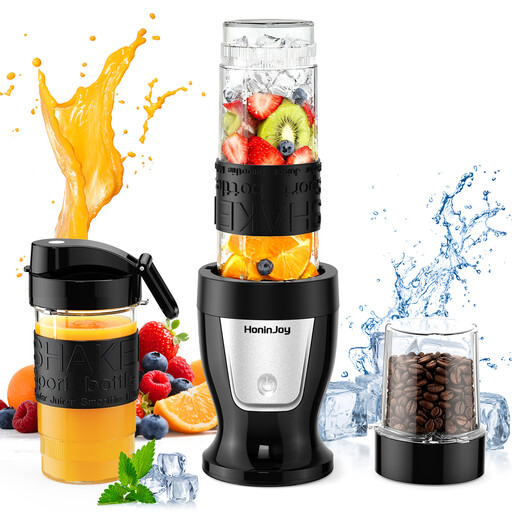
Why this choice suits this profile : The two travel cups and grinding bowl are ideal for students, smaller homes and a range of uses.
The cup-locking system and overheating protection help reduce the risks associated with incorrect assembly or overloading.
Advertised peak power of 650 W, two BPA-free cups and an included grinding bowl, according to the product information.
We have put together a comprehensive, real-time updated list of products that meet these strict selection criteria and European safety regulations.
To keep your smoothie mixer in good condition:
A rechargeable appliance uses little electricity each time it is used, but its battery may gradually lose capacity. Its operating time depends in particular on the number of cycles, storage conditions and whether the charging instructions are followed.
It depends on the motor and the manufacturer’s instructions. The Ninja BlendBoss and NUTRIBULLET Flip state that they can process ice cubes under the specified conditions. By contrast, the H.Koenig SMOO9 specifies that it must not be used to blend ice cubes or frozen fruit. Always consult the instructions for your chosen model.
Charging time varies depending on the battery and charger used. The nutribullet Portable NBP003B claims to take around 90 minutes to charge fully. Use the supplied cable or compatible equipment, and allow the appliance to cool between cycles if recommended in the instructions.
Yes, provided you choose a capacity suited to your portions, respect the cycle duration and clean the parts after each preparation. For intensive use with ice cubes or frozen fruit, choose a model whose technical specifications explicitly state that it can process these ingredients.