
Same-day & Next-day Delivery

Quality Guaranteed

Unlock Your Welcome Offers: FREE Delivery | Up to 80% OFF | Free 30-day JoyPlus trial
Download the APP
A portable air pump can be a lifesaver at the roadside, speed up setting up an airbed at the campsite or make inflating a paddleboard easier. But not all models are created equal. A device designed for car tyres may not be suitable for an airbed, while a pump designed to move large volumes of air may not reach the pressure required by a tyre.
Before you buy, three common mistakes are worth avoiding:
For car and motorbike tyres, choose a portable air compressor that clearly states its maximum pressure, with a sufficiently long hose and an easy-to-read display. A 150 PSI electric tyre inflator may be suitable for topping up many tyres, but this figure should be considered alongside the airflow, measured in L/min, and the time required to reach the desired pressure.
Compact pumps such as the Porbi Q16 and Q19 state 150 PSI, an airflow of 26 L/min and approximately 7 to 8 minutes to fully inflate a flat car tyre, under the conditions specified in the product listing. For a simple top-up, the stated time drops to around 30 seconds. These figures do not replace the pressure recommended in the vehicle handbook or by the tyre manufacturer.
For an airbed, inflatable ring or paddleboard, the priorities are different: it is usually the volume of air that matters, far more than the pressure. A pump for airbeds and inflatables or an electric paddleboard pump should therefore offer high airflow, suitable nozzles and, where necessary, a deflation function.
A cordless tyre pump can easily be stored in a car, cycling bag or motorbike boot. Before choosing one, however, check:
The Porbi Q16 and Q19 models feature a 4 000 mAh battery, with a stated charging time of 3.5 hours and approximately 25 minutes of operating time. That is enough for occasional top-ups, but you should not set off on a long journey without charging them first.
For extended use, a mains-powered model or one that runs from a 12 V socket reduces your reliance on the battery. The INTEX Electric Air Pump operates at 12 V DC and 230 V AC, but its product listing specifies that it is not intended for high-pressure tyres or sports equipment requiring high pressure.
A pump with a digital pressure gauge lets you select a target value and monitor the pressure in real time. Thanks to the automatic shut-off air pump function, inflation stops once the selected setting has been reached, helping to reduce the risk of exceeding the desired pressure. You should still always check the recommendations provided by the vehicle, bicycle or inflatable equipment manufacturer.
Pay attention to the cooling instructions too. The motor can heat up during prolonged inflation. Do not leave the pump running unattended and protect it from water during use, particularly when it is connected to the mains.
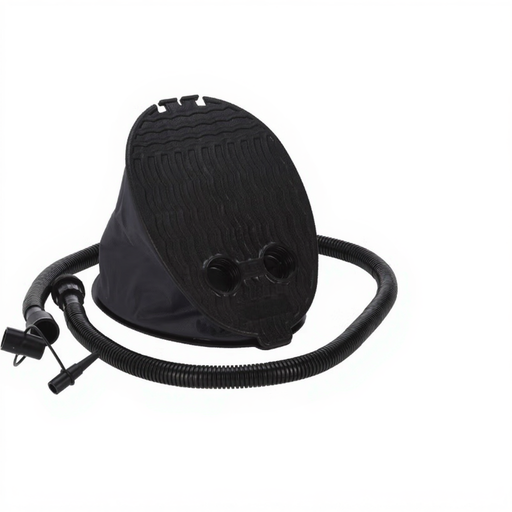
Why this choice suits this profile : Its foot-operated design does not rely on a battery or mains power. It is suitable for occasional outings, camping and pool inflatables.
The listing clearly states a 3-litre capacity and two functions — inflation and deflation — without promising high pressures.
Compact design, low weight, manual operation and a nozzle compatible with several inflatable items.
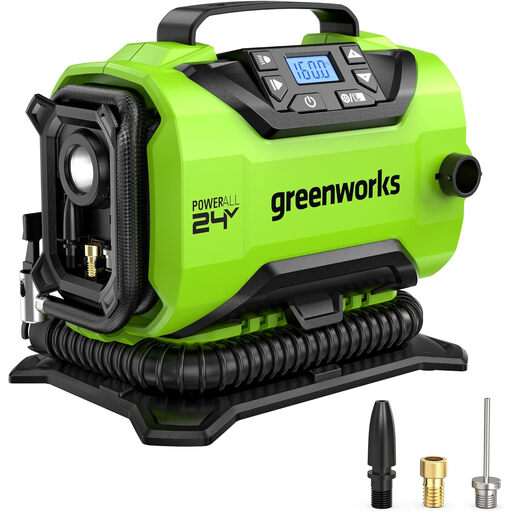
Why this choice suits this profile : Users who already own Greenworks 24 V batteries can enjoy a cordless pump for their tyres, airbeds and sports equipment.
The listing specifies that the battery and charger are not included. This is important to know to avoid an unexpected expense if you do not already own a compatible product.
Stated maximum pressure of 11 bar, automatic shut-off, digital display, three adapters and high- and low-pressure modes.
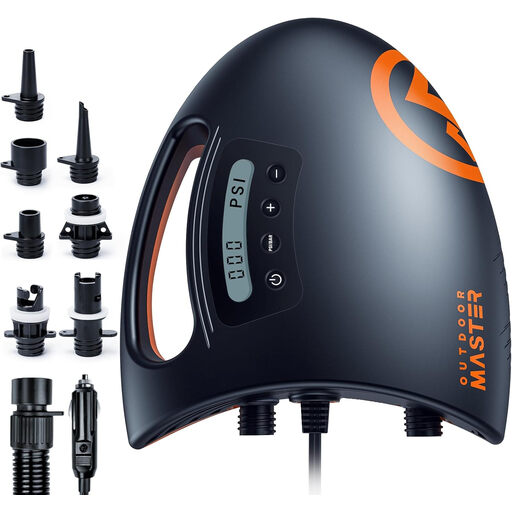
Why this choice suits this profile : Inflatable paddleboard and boat enthusiasts get a pump designed for large volumes and capable of reaching 20 PSI.
Its listing distinguishes between the two airflow levels — 350 L/min, then 70 L/min — rather than simply displaying a maximum pressure.
Two-stage operation, automatic shut-off, deflation, sand filter, three nozzles and 12 V power supply.
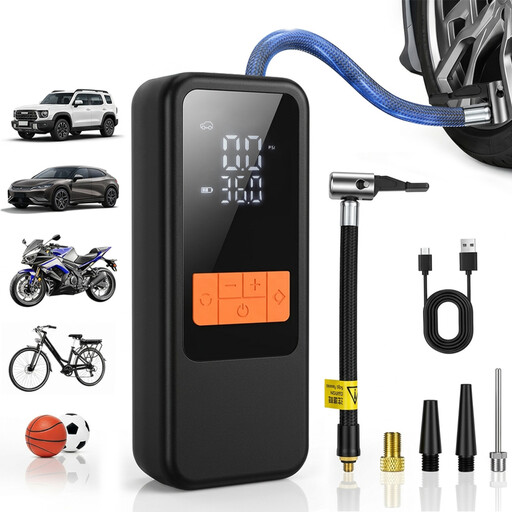
Why this choice suits this profile : Measuring 67 × 67 × 174 mm, it can be stored easily in a vehicle. Its five modes cover cars, motorbikes, bicycles, balls and custom settings.
The 4 000 mAh capacity, stated 25-minute operating time and specified inflation time make it clear what to expect before buying.
Stated maximum pressure of 150 PSI, USB-C port, continuous light and SOS mode, with measurement accuracy specified at ± 0,01 kg/cm².
We have brought together a complete, real-time updated selection of products that meet these strict criteria as well as European safety requirements.
To keep your device in good condition for as long as possible:
Yes, provided the model is designed for tyres and has the right connector. The Porbi and CARSUN models featured in this selection state that they are compatible with cars, motorbikes and bicycles. Inflation time varies depending on the tyre size, its starting pressure and the battery charge level.
A tyre pump prioritises pressure and measurement accuracy. An electric paddleboard pump focuses first on airflow, then reaches a generally lower pressure, expressed in PSI. Using an airbed or inflatable-ring pump on a tyre may therefore produce poor results, just as using a tyre inflator to quickly fill a large volume is unlikely to be effective.
The electricity consumption of a rechargeable air pump is generally limited to recharging its battery. The cost depends on its capacity, the number of cycles and the price of electricity. To avoid running out of power while travelling, fully charge the device and check its battery condition regularly.