
Livraison le jour même ou le lendemain

Qualité garantie

Débloquez vos offres de bienvenue: Livraison GRATUITE | Jusqu'à -80 % | 30 jours d'essai gratuits à JoyPlus
Téléchargez l'application
An underinflated car tire on the side of the road, an air mattress to set up at the campsite, balloons to prepare for a birthday party... in many situations, a portable air pump can be a real lifesaver. The problem? The market is flooded with models making tempting promises, but their performance is often disappointing. Our mission: to help you cut through the noise and make an informed decision, free from marketing jargon.
Before you dive in, let's review the common pitfalls that can turn a smart purchase into a real headache.
To ensure you make the right choice, focus on these key technical specifications. They will determine if a model is truly suited to your needs.
These two values are crucial and define the primary use of your pump.
The convenience and runtime of your pump depend directly on its power source.
These are the details that separate a gadget from a truly useful tool.
To illustrate how these criteria apply in practice, here are a few models that meet very specific needs.
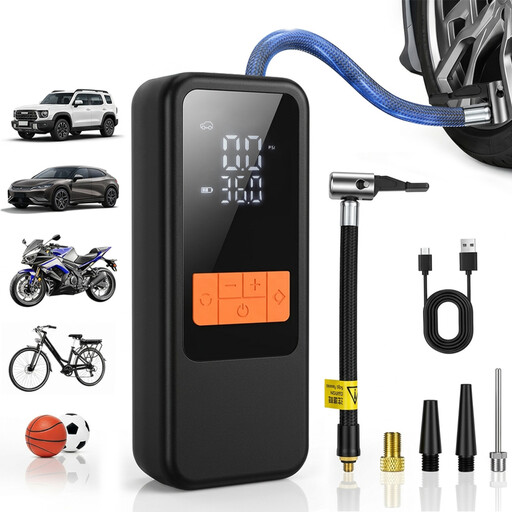
Why it's perfect for you: Compact and powerful, it stores easily in the glove box. Its maximum pressure of 150 PSI and 4000 mAh battery make it a powerful ally in an emergency, capable of fully reinflating a car tire.
It doesn't just promise runtime in minutes. Its spec sheet specifies its ability to inflate approximately 2 standard 195-size tires from flat—a concrete and verifiable metric.
5 preset inflation modes (car, motorcycle, etc.) with auto-shutoff. Power bank function to charge a smartphone and an LED light with SOS mode.
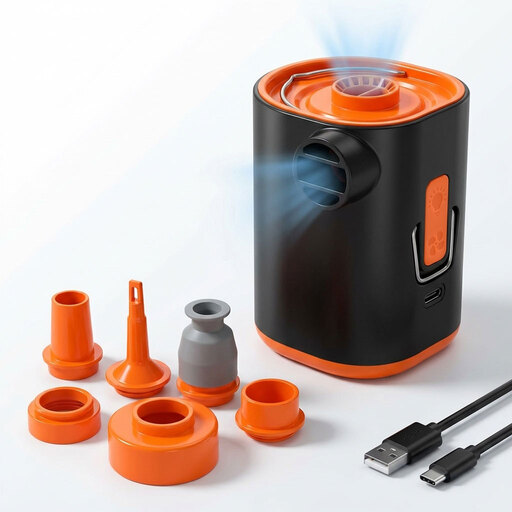
Why it's perfect for you: Designed for camping, this ultra-lightweight pump focuses on airflow to inflate mattresses, pool floats, or even deflate vacuum storage bags in the blink of an eye.
It doesn't try to pass itself off as a tire inflator. Its specifications (300 L/min airflow, low pressure) are clearly tailored for volume, preventing any confusion at purchase.
Very high airflow for express inflation/deflation. Powerful LED light (260 lm) with 5 hours of runtime and a metal hook for hanging it in a tent.
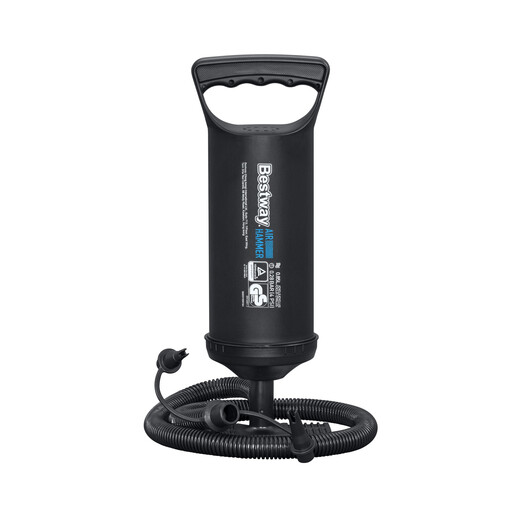
Why it's perfect for you: For inflating a spare mattress, a pool float, or a ball without any fuss, this manual pump is a simple and budget-friendly solution. No battery, no breakdowns: just pure, simple efficiency.
As a manual pump, there are no promises of battery life or power to verify. It's a simple mechanical tool whose only limit is your own energy.
Absolute reliability and independence from any power source. Its dual-action system inflates on both the push and pull strokes, significantly speeding up the process.
If you're primarily looking to inflate mattresses, pool floats, and other recreational gear, check out our dedicated selection to prepare for your next adventures.
The lifespan mainly depends on the lithium-ion battery. Generally, you can expect several hundred full charge cycles before its capacity begins to decrease significantly. To preserve it, avoid storing it completely discharged for long periods and keep the device in a place where temperatures are not extreme.
It is crucial to check the storage and operating temperature ranges specified by the manufacturer. Most models, like the Porbi Q16, have a storage range of -20°C to 60°C and an operating range of -20°C to 50°C. Leaving the device in a scorching hot car in the summer or during a deep freeze in the winter could damage the battery and electronics in the long run. It's best to store it in a more temperate location when possible.
Not at all. Quality modern pumps include an auto-shutoff feature. You select the mode (e.g., "Ball") or manually set the desired pressure (around 0.7 bar / 10 PSI for a football). The mini-compressor will inflate to that exact pressure and then stop on its own, eliminating any risk of over-inflation or bursting.