
Livraison le jour même ou le lendemain

Qualité garantie

Débloquez vos offres de bienvenue: Livraison GRATUITE | Jusqu'à -80 % | 30 jours d'essai gratuits à JoyPlus
Téléchargez l'application
A portable air conditioner can cool a bedroom, living room or office without the need for permanent installation work. For tenants, remote workers or small businesses, it’s a practical solution — provided you don’t overlook three criteria that are often glossed over in product descriptions: the actual cooling power available, the hot air exhaust system and the noise level.
A unit marketed as “powerful” may not live up to expectations in a south-facing room. Similarly, a portable air conditioner might be easy to move around, but can become frustrating to set up if the window kit doesn’t fit your opening. And as for silent mode, it won’t make the appliance disappear, especially when the compressor kicks in.
BTU figures give an indication of cooling capacity. However, the area a unit can cover also depends on insulation, ceiling height, sun exposure and the number of people in the room.
As a rough guide:
If the power is too low, the unit has to run continuously and cooling will be uneven. On the other hand, an oversized model may drop the temperature quickly without reducing humidity enough.
A single-unit air conditioner must vent hot air outside through a hose. Without this exhaust, the heat stays in the room and the appliance loses much of its benefit.
So check:
A draught seal kit helps limit warm air from entering, but it doesn’t replace a properly sealed installation. If you have a tilt-and-turn window, it’s worth checking compatible accessories before placing your order.
The dehumidifier mode reduces ambient humidity, but doesn’t necessarily provide the same cooling effect as the cool mode, which runs the compressor. This function can be useful in a damp room, a utility area or on particularly muggy days. Fan mode, meanwhile, simply circulates the air.
A unit described as a 3-in-1 air conditioner typically combines:
Some models also include heating, making them reversible air conditioners. That’s a handy feature for a home occupied all year round, as long as you compare the cooling and heating capacities separately.
Don’t stop at the maximum floor area stated on the box. In a top-floor flat, a room with lots of windows or an open-plan living area with a kitchen, allow for some extra margin. The airflow rate, expressed in m³/h, also tells you how well the unit can circulate air, but it isn’t enough to measure its cooling performance.
The noise level given in decibels deserves careful attention. Some models claim a sleep mode below 49 or 51 dB, while others reach around 54 to 57 dB. These figures are only truly comparable if they were measured under similar conditions.
For a bedroom, look for:
Even a so-called quiet air conditioner produces mechanical noise from the compressor. Place it on a stable floor and make sure it isn’t touching any furniture or the wall.
The energy rating gives you a starting point, but actual consumption depends mainly on how long you use the unit, the temperature you set and your home’s insulation. So an A or A+ rating doesn’t guarantee low consumption in every situation. Also check the power input and, where stated, the Energy Efficiency Ratio (EER).
R290 refrigerant has a low global warming potential and is used in several models featured here. The circuit must never be punctured or dismantled. During periods of heavy use, clean the washable filter roughly every two weeks, then let it dry completely before putting it back.
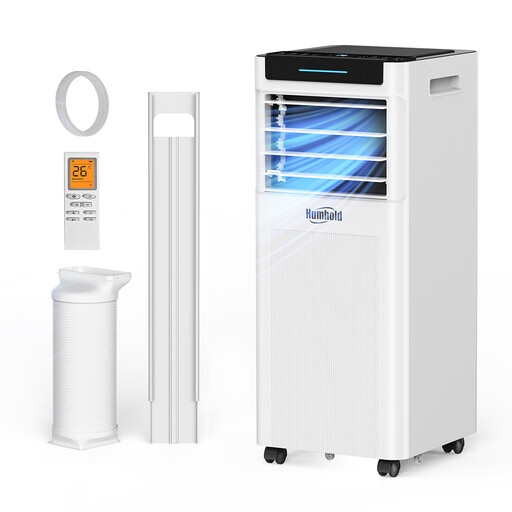
Why this choice suits this profile: At 19.7 kg and 2.0 kW, it’s suitable for a bedroom, home office or small room where you don’t need high cooling capacity.
The window kit, exhaust hose and castors are all included, so you don’t need to buy essential accessories separately.
Cool, dehumidify and fan modes, sleep mode below 49 dB and 24-hour timer.
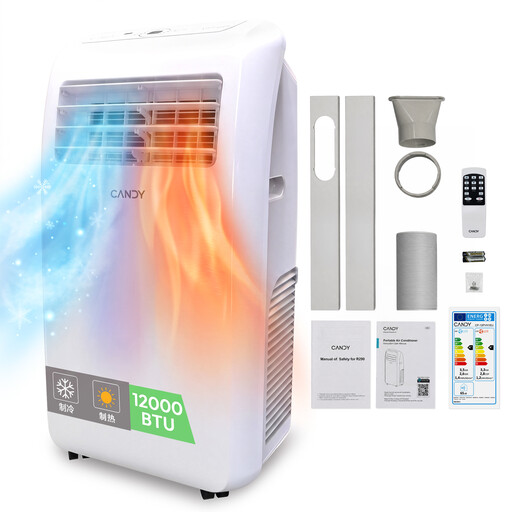
Why this choice suits this profile: Its 4-in-1 design is aimed at households that want a single appliance for summer and cooler periods alike.
The product page separates the cooling and heating capacities, rather than giving a single figure for both functions.
12,000 BTU, A+ rating claimed for both cooling and heating, remote control, window kit and 400 m³/h airflow.
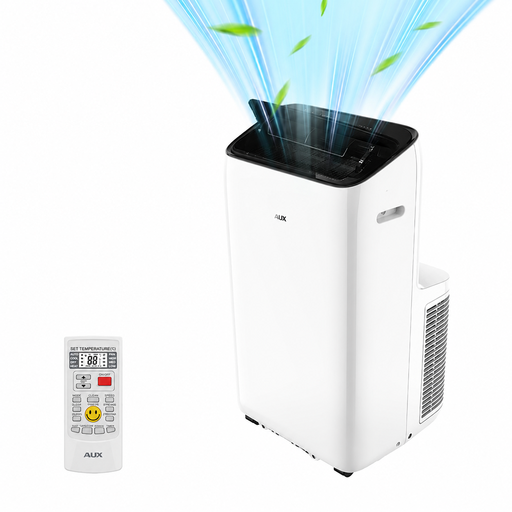
Why this choice suits this profile: Wi-Fi, 450 m³/h airflow and remote control make it especially suitable for frequent use in a large room.
The product page lists the maximum noise level of 64 dB separately, so you don’t confuse sleep mode with full-power operation.
12,000 BTU, Wi-Fi, remote control, three fan speeds, 24-hour timer and R290 refrigerant.
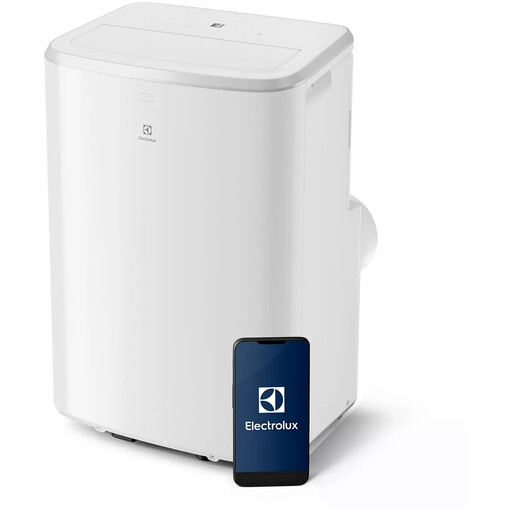
Why this choice suits this profile: This reversible model with Wi-Fi is aimed at those who want to control the comfort of a room remotely, for both cooling and heating.
The product page states that control is via Wi-Fi, with no mention of an included remote control — something to check depending on your preferences.
Cool, fan, dehumidify and heat functions, 9,000 BTU power, Wi-Fi and drainage kit.
We’ve rounded up the products that fully meet these demanding selection criteria and European safety regulations, in a complete list updated in real time.
The window needs to allow the exhaust hose to pass through, but the gap around it should be sealed using the kit supplied or a suitable accessory. Leaving a window wide open would let warm air back in and significantly reduce cooling efficiency.
It depends on the electrical power input, your supplier’s rate and how long you use it. To get an estimate, multiply the power in kW by the number of hours of operation, then by the price per kWh. The energy rating and timer can help limit running time, but they don’t guarantee a specific amount on your bill.
This depends on build quality, how often you use it and how well you maintain it. Clean the filter regularly, never block the air intakes or outlets, observe the recommended waiting time after moving the unit and store it in a dry place when not in season. For any work on the refrigerant circuit, always refer to the instruction manual.