
Livraison le jour même ou le lendemain

Qualité garantie

Débloquez vos offres de bienvenue: Livraison GRATUITE | Jusqu'à -80 % | 30 jours d'essai gratuits à JoyPlus
Téléchargez l'application
A portable air conditioner lets you cool a bedroom, living room or office without any permanent installation work. It’s especially popular with tenants, remote workers and households who want to move their appliance around as needed. The problem? Product listings often mix up power, coverage area and noise levels, which can lead to a purchase that doesn’t suit your needs.
Before comparing models, check three things: a power rating that matches your room, effective hot-air extraction, and a noise level measured under the right conditions. Extra features like Wi-Fi or heating are only worthwhile if they genuinely match how you’ll use the unit.
A claim of “up to 30 m²” doesn’t guarantee the same result in a room with a sloping ceiling, one that gets a lot of sun, or a poorly insulated space. Ceiling height, the number of occupants, electronic devices and window orientation all affect how much heat needs to be removed.
For a small bedroom or office, a 7,000 BTU model may be suitable depending on the layout. A 9,000 BTU portable air conditioner generally suits a medium-sized room, while a 12,000 BTU portable air conditioner is aimed at larger spaces, subject to the manufacturer’s precise specifications.
A single-unit appliance doesn’t make heat disappear – it pushes it outside through a hose. Simply leaving a window slightly open lets warm air back in, significantly reducing comfort. An air conditioner with a window kit makes installation easier, but check it’s compatible with your window type, its dimensions and which way it opens.
To improve sealing, a portable air conditioner window seal strip can be very useful. Strips of 3 or 4 metres attach around the opening to limit warm air ingress. You could, for example, look at the 3-metre window seal strip or the 4-metre version, after measuring your window.
A compressor, a fan and moving air will always create some noise. So compare the dB values, checking whether they refer to night mode or the maximum level. A unit advertised at 48 dB in sleep mode can be noticeably louder at full power.
BTU figures indicate cooling capacity, but they aren’t enough on their own. Also look at the power in kW, the airflow rate and the recommended room size on the spec sheet.
These figures are guidelines to help you choose, not a guarantee of constant temperature. An oversized unit may run in short cycles, while one that’s too weak could run for a long time without reaching the desired temperature.
A 3-in-1 air conditioner typically combines cooling, fan and dehumidification. The dehumidifying function can make the air more comfortable during humid periods, but it may also fill the water tank more quickly. Check its dehumidification capacity, the drainage system and whether a drain hose is included.
A reversible air conditioner adds a heating function, handy during the mid-season. As for a Wi-Fi air conditioner, it lets you adjust settings from an app. However, it doesn’t remove the need to install the exhaust hose properly.
The energy rating is useful for comparing units assessed under the same measurement framework. It isn’t enough to calculate the total cost – how long you use it, the temperature you set and the quality of your insulation all matter too. Also look at the power consumption in watts and the efficiency data on the spec sheet.
In the UK, check compatibility with a 220–240 V / 50 Hz supply, use an earthed socket and follow the manufacturer’s recommendations. Avoid extension leads and multi-socket adaptors if the manual advises against them. Models using R290 also require that you don’t puncture the refrigerant circuit and that the grilles are kept completely clear.
Clean the filter as instructed, typically every two weeks during regular use. A clogged filter reduces airflow and can increase running time.
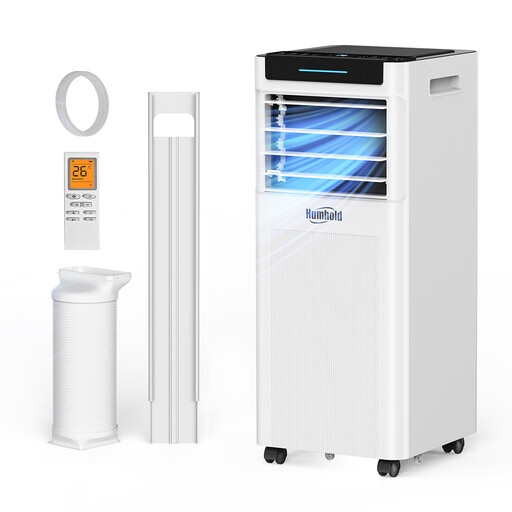
Why this choice suits this profile: At 19.7 kg, with castors and three modes, this model works well in a modest-sized bedroom or office without permanent installation.
The listing states a capacity of 2.0 kW, a stated coverage of up to 28 m² and an included exhaust kit – all data to compare against your room’s characteristics before ordering.
Dehumidification stated at up to 26 L/day, 24-hour timer and sleep mode under 49 dB according to the specifications provided.
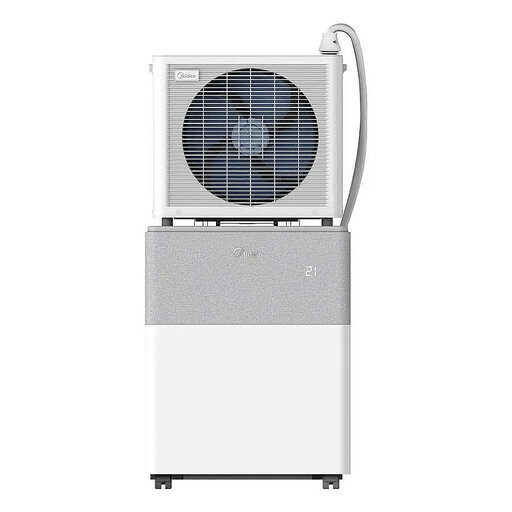
Why this choice suits this profile: This reversible system, made up of an indoor and an outdoor unit, is aimed at users who want both heating, Wi-Fi and power suitable for rooms up to 42 m².
The listing specifies the dimensions and weight of both units, as well as the 2-metre hose length – measure the available space before installation.
12,000 BTU cooling, heat pump, night and quiet modes, SmartHome app and window kit included according to the listing.
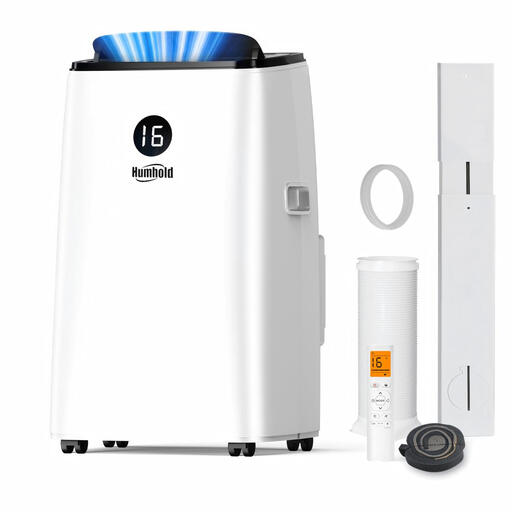
Why this choice suits this profile: Its 3.5 kW power and 380 m³/h airflow meet the needs of a living room, workspace or room stated at up to 50 m².
The listing details the noise level below 48 dB in sleep mode, the additional drainage and the three panels of the window kit.
Cooling, dehumidification and fan, 24-hour timer, automatic oscillation and R290 refrigerant are stated in the listing.
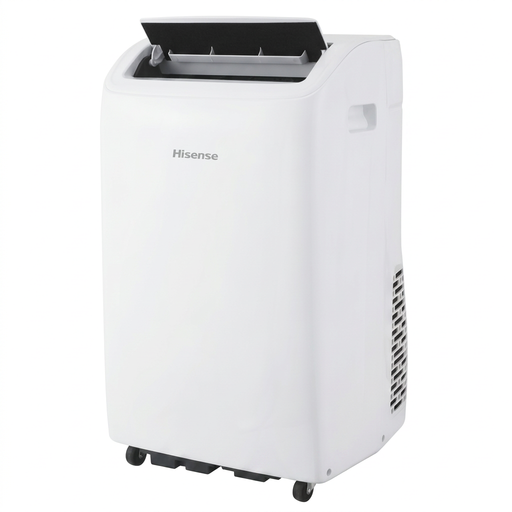
Why this choice suits this profile: The Wi-Fi control, 24-hour timer and single-unit format without an outdoor unit fit easily into a daily-use office or bedroom.
The listing mentions a power of 2.6 kW, a stated coverage of 14 m² and a minimum noise level of 50 dB – valuable figures for comparing models more closely.
Cooling, heating, fan and night modes, Wi-Fi control and class A in cooling according to the information provided.
We’ve put together a comprehensive, real-time updated selection of products that meet these demanding criteria and European safety regulations.
Place the unit on a level floor, leaving about 50 cm of clearance from any obstacle when the manual recommends it. The hose should be as short and straight as possible. Don’t block the air intakes or outlets, and only use a socket that meets the manufacturer’s specifications.
After transport, some models need to stay upright for several hours before first use. Check your appliance’s manual. In dehumidification mode or when humidity is high, regularly check the water tank and drain hose.
Yes. In cooling mode, the exhaust hose generally needs to push hot air outside. A compatible window or a sealing kit improves installation efficiency. Without proper venting, the heat stays in the room.
A 7,000 to 9,000 BTU model could suit this area, depending on insulation, sun exposure and ceiling height. Before choosing, compare the power in kW, the noise level in night mode and whether a timer is included.
It all depends on the electrical power consumption, your energy tariff and how many hours you use it. To get an estimate, multiply the power in kW by the hours of use, then by the price per kWh on your bill. Closing windows, cleaning the filter regularly and setting a reasonable temperature can also help reduce running time.