
Livraison le jour même ou le lendemain

Qualité garantie

Débloquez vos offres de bienvenue: Livraison GRATUITE | Jusqu'à -80 % | 30 jours d'essai gratuits à JoyPlus
Téléchargez l'application
A portable air conditioner lets you cool a bedroom, living room or office without any permanent installation work. It’s a particularly handy solution for tenants, students and anyone who wants to move their appliance around as needed. But to make the right choice, it’s not enough to simply compare the number of BTU on the box.
Some marketing promises can quickly disappoint once the unit is set up. A model that’s too powerful may use more energy and run in short bursts, while an undersized appliance will struggle to maintain a comfortable temperature. As for the advertised noise level, it might refer to a specific mode rather than the most common usage.
Here are the criteria to examine before buying a portable air conditioner in the UK.
The area covered depends on many factors: insulation quality, sun exposure, ceiling height and the number of occupants. A room in the loft or facing south may therefore need more power than a well-insulated bedroom of the same size.
As a rough guide, the following models generally suit different uses:
These benchmarks should always be checked against the full technical specification. The area highlighted in an advert alone is not enough.
A single-hose portable air conditioner produces hot air that must be vented outside using a hose. Without this exhaust, the heat eventually returns to the room and performance drops quickly.
Check that the appliance comes with a window kit suitable for your opening. A sliding or sash window can accommodate a rigid panel. For a tilt-and-turn window, a fabric sealing strip or a specially designed solution will help limit warm air ingress. A strip of 3 or 4 metres may also prove useful if the supplied kit doesn’t cover the entire window perimeter.
Noise varies depending on the mode used, the fan speed and when the compressor kicks in. To compare models, look at the dB(A) value stated by the manufacturer, while bearing in mind that test conditions aren’t always the same.
In a bedroom, choose a model with a clearly described night mode and check the corresponding noise level. A unit advertised at under 49 dB in sleep mode won’t necessarily be as discreet when running at full power.
A 9,000 BTU portable air conditioner often suits a medium-sized bedroom, studio or home office. For an open-plan living area or a room particularly exposed to heat, a 12,000 BTU portable air conditioner will generally offer a more comfortable power reserve.
Expressed in m³/h, the airflow rate tells you about air circulation in the room. However, on its own it doesn’t allow you to assess cooling capacity. Always compare the airflow, cooling power and recommended room size.
A 3-in-1 air conditioner typically includes:
A portable air conditioner with dehumidifier can be useful in a damp room. However, its water tank may need emptying during prolonged use or when humidity levels are high. The auto-evaporation function reduces the need for intervention in certain conditions, but it doesn’t eliminate maintenance entirely.
Reversible models add a heating mode. This feature can be relevant in a second home or for seasonal use, provided you check the heating power and the stated coverage area separately.
The energy rating and EER allow you to compare appliances under standardised conditions. However, a class A or A+ rating doesn’t mean the energy consumption will be the same for everyone: the duration of use, the selected temperature and your home’s insulation all have a direct impact on your bill.
The R290 refrigerant is used in several appliances in this selection. It is mentioned in the manufacturers’ technical data sheets. Never attempt to pierce the refrigeration circuit, and always follow the safety instructions regarding installation, storage and room ventilation.
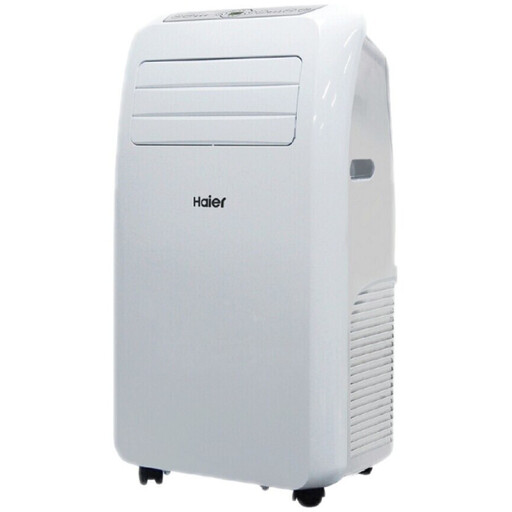
Why this choice suits this profile: This 9,000 BTU model provides cooling, fan and dehumidification in rooms up to 25 m² according to the product sheet. Its castors, remote control and 24-hour timer make it particularly easy to use.
The power, stated noise level of 54 dB and recommended room size are clearly indicated. That means you can compare on concrete grounds rather than relying on a vague promise.
2.6 kW power, class A, dehumidification up to 0.9 l/h and automatic condensate drainage according to the technical data sheet.
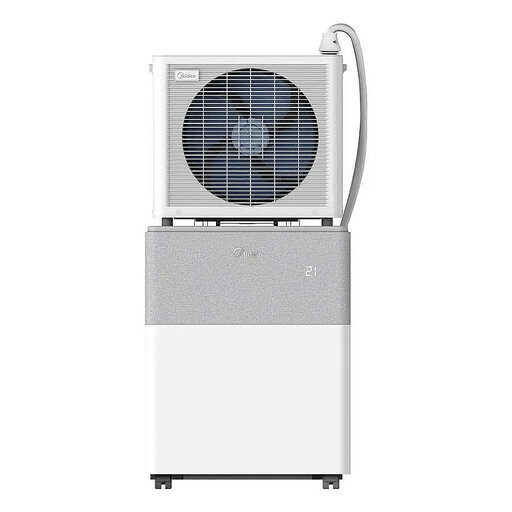
Why this choice suits this profile: This model uses a split design, with an indoor unit and an outdoor unit connected by a 2-metre tube. It’s aimed at those who want heating, cooling and app control all in one.
The data sheet details the minimum and maximum noise levels, the dimensions of both units and the accessories included. This makes it easier to plan for space and installation.
3,500 W cooling power, class A+, reversible modes, dehumidification and fan, Wi-Fi connectivity and window kit included.
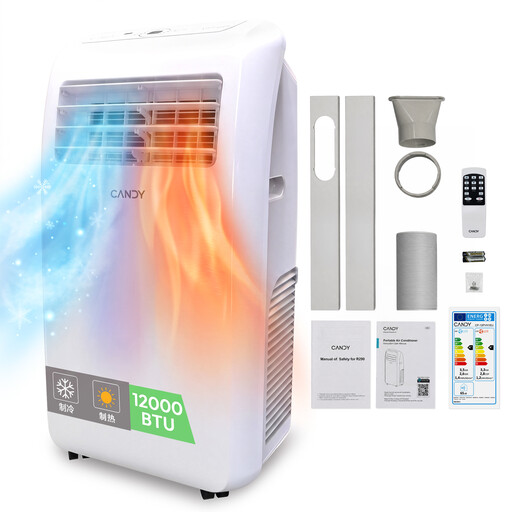
Why this choice suits this profile: This 4-in-1 model is designed for homes occupied all year round, with cooling, heating, fan and dehumidification functions. The timer and remote control make everyday use simple.
The cooling and heating powers are stated separately, as are the recommended room sizes. So there’s no risk of assuming the appliance delivers the same performance in both modes.
3.5 kW cooling, 3.3 kW heating, class A+ stated in both modes, 400 m³/h airflow and window kit included.
We’ve put together a complete, real-time updated selection of products that meet these demanding criteria, as well as European safety standards.
Place the appliance on a level floor, a good distance from walls and curtains. The exhaust hose should remain as straight as possible and must never be blocked. Plug the air conditioner into a suitable socket. Avoid extension leads and multi-socket adaptors if the manufacturer advises against them.
Clean the filter following the instructions in the manual, typically every two weeks during regular use. Before any maintenance, switch off and unplug the appliance. After transporting the unit in a tilted position, some manufacturers also recommend waiting before switching it back on: always consult the manual for your specific model.
Yes, in cooling mode the hose must generally vent hot air outside. A window kit or sealing strip helps limit heat re-entering the room. Fan-only mode can work without venting, but it won’t cool the room in the same way.
It all depends on the appliance’s electrical power, how long you use it and your energy supplier’s rate. Note the power consumption in watts on the data sheet, then multiply it by the number of hours of use and the price per kilowatt-hour. The energy rating helps you compare models, but it doesn’t guarantee the same bill from one home to another.
It depends on build quality, how often you use it, how well you maintain the filter and whether you follow the installation instructions. Regular cleaning, good airflow and storing the unit in a dry place will all help preserve its performance.