
Livraison le jour même ou le lendemain

Qualité garantie

Débloquez vos offres de bienvenue: Livraison GRATUITE | Jusqu'à -80 % | 30 jours d'essai gratuits à JoyPlus
Téléchargez l'application
A portable air conditioner lets you cool a flat, bedroom or office without any building work. You simply place the unit near a window, connect the exhaust hose and fit the supplied draught‑proofing kit. It’s a particularly handy solution for tenants, homeworkers and anyone who wants to move their air conditioner from room to room.
But beware of product listings that push power or a long list of features without always spelling out the practical limitations. Here are the criteria to check before you buy a portable air conditioner.
A 9000 BTU portable air conditioner isn’t automatically right for every room. The claimed floor area also depends on ceiling height, insulation quality, sun exposure, the number of people in the room and the heat given off by electrical appliances.
As a rough guide, models from 7000 to 9000 BTU are generally suited to bedrooms, studios and offices of around 22 to 30 m², depending on conditions. For a larger room or one that’s particularly exposed, a 12000 BTU portable air conditioner will give you more headroom.
A single‑unit appliance has to push hot air outside. If the hose is poorly fitted or the window isn’t properly sealed, some of that heat finds its way back into the room and the real‑world performance suffers. So check that a window kit is included, note the hose length and make sure it’s compatible with your type of window.
Sliding windows and certain casement windows may need the supplied panel or seal to be adapted. Take your window opening measurements before you order.
A portable air conditioner contains a compressor and a fan. Even a quiet air conditioner therefore produces a measurable noise level in decibels. The figure quoted — 48, 49 or 51 dB, for example — often refers to a specific mode, usually night mode, and not necessarily to all fan speeds.
For a bedroom, compare the stated noise level and check for a sleep mode. In an office, the timer and the ability to reduce the fan speed can matter just as much as the cooling power.
Compare the cooling capacity in BTU/h or kilowatts, but also the airflow rate in m³/h. A model described as suitable for 22 m² shouldn’t be judged the same way as a unit intended for a 50 m² room.
Also allow plenty of clear space around the air conditioner. The models featured here generally recommend about 50 cm of free space so that the air intakes and outlets aren’t blocked.
A 3‑in‑1 air conditioner typically includes:
A portable air conditioner with dehumidifier can be useful in a damp room, but this function fills the water tank more quickly. You’ll then need to drain it as instructed in the manual.
A reversible air conditioner adds a heating function. This versatility can be handy in an office or small room used all year round, as long as you compare the heating power and the stated operating conditions.
The energy rating, EER and power consumption shown on the product sheet let you compare units on a consistent basis. An energy rating of A or A+ doesn’t mean it costs nothing to run: the hours of use, the temperature you set and the quality of your insulation all directly affect consumption.
The refrigerant R290 is used in several models in this selection. It’s a technical detail to check on the product sheet and on the appliance’s label. A 24‑hour timer lets you schedule the unit to switch off or on around your daily routine, so you don’t run the air conditioner unnecessarily.
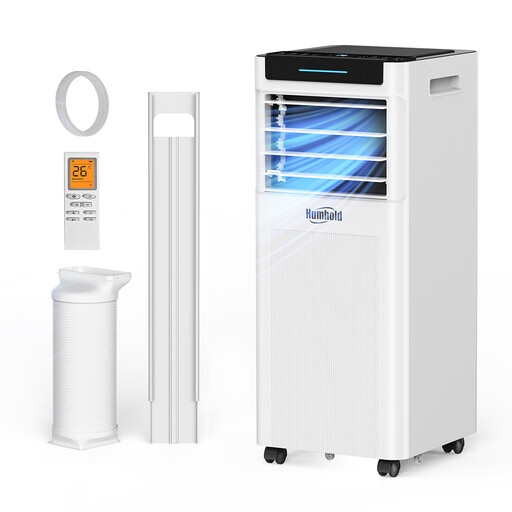
Why this choice suits this profile: With its 2.0 kW, 19.7 kg weight and compact footprint, this model is suitable for bedrooms, studios and small offices up to around 28 m², depending on insulation.
Its capacity is consistent with a small or medium room, without needlessly oversizing the unit.
Cooling, dehumidification and fan modes, washable filter, 24‑hour timer and R290 refrigerant stated.
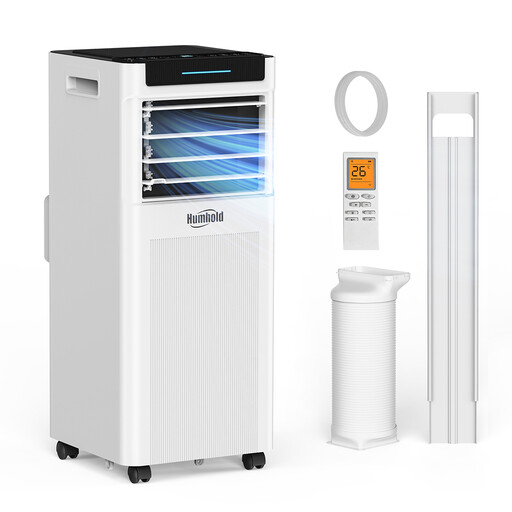
Why this choice suits this profile: With its 2.6 kW output, compact size and sleep mode, it’s well suited to a home office or bedroom of around 30 m².
The window kit, remote control and timer mean no extra purchases and simpler day‑to‑day use.
Three modes, dehumidification stated up to 28 L/day, 24‑hour timer and washable filter.
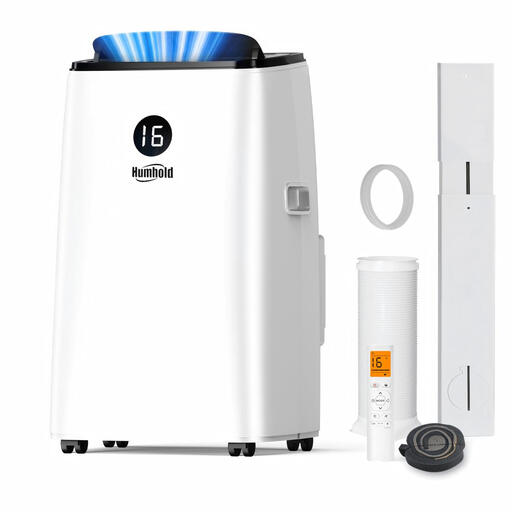
Why this choice suits this profile: With its 3.5 kW and stated airflow of 380 m³/h, this model targets living rooms, offices and loft conversions up to around 50 m², depending on the property’s characteristics.
The product sheet mentions a three‑piece draught‑proofing kit plus a water drain for periods of high humidity or extended use.
Dehumidification stated up to 42 L/day, auto swing, three fan speeds and energy rating A stated.
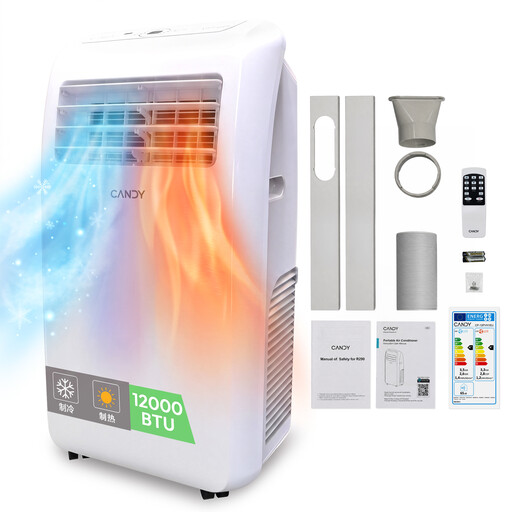
Why this choice suits this profile: This reversible model combines cooling, heating, fan mode and dehumidification for versatile use throughout the seasons.
The product sheet lists the cooling and heating outputs separately, rather than presenting a single figure for both uses.
Four modes, energy rating A+ stated, airflow of 400 m³/h, 24‑hour timer and window kit included.
We’ve put together a full, real‑time updated selection of products that meet these demanding criteria, while complying with European safety regulations.
To set up your portable air conditioner properly:
In dehumidification mode or during very humid weather, keep an eye on the tank‑full indicator. Always unplug the appliance before cleaning it, and never block the ventilation grilles.
The consumption depends on the unit’s power, its energy rating, the temperature you select and how long you run it. Check the electrical power and EER shown on the technical data sheet, then use the timer to avoid unnecessary running periods.
Yes, as long as the model has a night mode and its noise level is acceptable to you. Seal the window properly around the hose, avoid directing the airflow straight at the bed, and check the filter regularly.
That depends on how often you use it, how well you maintain the filter, how you store it over winter and whether you follow the electrical safety instructions. Before putting the unit away, clean it, let it dry, then store the hose and accessories together with the manual.