
Livraison le jour même ou le lendemain

Qualité garantie

Débloquez vos offres de bienvenue: Livraison GRATUITE | Jusqu'à -80 % | 30 jours d'essai gratuits à JoyPlus
Téléchargez l'application
A portable air conditioner lets you cool a bedroom, living room or home office without any building work. For tenants, students or anyone working remotely, that’s a real advantage: the unit can be moved around easily and stored away when the heat subsides. But some of the promises made in product listings can lead to nasty surprises once you’ve made your purchase.
Before comparing a 9000 BTU portable air conditioner, a 12000 BTU model or a reversible unit, take the time to check its actual cooling power, how the hot air is expelled and the noise level that’s genuinely stated.
The BTU rating corresponds to the unit’s cooling capacity. However, it isn’t enough on its own to determine the room size in which it will actually be effective. A room facing south, located under the eaves or poorly insulated will need more power than a shaded bedroom.
The room sizes quoted by manufacturers should therefore be taken as a guide, not a guarantee. A 9000 BTU portable air conditioner is generally suitable for a bedroom or a reasonably sized home office. A 12000 BTU portable air conditioner will be far more at home in a large room or a property that’s particularly difficult to cool.
A portable air conditioner without an outdoor unit is not a device that works without ventilation. In cooling mode, its hose must discharge hot air to the outside. If it doesn’t, some of the heat returns to the room and performance drops.
Check that a window kit is included, that it’s compatible with your window type and note the length of the hose. A sliding, casement or tilt-and-turn window may require a different sealing system.
The noise level varies depending on the mode selected, the fan speed and the compressor’s operating phases. Compare the decibel values and check whether they represent a minimum, maximum or night-mode measurement. In a bedroom, a sleep function and a timer will often be more useful than a vague promise of quiet operation.
To compare models effectively, match the cooling capacity to the layout of your home:
More powerful doesn’t necessarily mean more comfortable. An oversized unit may run in short cycles, which can push up energy consumption. Conversely, an undersized model will run for a long time without reaching the desired temperature.
A 3-in-1 air conditioner typically offers three functions: cooling, fan and dehumidification. The latter can be useful in a damp room, but it doesn’t replace proper ventilation. Check the stated dehumidification capacity in litres per day and the drainage system provided.
A reversible air conditioner adds a heating function for the shoulder seasons. Its heating power, energy rating in this mode and conditions of use should be examined separately. A remote control, a 24-hour timer and an easy-to-read display also make the unit more pleasant to use.
The energy rating, EER and coefficient of performance give more concrete indications than a simple promise of savings. Consumption then depends on usage time, the temperature selected, your home’s insulation and the price per kilowatt-hour on your bill.
Several of the models shown use R290 refrigerant. This refrigerant must be handled in accordance with the manufacturer’s instructions. Never pierce the circuit and never attempt to repair the compressor or the refrigeration circuit yourself.
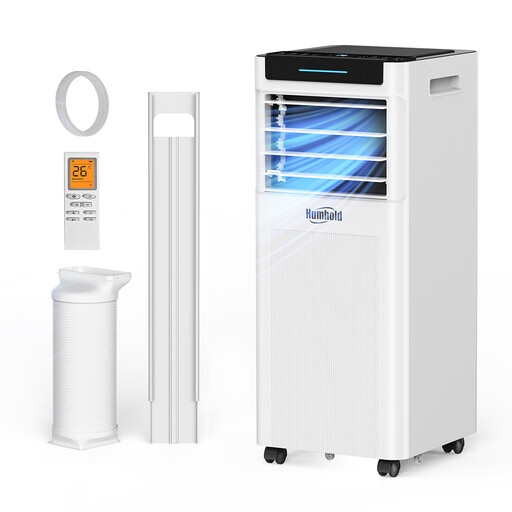
Why this model fits this profile: With its 2.0 kW and 19.7 kg, it’s suitable for small rooms and studios, while remaining easy to move around regularly.
The stated room size must still be weighed against your room’s characteristics. The window kit, exhaust hose and timer are included, saving you a few extra purchases.
Cooling, fan and dehumidification modes, stated noise level below 49 dB in sleep mode, washable filter and 24-hour timer.
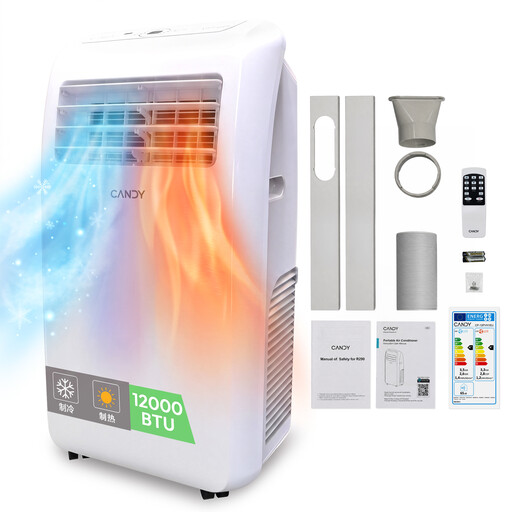
Why this model fits this profile: Reversible, it’s aimed at households that want to combine several functions in a single unit, for the living room or a multi-purpose room.
The functions are detailed separately: 3.5 kW in cooling, 3.3 kW in heating and window kit included. Consumption does, however, depend on usage time and the mode selected.
Stated A+ energy rating in both cooling and heating, remote control, 24-hour timer, 400 m³/h airflow and R290 refrigerant.
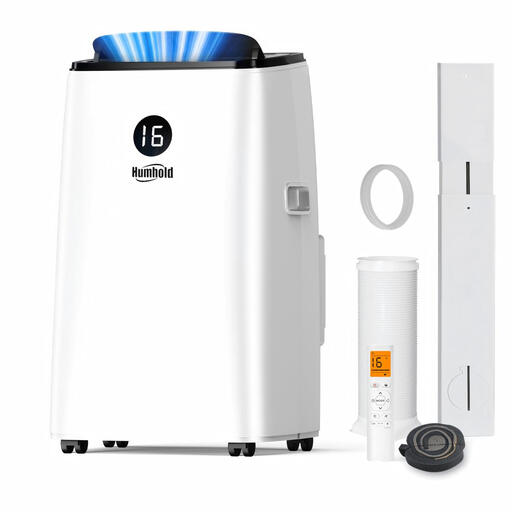
Why this model fits this profile: Its 3.5 kW power and 380 m³/h airflow make it suitable for large rooms, living rooms and offices that are particularly exposed to heat.
The window sealing kit and auto-evaporation system simplify installation and reduce the need for draining. However, they don’t eliminate the need for regular maintenance when humidity is high.
Three modes, stated dehumidification up to 42 L/day, automatic oscillation, remote control, 24-hour timer and stated noise level below 48 dB in sleep mode.
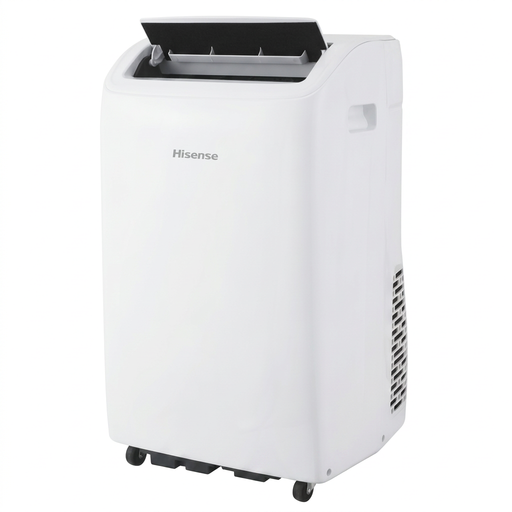
Why this model fits this profile: Its 2.6 kW is suitable for a room of around 14 m². Wi-Fi, the remote control and night mode make it easy to manage the temperature, even remotely.
The spec sheet states a minimum noise level of 50 dB, the need for an exhaust hose and an A energy rating in cooling. All data worth checking before you place your order.
Stated Wi-Fi and voice control, 2.4 kW heating, automatic mode, super-cooling function and programmable timer up to 24 hours.
We’ve put together a comprehensive, real-time updated list of products that fully meet these strict selection criteria and European safety regulations.
Place the unit on a level floor, a good distance from walls and curtains. The hose should remain as straight as possible and not be crushed. Plug the air conditioner into a suitable socket and avoid extension leads or multi-socket adaptors if the manual advises against them.
Clean the filter at the recommended frequency, typically every two weeks with regular use. Always unplug the unit before carrying out maintenance and let the filter dry completely before putting it back. In dehumidification mode or when humidity is high, the water tank may need emptying even if the unit has an automatic evaporation system.
No. In cooling mode, the hot air must be expelled to the outside. The window can remain almost closed thanks to a sealing kit, but the hose must pass through a suitable opening.
To get an estimate, multiply the electrical power consumed, in kilowatts, by the usage time, then by the price per kilowatt-hour shown on your bill. The energy rating alone isn’t enough to calculate the total cost: the temperature selected, your home’s insulation and the number of hours of daily use also play a role.
It depends on build quality, frequency of use, filter maintenance and adherence to the installation instructions. Storing it in a dry place, cleaning it regularly and keeping the hose free from kinks or crushing will all help to preserve the unit.