
Livraison le jour même ou le lendemain

Qualité garantie

Débloquez vos offres de bienvenue: Livraison GRATUITE | Jusqu'à -80 % | 30 jours d'essai gratuits à JoyPlus
Téléchargez l'application
With heatwaves becoming more and more frequent, the portable air conditioner stands out as the simplest solution for finding cool relief without undertaking complex installation projects. However, the market is flooded with models whose marketing promises are often vague. To help you see things more clearly, our guide breaks down the mistakes to avoid and the essential criteria to check before you buy.
Navigating the jungle of available options is a real headache. As a result, many buyers end up with a disappointing unit that falls far short of their expectations. Here are the three most common pitfalls.
To make an informed choice, it's essential to understand a few technical specs that directly determine the effectiveness and user comfort of your supplemental air conditioner.
An air conditioner's cooling capacity is measured in BTUs (British Thermal Units). The higher this number, the larger the volume the unit can handle. To give you a general idea:
Be aware that these are only estimates. Poor insulation, a south-facing exposure, high ceilings, or large picture windows are all factors that require you to slightly oversize the power.
This is the criterion that can make all the difference, especially if you plan to use it at night. Note that the decibel scale is logarithmic: an increase of just 3?dB doubles the perceived noise!
Our advice: rely solely on the technical specifications and look for the lowest dB value, which often corresponds to the night mode or the minimum fan speed.
An energy-efficient portable air conditioner is the best way to avoid a nasty surprise on your electricity bill. Check the energy label and prioritize models rated A or better (A+).
Other features can also make a difference in daily use:
Rather than an endless catalogue, we've selected models that meet specific needs. There's a solution for every profile.
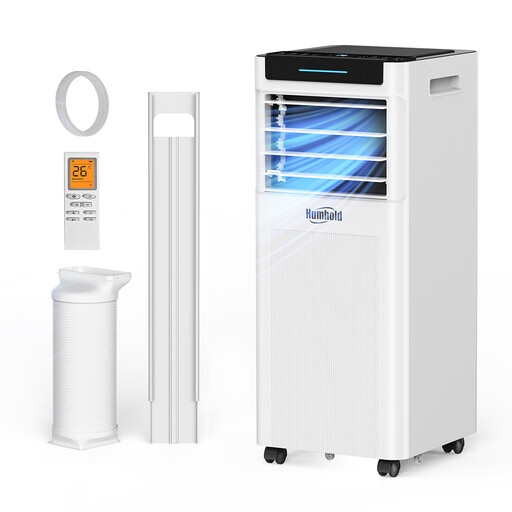
Editor's Pick: Its compact design and 7,000 BTU power are perfect for efficiently cooling an office, a student's room, or a small living room (up to 20-25 m?), without taking up too much space.
This model is perfectly calibrated for small areas, avoiding the trap of unnecessary oversizing. Its power is just right. Furthermore, its night mode is rated at under 49 dB: a concrete figure that's much more telling than a vague marketing claim.
Its auto-evaporation system greatly simplifies maintenance. Under normal humidity conditions, there's no more need to manually empty the condensate collection tray.
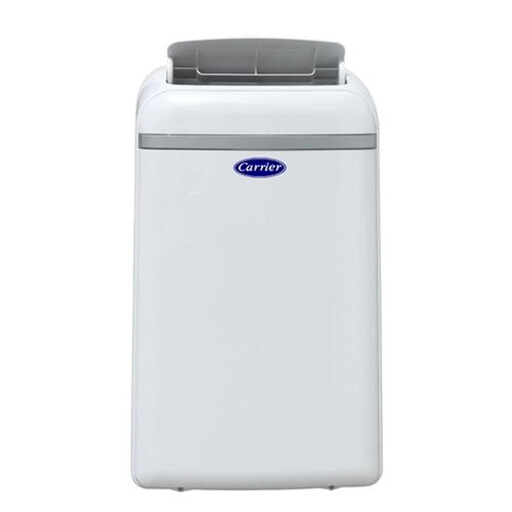
Editor's Pick: This is the Swiss Army knife of climate control. Its **reversible** function (heat pump) transforms it into a powerful supplemental heater for the shoulder seasons. With 3.5 kW (about 12,000 BTU), it's built for large living rooms.
It offers true versatility without falling into the trap of gimmicky features. The heating mode is a real added value, not just a selling point. Its energy classes (A for cooling, A+ for heating) are clearly displayed, guaranteeing controlled energy consumption.
Its dual heating/cooling capability makes it a cost-effective long-term investment, useful far beyond just a few weeks of summer heatwaves.
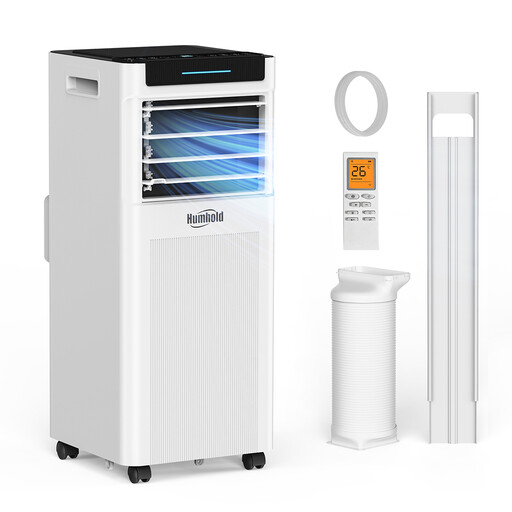
Editor's Pick: Specially designed for bedrooms and workspaces where silence is golden. Its **9,000 BTU** power is perfect for a medium-sized room (up to 30 m?), and its night mode has been optimized to fade into the background.
It tackles the noise problem head-on by advertising a sound level below 51 dB in night mode. This transparency is rare and allows you to make an informed decision, a crucial point for a **bedroom air conditioner**.
The combination of a "quiet night mode" and a "24-hour timer" is incredibly effective: you can cool the room before bed, then maintain an ideal temperature all night without being disturbed by noise.
Discover our full selection of products that meet our demanding selection criteria and current standards.
Yes, and this is non-negotiable. A true portable air conditioner (or monobloc unit) must vent the hot air it extracts from the room through a hose. Without this, the hot air would be released back into the room, completely cancelling out the cooling effect. Devices sold as "ventless air conditioners" are actually evaporative air coolers. Their technology, based on water evaporation, does not lower the ambient temperature; it only provides a very localized cooling sensation and increases humidity.
The operating cost depends on the unit's power (in kW), its energy class, your electricity plan, and, of course, how long you use it. To give you a rough idea: a 1,000?W (1?kW) Class A unit, used for 4 hours, will consume 4?kWh. With a kWh price of €0.25, this represents a cost of about €1 for 4 hours of cooling. Opting for an energy-efficient portable air conditioner (Class A or higher) is therefore essential to keep your bill from skyrocketing.
On average, with proper maintenance, you can expect your portable air conditioner to last between 5 and 10 years. Maintenance is simple but crucial: it mainly involves cleaning the air filters very regularly (every two weeks in summer) to ensure optimal airflow. At the end of the season, remember to store it in a dry place, away from dust.