
Livraison le jour même ou le lendemain

Qualité garantie

Débloquez vos offres de bienvenue: Livraison GRATUITE | Jusqu'à -80 % | 30 jours d'essai gratuits à JoyPlus
Téléchargez l'application
A portable air conditioner can cool a bedroom, living room or home office without requiring permanent work. For renters, it is a flexible solution that can be moved wherever it is needed. However, a product specification sheet does not always tell the whole story: incorrectly sized capacity, a poorly positioned exhaust hose or underestimated noise levels can turn a convenient purchase into an appliance that is quickly abandoned.
Here are the key criteria to consider before choosing a portable air conditioner, along with a selection of models available on Joybuy.
A 12,000 BTU air conditioner is not automatically suitable for every large room. The area it can cool depends on insulation, ceiling height, sun exposure and the number of occupants.
As a general indication, 7,000 to 9,000 BTU models are typically suitable for rooms of around 20 to 30 m², depending on the conditions. A 12,000 BTU unit may be intended for a room of up to 35 m², while a portable model with an outdoor unit may be designed for an area of up to 42 m². These figures remain manufacturer estimates and should be assessed against the actual layout and conditions of your home.
A single-hose portable unit must expel hot air outdoors through an exhaust hose. Without a portable air conditioner with a window kit, heat can flow back into the room and seriously reduce comfort.
Before placing your order, check:
A 3- or 4-metre window sealing strip can complete the installation when the supplied kit does not cover the full width of the opening.
The promise of a quiet portable air conditioner deserves closer examination. Check the decibel rating and the operating mode used to obtain it. A unit advertised at under 49 or 51 dB in night mode may be noticeably louder at maximum power. The compressor, vibrations and airflow also affect how the noise is perceived.
For a bedroom, prioritise a night mode, a timer and a stable installation positioned a reasonable distance from the wall.
Cooling capacity is expressed in BTU/h or kilowatts. The values listed below provide a useful starting point for comparison:
An undersized unit may run continuously without reaching the desired temperature. A more powerful model may cost more upfront and take up more space. Room size, orientation and frequency of use should therefore all factor into your decision.
A portable air conditioner with dehumidifier can be useful in a damp room or on particularly muggy days. However, dehumidification mode is not a substitute for suitable ventilation and may require the water tank to be emptied more frequently.
The following functions should be distinguished:
In very humid conditions, the tank may still fill up. The “Water Full” indicator, or its equivalent, signals that the tank needs to be emptied.
The energy rating, EER or SEER provide useful points of comparison, but actual consumption depends on operating time, the selected temperature and insulation. An energy-efficient portable air conditioner is, above all, an appliance used at a reasonable temperature, with a properly sealed window and clean filters.
Plug the unit into a suitable, grounded outlet. Do not use a power strip or extension cord where the manual prohibits it. Also observe the clearance recommended by the manufacturer, which is often around 50 cm around the air intakes and outlets.
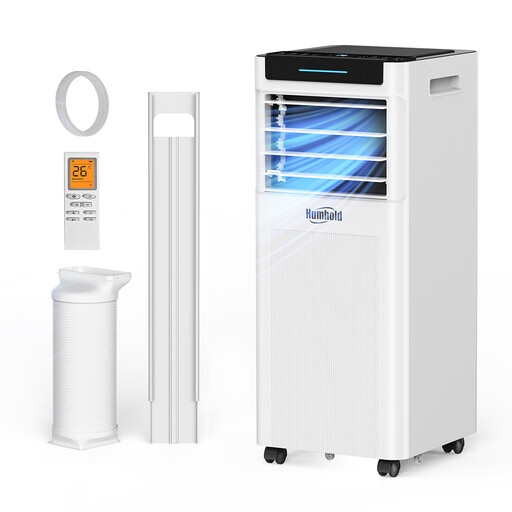
Why this model suits this profile: with 2.0 kW of capacity and an advertised coverage area of up to 28 m², it is suitable for a bedroom, home office or small living room used occasionally.
The product sheet specifies the intended room size, a noise level below 49 dB in night mode and the inclusion of a window kit.
Three modes, a 24-hour timer, washable filter, castors and R290 refrigerant.
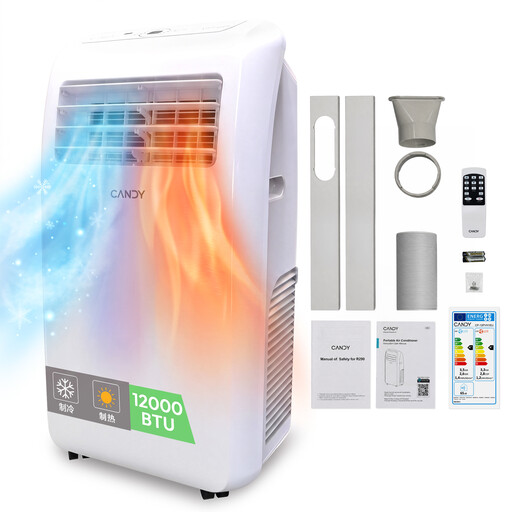
Why this model suits this profile: its 4-in-1 format is designed for households that want to cool, ventilate, dehumidify and heat a room without having to purchase multiple appliances.
The product sheet specifies 3.5 kW in cooling mode, an advertised coverage area of up to 35 m² and a window kit compatible with two configurations.
Advertised A+ energy rating, 3.3 kW heating capacity, 400 m³/h airflow and a 24-hour timer.
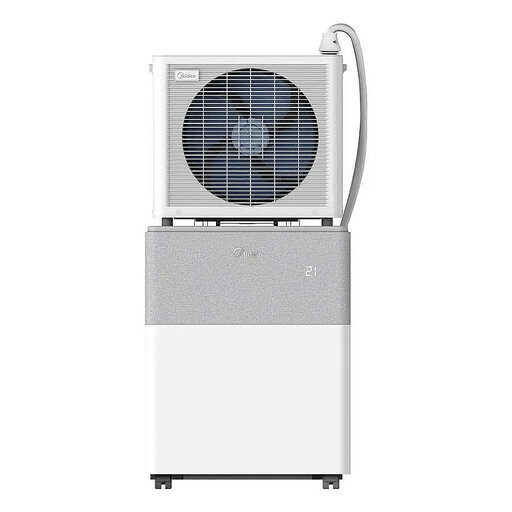
Why this model suits this profile: its portable split system is designed for rooms advertised as measuring up to 42 m² and for users looking for heating, cooling and connected control in one solution.
Its indoor and outdoor unit design reduces the usual compromises of a single-unit system, but requires more space and installation in accordance with the manual.
12,000 BTU, heat-pump heating, Wi-Fi, night and quiet modes, with an advertised noise level of 39 to 59 dB(A).
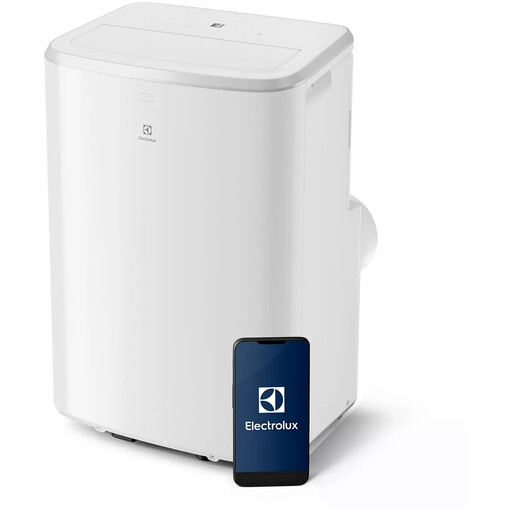
Why this model suits this profile: it combines cooling, heating, dehumidification and Wi-Fi connectivity in a portable appliance designed for a room advertised as measuring up to 30 m².
The inclusion of a drainage kit and scheduling of up to 24 hours make the conditions for everyday use clearer.
2.6 kW of capacity, 380 m³/h airflow, advertised dehumidification of 28 L/24 h and R290 refrigerant.
We have brought together an up-to-date selection of products designed to meet different cooling-capacity, installation and comfort requirements for homes in France.
Install the unit on a level surface, away from curtains and furniture. The exhaust hose should remain as straight as possible, without sharp bends or kinks. Before switching the unit on for the first time, allow it to stand if it was tilted during transport, following the instructions in the manual.
Clean the air filter regularly, for example every two weeks during periods of intensive use. Always unplug the unit before carrying out maintenance. Models using R290 contain flammable refrigerant: do not puncture the circuit and have any internal work carried out by a qualified professional.
Consumption depends on the capacity, operating time and insulation. Check the power draw in watts as well as the energy rating. The timer, night mode and a properly sealed window can reduce operating time, but they cannot provide an exact prediction of your electricity bill.
Yes, provided you can exhaust the hot air outdoors. In a bedroom, compare the measured noise level, activate night mode and schedule the unit to switch off. Avoid placing the appliance too close to the bed or blocking its ventilation grilles.
It varies depending on usage, maintenance and storage conditions. A clean filter, an unobstructed hose and drainage carried out in accordance with the manufacturer’s instructions all contribute to reliable operation. At the end of the season, store the unit in a dry place and keep the manual for future maintenance procedures.