
Livraison le jour même ou le lendemain

Qualité garantie

Débloquez vos offres de bienvenue: Livraison GRATUITE | Jusqu'à -80 % | 30 jours d'essai gratuits à JoyPlus
Téléchargez l'application
A portable air conditioner lets you cool a bedroom, home office or living room without committing to permanent installation work. It is particularly practical for renters, older properties or rooms used only during periods of extreme heat. However, keep in mind that performance can vary considerably from one model to another depending on the advertised output, noise level and installation requirements.
Here are the key criteria to consider before buying, along with a selection of models suited to different uses in France.
A 9000 BTU portable air conditioner will not necessarily provide the same level of comfort in every room. Insulation, sun exposure, ceiling height, the number of occupants and the presence of heat-generating appliances all play a decisive role.
A well-insulated 25 m² room will not respond in the same way as a south-facing living room of the same size. For a larger space, a 12000 BTU portable air conditioner may be more suitable, although the unit will generally be bulkier and potentially noisier.
A single-hose portable air conditioner must expel hot air outside through a hose. Without this exhaust, the heat removed from the room quickly returns to the home. An air conditioner with a window kit makes installation easier, but you must ensure that the system is compatible with your type of window: sliding, casement or tilt-and-turn.
The included kit does not always guarantee a perfect seal. Depending on the configuration, adding a draught-proofing seal can help reduce the amount of hot air entering the room.
Noise levels are measured in decibels, but readings can vary depending on the operating mode. A unit advertised at 49 or 51 dB in night mode will not necessarily remain at that level when running at full power. For a bedroom, check the stated noise level, whether a sleep mode is available and whether the unit can be programmed to switch off automatically.
The room sizes stated by manufacturers are commercial estimates. They should always be assessed alongside the actual configuration of the room. As a general guide:
Airflow, expressed in m³/h, complements the cooling capacity. A high airflow rate helps distribute cool air more effectively, but it cannot compensate for poor installation of the exhaust hose.
An air conditioner with dehumidifier can be particularly useful in a damp room or during especially humid, oppressive weather. However, this function is not a substitute for adequate ventilation. Also check whether the water tank needs to be emptied manually: automatic evaporation reduces maintenance in certain conditions, but the tank may still fill up when humidity levels are high.
A reversible air conditioner adds a heating function, which is useful during the transitional seasons. Compare the available heating output separately from the cooling capacity. This feature does not turn the unit into a primary heating system for the entire home.
The energy rating, EER and COP provide useful points of reference, but your electricity bill will depend primarily on how long the unit is used, the selected temperature and the insulation of your home. To estimate running costs, multiply the electrical power consumption in kW by the number of operating hours, then multiply the result by your electricity tariff.
Before placing your order, also check:
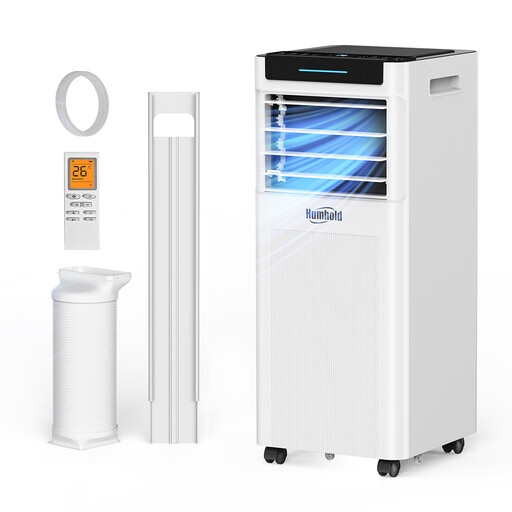
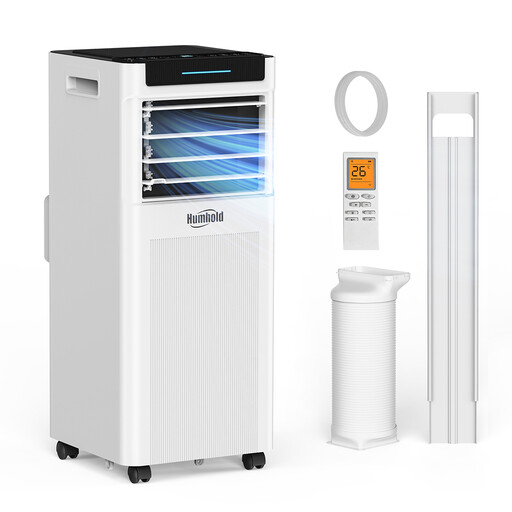
Why this model suits this profile: weighing 19.7 kg, it can be suitable for a bedroom, home office or room of up to 28 m², depending on the conditions of use.
The window kit is included, and night mode is rated below 49 dB. The product information also specifies the draining procedure when the tank is full.
7000 BTU cooling capacity, three modes, 24-hour timer, washable filter and R290 refrigerant.
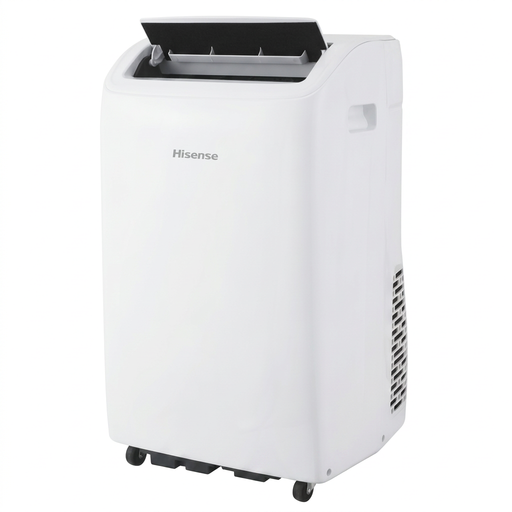
Why this model suits this profile: its 2.6 kW output and wheeled design make it suitable for a living room, bedroom or workspace of approximately 30 m², depending on the environment.
The specifications state the noise level in night mode, the timer settings and the sealing kit included. The automatic evaporation system reduces the need for draining when humidity remains within normal levels.
9000 BTU, three modes, three fan speeds, washable filter, remote control and temperature adjustment from 16 to 32 °C.
Why this model suits this profile: its Wi-Fi connectivity and automatic modes are designed for users who want to control the temperature remotely.
The product information makes clear that the exhaust hose remains essential, despite the portable format without an outdoor unit. Connectivity does not eliminate the installation requirements.
Wi-Fi, advertised voice control, 2.4 kW heating output, 24-hour timer and a minimum advertised noise level of 50 dB.
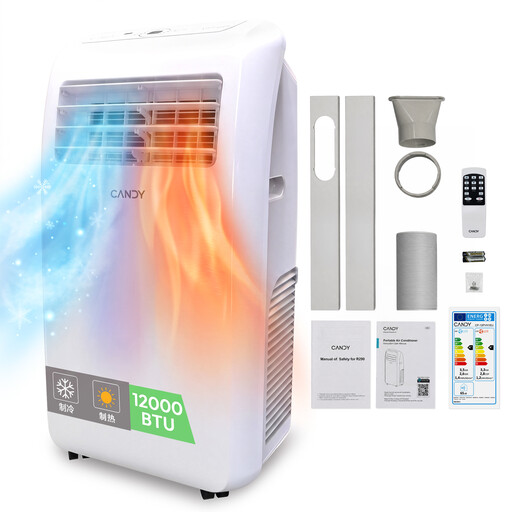
Why this model suits this profile: its 3.5 kW cooling capacity is rated for rooms of up to 35 m², with a heating function for cooler periods.
The cooling capacity, airflow of 400 m³/h and dimensions are clearly detailed. However, you must allow for 51 cm of clearance around the unit, in line with the supplied instructions.
Four modes, advertised A+ energy rating for both cooling and heating, dehumidification of up to 33.6 litres per day, 24-hour timer and included window kit.
We have brought together an up-to-date selection of products suited to different installation requirements and usage needs in France.
Install the unit on a level surface near a window, avoiding sharp bends in the hose. Follow the clearance requirements stated in the instructions and never block the air intake or outlet grilles.
Clean the filter at the recommended intervals, often every two weeks when the unit is used regularly. After transport, some appliances must remain upright for several hours before being switched on for the first time. Always consult the manual for your chosen model.
It depends on the unit’s electrical power, the selected temperature and how long it runs. An appliance with an A or A+ energy rating may consume different amounts depending on the mode used. Compare the power consumption in watts rather than relying solely on the term “low energy consumption”.
A conventional single-hose portable air conditioner must expel hot air outside. Products marketed as “hose-free” often rely on different technology and should not be confused with a standard portable air conditioner fitted with an exhaust hose. Before ordering, check the technology used, the manual and the operating requirements.
Operating time depends on the model, its maintenance and ambient humidity. Automatic evaporation can reduce the need to drain the tank in cooling mode, but the tank may still eventually fill up. A clean filter, unobstructed exhaust and correct installation all contribute to reliable operation.