
Livraison le jour même ou le lendemain

Qualité garantie

Débloquez vos offres de bienvenue: Livraison GRATUITE | Jusqu'à -80 % | 30 jours d'essai gratuits à JoyPlus
Téléchargez l'application
With summers getting more and more scorching, the portable air conditioner has become the go-to solution for finding some cool relief at home or in the office. The problem: the market is flooded with options, marketing claims can be misleading, and it's easy to make the wrong choice. An undersized unit, a device that's too noisy, or a simple "air cooler" sold as an air conditioner... disappointment is common.
As a product expert for Joybuy, my mission is to help you make sense of it all. This guide gets straight to the point: we'll decode the spec sheets so you can choose a truly effective unit that's right for your needs and, most importantly, avoid the marketing traps.
Before you even start comparing spec sheets, let's review the classic mistakes that lead straight to disappointment.
To make an informed choice, three technical criteria are non-negotiable. These are what determine the real performance and user comfort of your future supplemental air conditioner.
The BTU (British Thermal Unit) is the unit that measures an air conditioner's cooling capacity. The higher this number, the larger the area the unit can cool. Here are a few benchmarks to guide you:
Properly sizing the power is therefore the first step to ensuring the unit's effectiveness without sending your electricity bill through the roof.
Noise is the Achilles' heel of the portable air conditioner. This information is always listed on the energy label in decibels (dB).
Pay close attention to mentions of "night mode" or "sleep mode": check the specific decibel value for that mode, as it's often the only one that's truly bearable for sleeping.
Today, many models do more than just cool the air. A 3-in-1 air conditioner offers very practical additional modes:
This versatility transforms a purely seasonal purchase into a device that's useful for a good part of the year.
Here are a few options that cater to different user profiles, taking into account performance and practicality criteria.
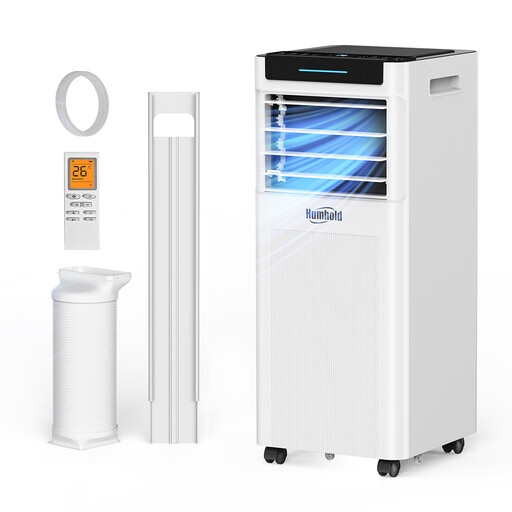
Why we recommend it: Perfect for renters or apartment owners who want to effectively cool a bedroom or office (up to 28 m? according to the manufacturer). Its compact size and manageable weight make it easy to move and store in the off-season.
With its 7000 BTU, it delivers real, well-calibrated cooling power for small rooms, avoiding the trap of being undersized. Its night mode, rated at less than 49 dB, is an objective and reassuring figure for nighttime use.
Its 3-in-1 versatility (cool, dehumidify, fan) and its self-evaporating system that eliminates the constant chore of emptying the water tank.
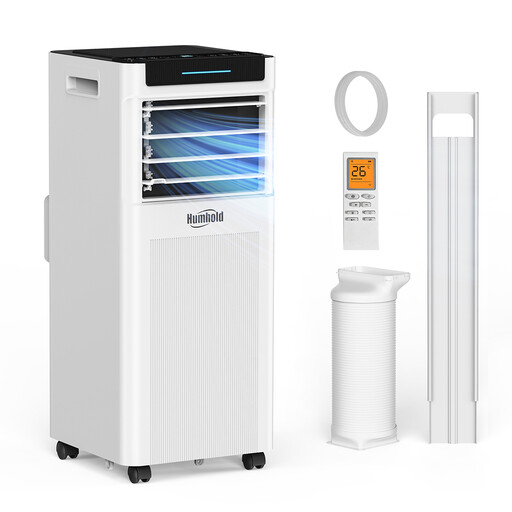
Why we recommend it: Designed for those who want to cool more generous spaces like a living room or a large bedroom (up to 30 m?). It has a comfortable power reserve to tackle heatwaves without faltering.
Its 9000 BTU ensures it has enough performance for living areas, where a 7000 BTU unit would struggle. We are clearly talking about a real air conditioner here, not just an air cooler.
Its high dehumidification capacity (28 L/day) is a major asset, as is its 24-hour timer, perfect for programming it to cool before you get home. The washable filter makes maintenance much simpler.
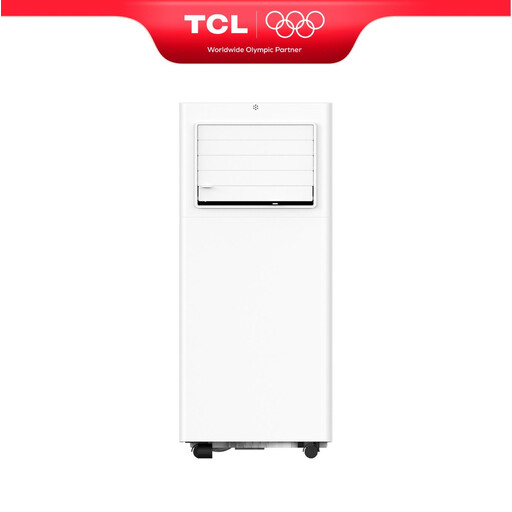
Why we recommend it: For those who prefer to turn to a recognized brand for a simple and effective solution. Its 9000 BTU power makes it versatile, and its "Sleep" mode is specifically designed for nighttime comfort.
It's a true 3-in-1 air conditioner, which removes any ambiguity with simple coolers. Its "Sleep" mode adjusts the temperature in increments, offering a much better comfort/noise trade-off than basic "silent" modes.
Installation is made easy with the included window kit, and maintenance is a breeze thanks to the washable dust filter. The 24-hour timer remains a valuable ally for controlling energy consumption.
Discover our complete and up-to-date selection of products that meet our selection criteria and current safety standards.
Yes, but the frequency depends on the model and the humidity level. The warm, humid air from the room condenses into water when it comes into contact with the unit's cold coil. Most recent models include a self-evaporation system: they reuse this water to cool their own components before expelling it with the hot air through the exhaust hose. In standard cooling mode with normal humidity, it's rare to have to empty the tank. However, if you use the dehumidification mode intensively, manual draining (or a permanent connection via the provided drainage hose) becomes necessary.
Consumption depends on its power (BTU), its energy class (often A for this type of device), and, of course, how you use it. To give you an idea, a 9000 BTU model (which is about 2600?W of cooling power) generally consumes around 1000?W of electricity (1?kWh) per hour of operation at full power. To control your bill, it's best to use the timer to cool the room in advance and aim for a reasonable target temperature (24-25?°C), rather than trying to turn your living room into a walk-in freezer.
No, the installation is designed to be very simple and generally requires no tools. It consists of: