
Livraison le jour même ou le lendemain

Qualité garantie

Débloquez vos offres de bienvenue: Livraison GRATUITE | Jusqu'à -80 % | 30 jours d'essai gratuits à JoyPlus
Téléchargez l'application
Summer is here, and with it, the heatwaves that turn our homes into virtual ovens. For renters or homeowners who can't or don't want to undertake major renovations, the portable air conditioner is the go-to solution. Easy to install and move, it promises immediate cooling. But be warned: the market is saturated with models making vague promises, and it's easy to get lost.
As a Product Recommendation Manager at Joybuy, my mission is to help you see things more clearly. Let's cut through the marketing jargon and get straight to the point so you can make a truly informed purchase. This guide breaks down the common pitfalls and gives you the keys to choosing a unit that will deliver on its promises.
Marketing can be misleading. Some selling points hide flaws that could make you regret your purchase. Here are the three most common mistakes.
This is the number one trap. A true air conditioner works on a simple principle: it captures warm air from the room and expels it outside. This process requires, without exception, an exhaust hose. Units sold as "ventless portable air conditioners" are actually evaporative air coolers. Their technique? Water evaporation, which merely humidifies the ambient air for a very limited cooling sensation. Worse, they become completely ineffective, or even counterproductive, if the air is already humid. To actually lower the temperature, an exhaust hose isn't an option—it's a requirement.
A unit marketed as "quiet" can actually be loud enough to disrupt your sleep or prevent you from concentrating. The noise level, expressed in decibels (dB), is therefore a criterion you should never overlook.
To find a quiet portable air conditioner, pay close attention to the noise level listed for night mode or the lowest fan speed.
Buying an undersized unit is a costly mistake. It will run constantly without ever reaching the desired temperature. The result: your electricity bill will skyrocket. Conversely, an oversized model will cool the room very quickly, but its constant on/off cycles are uncomfortable and cause premature wear on the compressor. Power is expressed in BTU (British Thermal Unit).
To ensure you make the right decision, focus on these three objective technical specifications.
Power is the number one criterion. It must be perfectly matched to the room's size. Here are some simple guidelines to help you:
Also consider reversible portable air conditioner models if you need supplemental heating for the shoulder seasons.
Let's be honest: an air conditioner is an energy-intensive appliance. Opting for a Class A or higher (A+) portable air conditioner isn't a luxury; it's essential for keeping your budget in check. The energy label, mandatory on all units, informs you of the estimated annual consumption and the Energy Efficiency Ratio (EER for cooling). A good EER means the unit produces more cooling for every watt consumed.
The effectiveness of your portable AC depends directly on the quality of its installation. Most models come with a kit for sliding windows, which is often unsuitable for the casement windows common in Europe.
Rather than drowning you in an endless list of products, we've matched relevant models to user profiles to help you find the one that's right for you.
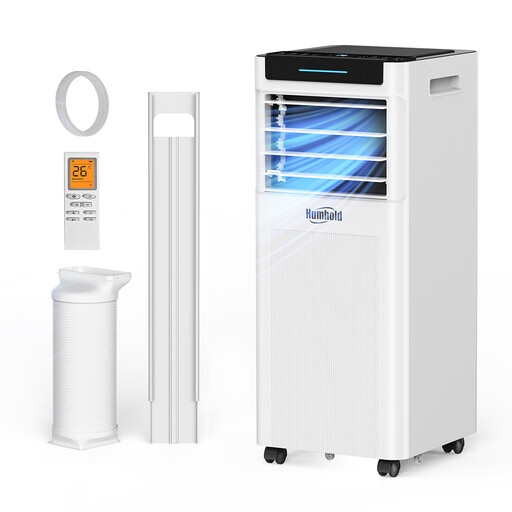
Why this model? Perfect for a bedroom, office, or small living room up to 28 m? (approx. 300 sq ft). Its compact design and low weight (19.7 kg) make it especially portable. It's the quintessential effective and affordable supplemental cooling solution.
It features a dedicated night mode that operates below 49 dB, a major asset against noise disturbance. Its 7000 BTU power rating is clearly stated for a suitable area, avoiding the trap of being undersized for small rooms.
Its auto-evaporation system means you don't have to empty the condensate tray (except in extreme humidity), which greatly simplifies daily use.
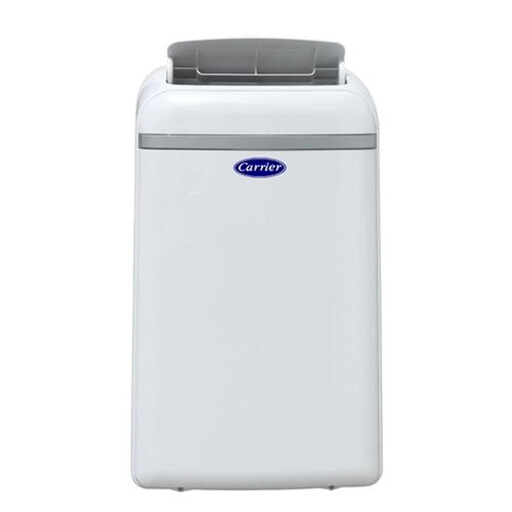
Why this model? For those looking for an all-in-one solution. Thanks to its heat pump, it cools in the summer and heats in the winter. It's an investment that pays off year-round for a living space up to 23 m? (approx. 250 sq ft).
Its 12,000 BTU (3.5 kW) power is well-calibrated for the recommended area. Its A for cooling and A+ for heating energy ratings ensure controlled consumption, a crucial detail often overlooked in reversible models.
Its reversible (heat pump) function turns it into a 4-in-1 appliance (cool, heat, dehumidify, fan), making it useful in any season and ensuring the purchase pays for itself over the long term.
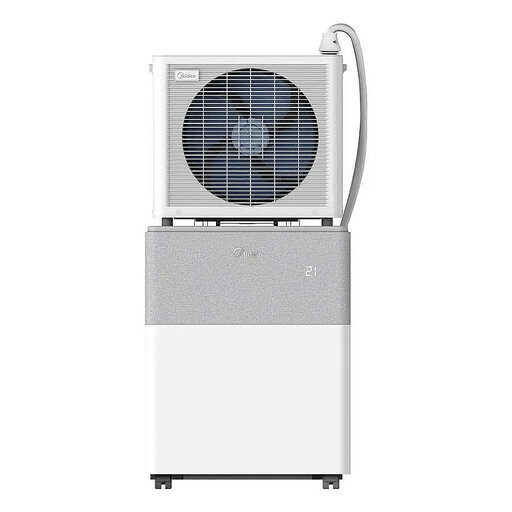
Why this model? For those who demand the power of a fixed split system without sacrificing the flexibility of a portable unit. It's the ideal solution for large spaces (up to 40 m? / 430 sq ft) and for noise-sensitive users, as the compressor (the loudest component) is located outside.
It tackles the noise problem at its source: by moving the compressor outside, the indoor noise level drops to 39 dB(A) in quiet mode. Its 12,000 BTU power is suitable for large areas, preventing a lack of efficiency in a large living room.
Its 'split' architecture gives it an energy efficiency (SEER 6.1) and an indoor quietness that are simply out of reach for a conventional monobloc air conditioner. A dedicated installation service is available.
We have compiled a complete, up-to-date list of products that meet these strict selection criteria and current regulations.
With regular maintenance, a portable air conditioner has a lifespan of 5 to 10 years. Maintenance mainly consists of cleaning the filters every two weeks during use and storing the unit upright in a dry place during the off-season. The availability of spare parts, as offered by Electrolux for some models, can also extend its longevity.
The cost depends on the unit's power (in kW), its energy class, the duration of use, and your electricity price. For a simple estimate: a 1?kW (1000?W) unit running for one hour consumes 1?kWh. With an average kWh price of $0.25, this amounts to $0.25 per hour of use. Choosing a Class A or A+ portable air conditioner is the most effective way to limit this expense.
Yes, on two conditions: that it is correctly sized for the room and properly installed. Its entire effectiveness relies on exhausting the hot air outside. Using a window sealing kit is highly recommended to prevent hot air from re-entering and to ensure the unit is cooling the room instead of just circulating air. Its cooling power is far superior to that of a fan or an evaporative air cooler.