
Livraison le jour même ou le lendemain

Qualité garantie

Débloquez vos offres de bienvenue: Livraison GRATUITE | Jusqu'à -80 % | 30 jours d'essai gratuits à JoyPlus
Téléchargez l'application
A portable air conditioner allows you to cool a bedroom, home office or living room without building work or a fixed installation. It is a particularly practical solution for tenants, students and anyone who wants to move their appliance from one room to another. However, product specifications do not always tell the whole story.
Before placing your order, check three points that are often overlooked: the power you actually need, how the hot air is vented and the noise level. A promise of “rapid cooling” will not work miracles if the appliance is undersized, the window kit is incompatible or the noise becomes unbearable at night.
A 12000 BTU portable air conditioner is not automatically suitable for every room. Ceiling height, sun exposure, the quality of the insulation and the number of occupants can significantly affect your requirements. Conversely, a 7000 BTU portable air conditioner may be perfectly adequate for a small bedroom or home office, but it may struggle in a large, highly exposed room.
A portable air conditioner generally operates with an exhaust hose. If this does not lead outside, the heat removed from the room will immediately return to it. The window kit therefore deserves your full attention before ordering. Check that it is compatible with your window, whether it slides vertically or horizontally, and make sure there is enough space around the appliance.
Night mode, a remote control and a timer make the appliance easier to use, but they will not make compressor noise disappear. To choose a quiet air conditioner, compare the stated noise level in decibels and check which mode was used to measure it. Energy consumption also depends on how long the appliance runs, the selected temperature and the room’s insulation.
The area stated by the manufacturer is a useful reference point, not a guarantee that applies to every home. Here are a few basic comparisons:
In an attic room, a room with a lot of glazing or a poorly insulated space, it is better to take these factors into account than to rely blindly on the stated room size.
A 3-in-1 air conditioner generally combines cooling, fan and dehumidifying functions. The latter can be useful in a damp room, but it does not replace proper ventilation. Some models feature an automatic evaporation system, which allows some of the water to be expelled through the hose. However, if humidity is high or you use dehumidification for a long period, manual draining may still be necessary.
When choosing an air conditioner with a dehumidifier, also check the stated amount of water extracted, whether a drainage hose is included and how easy the tank is to access.
Noise level is an essential consideration in a bedroom or home-working space. The Humhold models featured below state a sleep mode below 49 dB or 51 dB, depending on the version. These figures are declared by the manufacturer; in practice, perceived noise varies according to the room, the installation and your distance from the appliance.
An A+ energy rating can help limit energy consumption, but your electricity bill also depends on how many hours the appliance is used. R290 is a refrigerant used in some portable air conditioners. Never pierce the circuit or modify the hose. Also ensure the appliance is properly earthed, avoid using extension leads and leave the clearances specified in the manual.
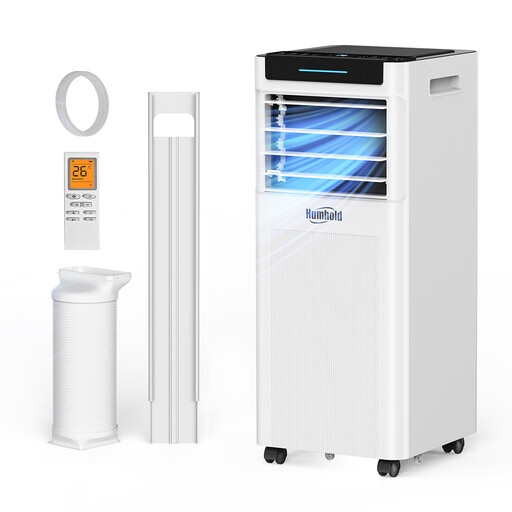
Why it suits this profile : With its stated 2.0 kW output, this model is suitable for bedrooms, home offices and spaces of up to 28 m² according to its technical specifications. Weighing 19.7 kg and fitted with castors, it can be moved easily from one room to another.
The power output is clearly stated and the window kit is included. The sleep mode, advertised below 49 dB, also provides a useful benchmark for assessing acoustic comfort.
Three modes, 24-hour timer, remote control, washable filter and R290 refrigerant.
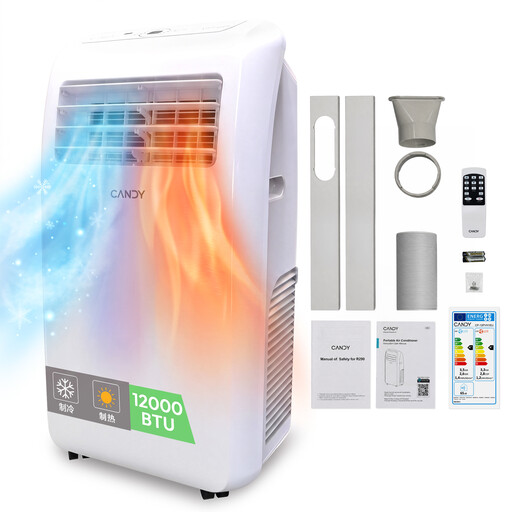
Why it suits this profile : This model combines cooling, heating, fan and dehumidifying functions. Its 3.5 kW output is advertised for rooms of up to 35 m², while its heating function is stated to cover up to 25 m².
The covered area, 400 m³/h airflow rate and included window kit are clearly specified, making it easier to compare models before buying.
Stated A+ energy rating, 24-hour timer, remote control, R290 refrigerant and four modes.
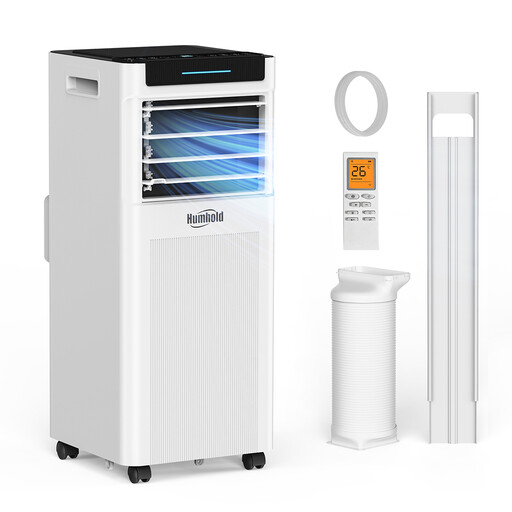
Why it suits this profile : With its 2.6 kW output and stated coverage of up to 30 m², it is aimed at home offices, bedrooms and medium-sized living rooms used regularly.
The stated noise level below 51 dB, window kit and 24-hour timer meet the demands of daily use, without overlooking installation-related limitations.
Three modes, dehumidification of up to 28 L/day, remote control and washable filter.
We have put together a complete, real-time-updated list of products that meet these demanding selection criteria and European safety requirements.
Place the air conditioner on a stable floor, approximately 50 cm away from walls and obstacles, following the recommendations specific to your model. Keep the hose as straight as possible, avoiding sharp bends. Use an earthed socket and avoid extension leads or multi-socket adapters if the manufacturer advises against them.
Clean the filter regularly: during periods of heavy use, servicing every two weeks may be recommended. If the appliance has been transported at an angle, wait for the period specified by the manufacturer before switching it on for the first time. Always unplug the air conditioner before cleaning it.
For this floor area, generally compare 9000 and 12000 BTU models. A 9000 BTU appliance may be suitable for up to 30 m², depending on the stated conditions, while a 12000 BTU model is specified for up to 35 m². However, insulation and exposure to sunlight remain decisive factors.
Consumption depends on the appliance’s power, the selected setting, how long it is used and the outdoor temperature. The 24-hour timer helps prevent unnecessary running periods. Check the power input and energy rating shown on the product page and label.
The appliance can operate, but hot air must be expelled outside for cooling to be genuinely effective. An air conditioner with a window kit makes installation easier. Check that the supplied system is compatible with your type of window and ensure the hose remains completely unobstructed.