
Livraison le jour même ou le lendemain

Qualité garantie

Débloquez vos offres de bienvenue: Livraison GRATUITE | Jusqu'à -80 % | 30 jours d'essai gratuits à JoyPlus
Téléchargez l'application
When the heat sets in at home, in the office or in the bedroom, a portable air conditioner can seem like the simplest alternative to a fixed installation. It’s easy to move, usually requires no permanent building work and is therefore particularly well suited to renters. However, the biggest disappointments rarely come down to price alone. They’re often caused by choosing the wrong capacity or misinterpreting the specifications.
Here are the pitfalls to avoid and the features to check before buying a portable air conditioner that’s right for your home.
A 9,000 BTU portable air conditioner won’t necessarily perform the same way in every room. Sun exposure, ceiling height, insulation quality and the number of people using the room can all have a significant effect on the cooling demand.
So, a claim such as ‘up to 30 m²’ should be treated as a rough guide, not a guarantee. In a room that gets a lot of sun or is poorly insulated, it’s best to allow a little extra capacity. Conversely, an oversized unit in a small bedroom may switch on and off frequently, making the temperature less stable and comfort less consistent.
Even if it’s described as quiet, a portable air conditioner still has a compressor and a fan. The best approach is to compare the noise level in decibels, checking which operating mode the figure applies to. A stated rating of 49, 51 or 53 dB may not apply to every setting.
For a bedroom or home office, look for a night mode and a timer, and position the unit far enough from your bed or desk. Make sure the exhaust hose is fitted correctly, without any sharp bends that could restrict airflow.
A portable air conditioner with a window kit needs to expel hot air outside. Without a suitable panel or seal, some of that hot air may flow back into the room and significantly reduce cooling efficiency.
Check that the kit is compatible with your window, whether it’s sliding, tilt-and-turn or an unusual design. If the supplied kit doesn’t cover the full width, an extra draught seal may come in handy.
For a small bedroom, home office or room measuring 15 to 25 m², a 7,000 BTU portable air conditioner can be a practical choice. Models rated at 9,000 BTU, delivering around 2.6 kW, are generally suitable for rooms advertised as up to 30 or 33 m², depending on the manufacturer and conditions of use.
A 12,000 BTU portable air conditioner, often rated at around 3.5 kW, is better suited to larger rooms. The Midea PortaSplit, for example, is advertised for spaces of up to 42 m². However, consider its two-unit design and weight before you buy.
A 3-in-1 unit usually combines:
An air conditioner with a dehumidifier can be useful in a damp room, but take the time to check the stated capacity in litres per day and the drainage system. In dehumidifying mode, the tank may fill more quickly.
A portable air conditioner with heating adds a heating function. This can be handy in spring and autumn, but it’s worth assessing the feature separately: heating capacity, electricity consumption and noise levels may differ from those in cooling mode.
Choose a model that’s compatible with the French electrical supply, generally 220-240 V, 50 Hz. Some units designed for camping or vehicles run on 110 V and can’t be plugged straight into a standard French socket without suitable electrical equipment.
For safe and effective use:
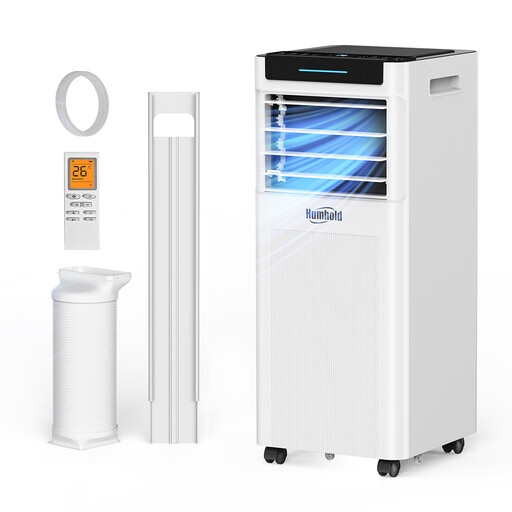
Why this model suits you: With 2.0 kW of capacity, a window kit, castors and cooling, fan and dehumidifying functions, it’s a good choice for smaller rooms and a first-time purchase.
Its capacity is matched to a recommended room size of 28 m², and an exhaust kit is included, so you won’t need to buy lots of extra parts.
Night mode rated below 49 dB, 24-hour timer, remote control and washable filter.
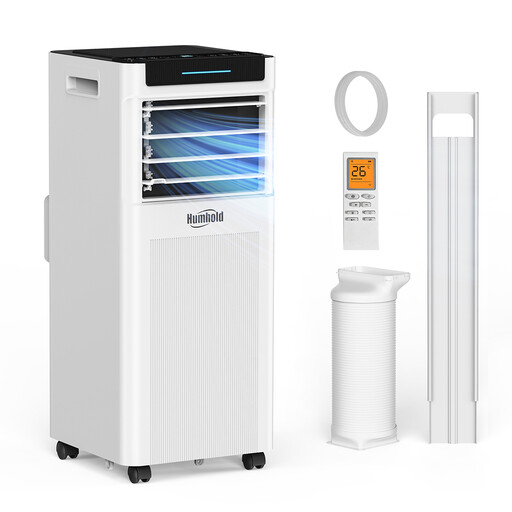
Why this model suits you: With 2.6 kW of capacity and a recommended room size of up to 30 m², it’s a good fit for a small living room, a spacious bedroom or a sun-facing home office.
The window kit, exhaust hose and self-evaporating system make installation easier and help reduce the hassle of managing water.
Night mode rated below 51 dB, dehumidifies up to 28 L/day and comes with a remote control.
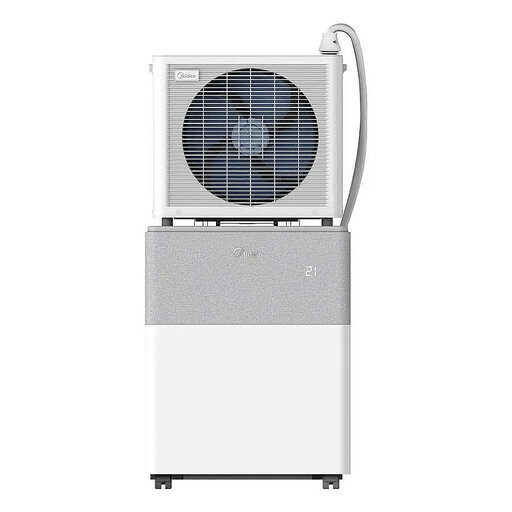
Why this model suits you: Its portable split design, heating and cooling functions, and app control make it a great option if you’re looking for extra versatility.
The product details set out the dimensions and weight of both units, as well as the stated noise level of 39 to 59 dB(A), helping you plan the installation more easily.
12,000 BTU capacity, heat pump, quiet mode, Wi-Fi and a recommended room size of up to 42 m².
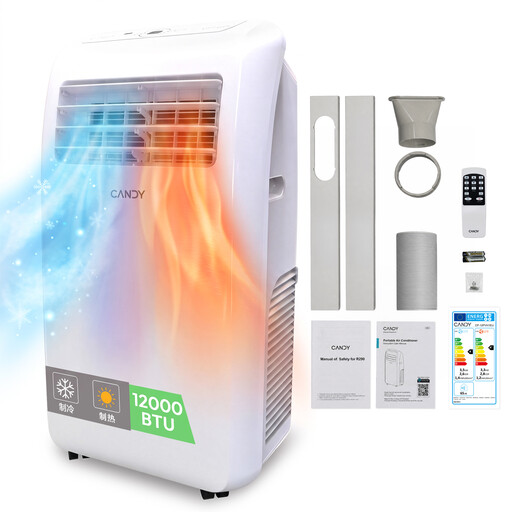
Why this model suits you: This portable air conditioner with heating is ideal if you want one unit to cool, dehumidify, ventilate and heat your home.
The specifications clearly distinguish cooling and heating capacities, as well as the stated energy consumption, rather than rolling everything into a single claim.
12,000 BTU, 3.3 kW heating capacity, stated airflow of 400 m³/h, 24-hour timer and window kit included.
We’ve selected a complete range of products, updated in real time, that meet these exacting criteria and European safety standards.
Place the unit near a window on a stable floor, then connect the hose to the exhaust kit. Keep gaps around the panel or seal to a minimum. Hot air must be vented outside, and the hose shouldn’t be sharply bent.
It depends on the unit’s capacity, how long you use it, the selected setting and the room’s insulation. For a quick estimate, multiply the electrical power in kW by the number of hours of use, then by your energy tariff. A timer and a sensible temperature setting can help prevent the unit from running for longer than necessary.
Lifespan varies according to build quality, maintenance and how often you use the unit. Clean the filter as directed in the instructions, keep the grilles clear, store the unit upright and follow the guidance on R290 refrigerant. If the refrigeration circuit develops a fault, contact a qualified professional rather than opening the unit yourself.