
Livraison le jour même ou le lendemain

Qualité garantie

Débloquez vos offres de bienvenue: Livraison GRATUITE | Jusqu'à -80 % | 30 jours d'essai gratuits à JoyPlus
Téléchargez l'application
Getting a flat tire far from any service station is every driver's nightmare. To avoid calling a tow truck, the portable air compressor is the essential accessory for peace of mind on the road. The problem?is that the market is flooded with models making tempting promises that often fall flat.
As a product specialist at Joybuy, my mission is to guide you through this jungle. Let's forget the marketing jargon! Together, we'll break down the common pitfalls and focus on the real criteria that matter for finding a reliable device that's truly suited to your needs, whether you drive a car, ride a motorcycle, or a bike.
Marketers love to highlight impressive numbers. But in the real world, it's often the technical details (or lack thereof) that render a device completely useless when you need it most.
To avoid being misled, here are the technical characteristics you should really focus on.
The choice depends entirely on your use case.
Forget maximum pressure; the real game-changer is airflow. An airflow rate of at least 15-20 L/min is the bare minimum for inflating a car tire without spending all afternoon on it. For a portable compressor intended for an SUV, aim for 30 L/min or more.
The auto-shutoff feature is a must-have. You preset the desired pressure on the screen, and the compressor stops automatically once the target is reached. No more risk of over-inflation, and you can even do something else while it works.
Rather than an endless list, here are three models that check all the right boxes for specific profiles, avoiding the pitfalls we've just discussed.
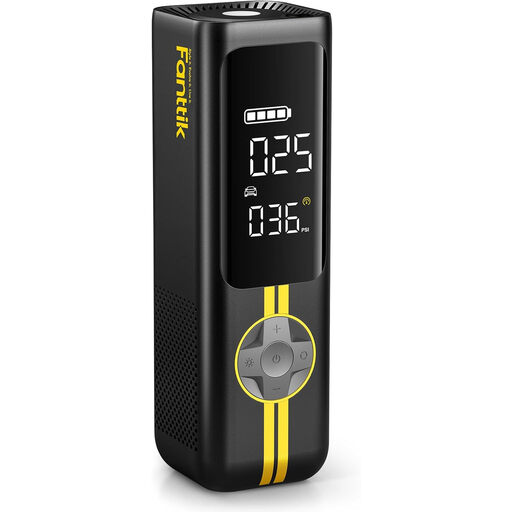
Best for : The driver who wants a high-performance, versatile device. Its speed and endurance make it a trusted ally for both routine maintenance and emergencies, with the bonus of handy features (light, power bank).
It sidesteps the slowness trap. Its spec sheet makes its intentions clear with a record-breaking inflation time and an efficient cooling system that allows it to handle multiple inflations without overheating or requiring a cooldown period.
Speed and endurance : Designed for fast, back-to-back inflations. 4-in-1 versatility : Inflator, LED light, power bank, and preset modes.
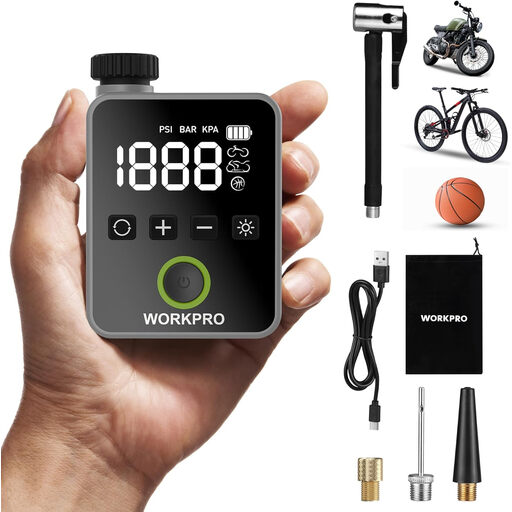
Best for : For cyclists and motorcyclists, every ounce counts. This model is designed to fit anywhere, in a backpack or saddlebag. It's the perfect emergency solution for a motorcycle or bicycle tire pump, without sacrificing the essentials.
It doesn't try to compete with heavy-duty models. Its number one selling point is its pocket-sized design (270g), which avoids the trap of devices that are called "portable" but are far too bulky for true on-the-go use on two wheels.
Ultra-portable : Lightweight and compact, it truly fits anywhere. Survival kit : It includes an LED light with an SOS mode and a power bank function.
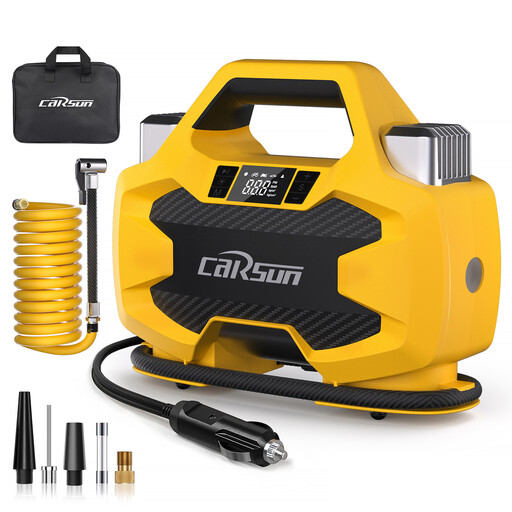
Best for : The tires on SUVs, vans, or RVs require a large volume of air. This corded 12V compressor is built for raw power. Its dual-cylinder design ensures a high airflow rate, capable of tackling the most demanding tires with ease.
It skips the battery and its limitations, relying entirely on a dependable 12V power source. There are no compromises here: the design is focused on pure power (dual cylinder), not miniaturization. This is exactly what's needed for large tires.
XXL Power : Its dual cylinder provides massive airflow, ideal for high-volume tires. Flawless Power Supply : The 12V connection guarantees constant power, so you never have to worry about a dead battery.
Explore our full selection of compressors that meet our strict requirements for performance and safety.
That's an excellent question. The answer is no, on one condition?: always start your car's engine before plugging in and using the 12V compressor. With the engine on, the alternator supplies the power, thereby protecting your battery.
A lithium-ion battery's life is measured in charge cycles. A quality model will retain a significant portion of its original capacity even after several hundred cycles. To make it last as long as possible, follow a few golden rules?: avoid fully discharging it to 0% and don't store it in extreme conditions (e.g., in direct sunlight inside a car during summer).
Be careful, the correct pressure is not the one written on the tire's sidewall (that's the maximum pressure it can handle)?! The only pressure that matters is the one recommended by your vehicle's manufacturer. You can find it on a sticker in the driver's side doorjamb, on the fuel door, or, of course, in the vehicle's owner's manual. It is indicated in Bar and/or PSI.