
Livraison le jour même ou le lendemain

Qualité garantie

Débloquez vos offres de bienvenue: Livraison GRATUITE | Jusqu'à -80 % | 30 jours d'essai gratuits à JoyPlus
Téléchargez l'application
Driving on an underinflated tire isn't just a minor inconvenience?— it's a real threat to your safety, not to mention a skyrocketing fuel bill. Keeping a portable air compressor in your trunk is therefore the ideal solution. The catch? The market is flooded with models making tempting promises that often turn out to be useless gadgets in practice. My job as a product expert at Joybuy is to navigate this jungle for you and help you make the right choice.
Before you make a purchase, keep an eye out for these three classic pitfalls that can turn a good idea into a case of buyer's remorse:
Knowing how to spot these flaws is the first step toward a smart purchase.
To make the right choice, forget the marketing hype and focus on the spec sheet. That's where you'll find the difference between a gadget and a reliable ally for your car tire inflator.
This is the first decision to make, as it completely dictates how you'll use your compressor.
Forget everything else; these two numbers are the true engine of your electric air pump.
Beyond raw power, certain features can turn a chore into a simple formality:
Instead of an endless catalogue, we've selected models that meet specific needs and avoid the pitfalls we've just described.
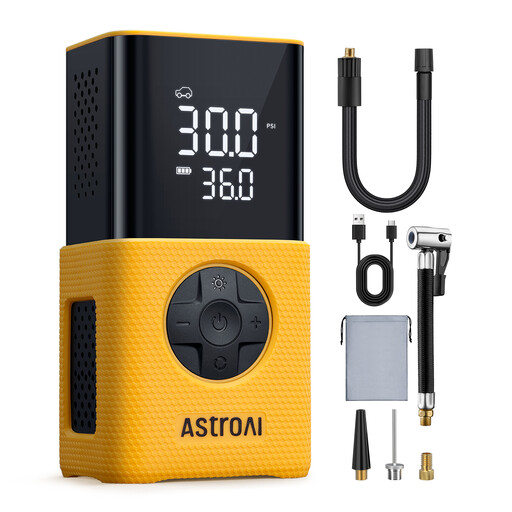
Why we recommend it: For the driver who wants a reliable and fast cordless tool for both monthly maintenance and roadside emergencies. Its 4000 mAh battery and auto-shutoff feature make it a trusted ally.
It tackles the unreliable gauge trap with pressure sensors advertised as highly accurate. As for battery life, it can top up several tires (up to 8, according to the brand), preventing you from running out of juice mid-task.
Its excellent balance. It's compact, reasonably fast (17 L/min), and packed with useful features (preset modes, auto-shutoff, power bank).
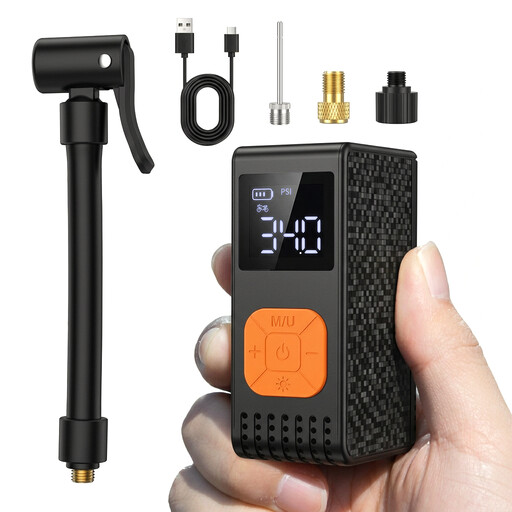
Why we recommend it: For two-wheeled adventurers where every gram counts. It's ultra-compact, slips into a pannier or backpack, and you'll forget it's there... until you need it.
Its positioning is clear and honest: it's not made for an SUV. Its 1600 mAh battery and dedicated modes are calibrated for motorcycle or bicycle tires. No false promises, no disappointment.
Its extreme compactness (8.5 cm tall) and feather-light weight. It's a flyweight that you'll completely forget is in your bag.
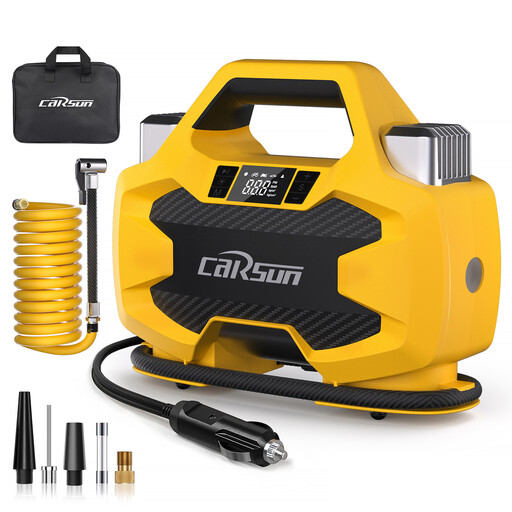
Why we recommend it: For those who drive large vehicles (SUVs, vans, commercial trucks) and whose tires demand power and high airflow. This 12V corded model is built for power and endurance.
It demolishes the slowness trap. Its dual-cylinder design ensures high airflow, drastically reducing inflation time for large tires. Being corded, there's no battery anxiety: it will go the distance.
Its raw power, dedicated to heavy vehicles. It succeeds where most compact compressors throw in the towel: quickly and reliably inflating an SUV or van tire without faltering.
Explore our full selection of tested and approved compressors, all of which meet our demanding specifications.
The 12V compressor (corded) is a marathon runner: as long as the engine is running, it delivers constant power, ideal for large tires or long inflation jobs. The battery-powered model (cordless) is a versatile sprinter: it's ultra-convenient and goes everywhere with you (bike, air mattress...), but you have to keep an eye on its battery level.
It all depends on the airflow (L/min) and the size of the tire. With a high-performance model (over 25 L/min), expect it to take 4 to 6 minutes to inflate a standard tire from 0 to 2.5 bar. With a more compact model (around 20 L/min), plan on 7 to 10 minutes. For a simple top-up, the job is done in under two minutes.
In theory, digital wins. A quality inflator with a digital gauge offers a more precise and readable display. Most importantly, it enables the auto-shutoff function, which is a major advantage. But be warned: its reliability depends on the quality of its sensors. A well-made, old-fashioned analog (mechanical) gauge can be just as accurate, even if it's less convenient to read at night.