
Livraison le jour même ou le lendemain

Qualité garantie

Débloquez vos offres de bienvenue: Livraison GRATUITE | Jusqu'à -80 % | 30 jours d'essai gratuits à JoyPlus
Téléchargez l'application
A flat or underinflated tyre at the worst possible moment can turn your daily commute into a nightmare. The portable air compressor has become the essential accessory to keep in your car's trunk, your motorcycle's pannier, or your cycling backpack. However, the market is saturated with models making tempting promises that don't always hold up.
But before you make a purchase, it's best to understand the marketing traps that too often lead to buyer's remorse. As the head of product selections at Joybuy, I'm here to help you see things more clearly.
The 3 Traps to Avoid When Buying a Tyre Inflator:
To make the right choice, focus on the features that truly matter for everyday use. Here are the three points you absolutely must check.
Don't be blinded by maximum pressure alone. For a portable car compressor, aim for an airflow rate of at least 20 L/min to ensure inflation doesn't take forever. The pressure, expressed in Bar or PSI (1 Bar ≈ 14.5 PSI), must be sufficient for your needs. A passenger car typically requires between 2.2 and 2.8 bar (32-40 PSI). A device that can reach 7-8 bar (around 100-120 PSI) is therefore more than enough for most uses (car, motorcycle, bike).
The choice will depend on your primary use case:
Modern features aren't just gimmicks: they simplify use and enhance your safety. Look for these two essentials:
There's an ideal compressor for every user. Here is our selection, designed for different profiles and based on our performance and reliability criteria.
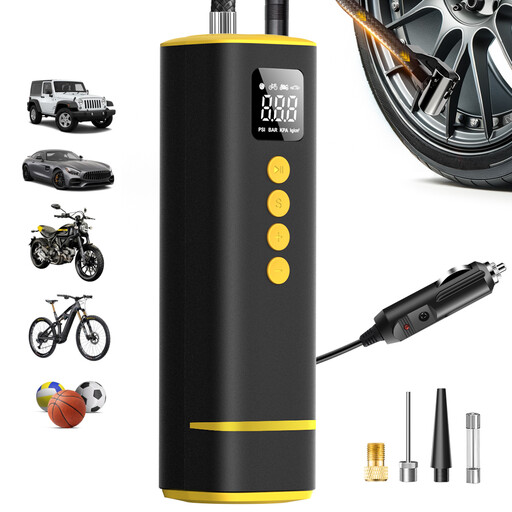
Why we recommend it: For the driver who wants a simple, reliable solution to keep in the glove box for emergencies. No battery to charge—just plug it into the 12V socket.
It eliminates the battery life problem. As long as your car can start, the compressor is ready to go.
The reliability of its 12V power source and its ease of use. Its long cable easily reaches all four of the car's tyres.
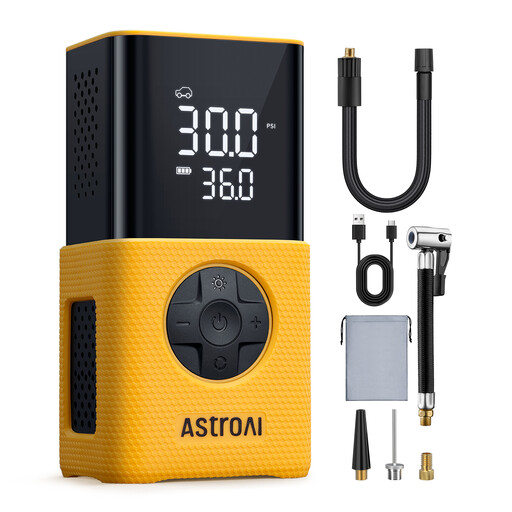
Why we recommend it: Weighing just 460 grams, it's designed for those seeking an ultra-compact solution to slip into a backpack or pannier. Perfect as an electric bike pump or for topping up a motorcycle tyre.
It bypasses the inaccurate gauge trap with sensors that, according to AstroAI, ensure a highly accurate reading. Its 17 L/min flow rate is consistent with its pocket-sized format.
Its extreme portability and bonus features (LED light, power bank). Its 4000 mAh battery is well-sized for its on-the-go use case.
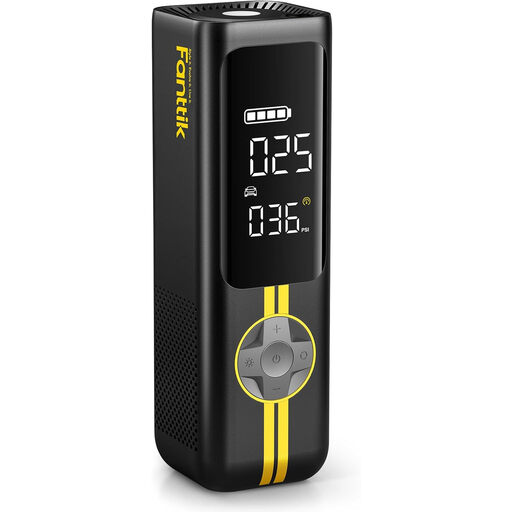
Why we recommend it: For the demanding user who wants a tool that is powerful, fast, and versatile enough for their car, motorcycle, bike... and even for charging their smartphone. A true Swiss Army knife of inflation.
It tackles the slowness trap head-on. According to Fanttik, it can reinflate a tyre from 28 to 33 PSI in under a minute. Its cooling system allows it to handle consecutive inflations without overheating.
Its inflation speed and endurance. Despite its power, it remains very simple to use thanks to its preset modes and auto-shutoff feature.
We have put together a complete selection of compressors that meet our quality and safety criteria.
1. What is the battery lifespan of a cordless compressor? The lifespan of a lithium-ion battery depends on its charge cycles and storage conditions. To preserve it, avoid letting it discharge completely and store the device in a cool, dry place. Most manufacturers recommend recharging it every 3 months, even when not in use, to keep the battery healthy.
2. Will a 12V mini compressor drain my car battery? This is a legitimate concern. To avoid any nasty surprises, the solution is simple: always start your car's engine before plugging in and using the 12V compressor. With the engine on, the alternator will supply the power, without drawing from the battery.
3. Can I use a portable compressor for a truck or RV tyre? No, most consumer-grade portable compressors are not powerful enough for the tyres on heavy-duty vehicles, RVs, or large 4x4s. These tyres require a much higher air volume and pressure than these small devices can provide. Always check the manufacturer's recommended uses before buying.