
Livraison le jour même ou le lendemain

Qualité garantie

Débloquez vos offres de bienvenue: Livraison GRATUITE | Jusqu'à -80 % | 30 jours d'essai gratuits à JoyPlus
Téléchargez l'application
Driving on an underinflated tire isn't just uncomfortable—it's a safety hazard and a drain on your fuel economy. And who wants to hunt for a gas station with a working air pump? The portable air compressor has become an essential tool to keep in your trunk. It's the perfect solution for checking your tire pressure in two minutes or for an emergency roadside fix, all on your own.
In this guide, we'll break down the features that truly matter and present our top picks to help you make the right choice, without falling for marketing hype.
The market is flooded with models. To cut through the noise, let's focus on the few technical specs that really make a difference in daily use.
Pressure, expressed in PSI (Pounds per Square Inch) or Bars, indicates the maximum force the device can deliver. Most models go up to 150 PSI (about 10.3 bars), which is more than enough for all types of tires (car, motorcycle, bike).
However, the most telling metric for judging efficiency is airflow, measured in liters per minute (L/min). A high flow rate (e.g., 35 L/min) means the tire inflator will fill your tire much faster—a critical advantage in an emergency.
Battery life is the key factor. There are two main product families:
The little extras that make life easier:
Let's get down to business: here are the models that caught our eye for their specs and versatility.
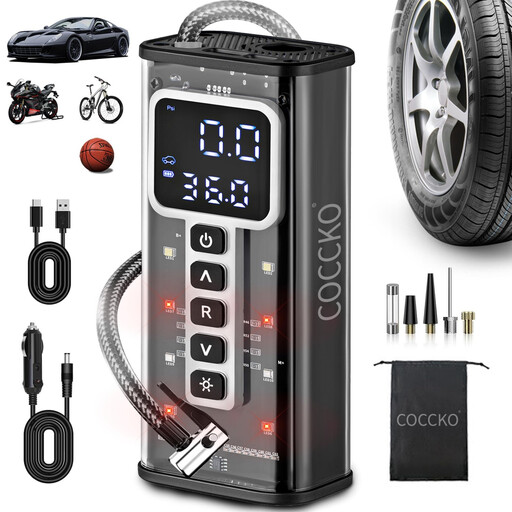
Why It Stands Out
This model focuses on speed and convenience. Its key feature, according to the manufacturer? A high-performance motor that, with its 35 L/min airflow, can take a standard tire from 28 to 33 PSI in just one minute. Its 6000 mAh battery provides solid battery life, and its smart LCD screen with 5 preset modes (car, motorcycle, bike, ball, custom) makes it incredibly easy to use.
Pros
Who is it for?
Ideal for the driver or motorcyclist looking for a versatile and fast solution, equally suited for routine checks and nighttime emergencies.

Why It Stands Out
The GOOLOO GT160 is the marathon runner of our selection. Its 7500 mAh battery is one of the most generous in its class, promising up to 45 minutes of continuous inflation, according to the brand. It's no slouch on performance either, with a 35 L/min airflow and a maximum pressure of 160 PSI. Its large LED screen and ergonomic handle make it very easy to operate.
Pros
Who is it for?
Perfect for those who juggle multiple vehicles (car, motorcycle, bikes) or who anticipate heavy use without wanting to constantly recharge. Its long battery life makes it a reliable companion for long road trips.

Why It Stands Out
This mini compressor from WORKPRO is all about compactness and portability. Weighing a feather-light 530 g and featuring a small design, it slips in anywhere. Despite its small size, it packs a motor running at 21,000 RPM and reaches a pressure of 150 PSI. Its 2500 mAh battery is more modest, but it's still sufficient for emergency top-ups or occasional adjustments.
Pros
Who is it for?
The perfect tool for cyclists, motorcyclists, or drivers who primarily want a lightweight and discreet device. It's the ideal companion to keep in a backpack or a small glove box to handle any unexpected situation.
A portable air compressor isn't just for the road. It's also a valuable ally for leisure activities: inflating a soccer ball, an air mattress, or pool floats. And if you're looking for gear for your sports activities, check out our selection of balls.
The recommended pressure is specific to each vehicle. You can find it on a sticker on the driver's side doorjamb, inside the fuel door, or in the owner's manual. It's typically between 2.2 and 2.8 bars (32-40 PSI) when cold. Using the preset function on your electric air pump is the easiest way to get it right.
Yes, these devices are designed to be stored in a vehicle. However, it's best to avoid leaving it in direct sunlight on the dashboard during summer heatwaves. The trunk or glove box are ideal storage spots to preserve the battery's lifespan.
Yes, absolutely. Most recent models, even compact ones, boast a maximum pressure of 150 PSI, which is much more than needed for SUV tires, which rarely require more than 3 bars (about 44 PSI). For larger tires, the spec to watch is the airflow (L/min): a model with a flow rate of 30 L/min or more will save you precious time.