
Livraison le jour même ou le lendemain

Qualité garantie

Débloquez vos offres de bienvenue: Livraison GRATUITE | Jusqu'à -80 % | 30 jours d'essai gratuits à JoyPlus
Téléchargez l'application
That dreaded tire pressure light flashing on in the middle of nowhere. The next service station? Miles away. It's a stressful situation too many drivers have experienced. Faced with this anxiety, the portable air compressor emerges as the promise of restored freedom and peace of mind. But be warned: the market is saturated with models making tempting promises that often hide critical flaws.
As a product expert at Joybuy, my mission is to clear the path for you. Let's cut through the marketing jargon and focus on the facts. Here are the pitfalls to avoid and the essential criteria for choosing a reliable device that won't let you down when you really need it.
Buyer's remorse is common with these devices, which are often designed to look good on paper rather than perform on the pavement. Here are the most common flaws to watch out for.
To avoid making a mistake, focus on the characteristics that have a direct impact on the device's performance and reliability.
The maximum pressure, often around 150 PSI (approx. 10.3 Bar), is standard on most devices. On its own, this number is meaningless. The true measure of efficiency is the airflow, expressed in litres per minute (L/min). This, and this alone, determines the inflation speed.
Also, check for an auto-shutoff feature. You set the target pressure, and the car tire inflator cuts off once it's reached. This is essential to prevent any risk of over-inflation.
The choice of power source depends on your use case and your need for security.
Certain options transform a simple inflator into a true multi-function emergency tool.
Rather than an exhaustive list, here are a few models that suit specific user profiles, based on the performance and reliability criteria we've just discussed.
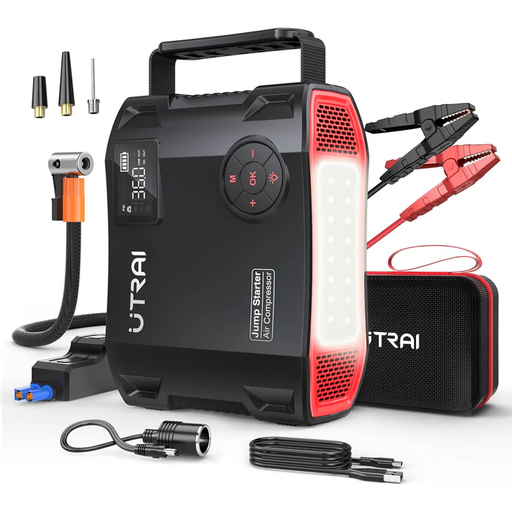
Why it's for you: It tackles the two most common roadside problems: a flat tire and a dead battery. It's the ultimate emergency tool to keep in your trunk to handle any eventuality, compatible with large petrol and diesel engines.
With a 27,000 mAh battery and an airflow of 45 L/min, it sidesteps the traps of phantom battery life and slowness. It's built for real-world performance.
6,000 A peak starting current and a 160 W DC output to power other 12V devices. 1,600-lumen LED light.
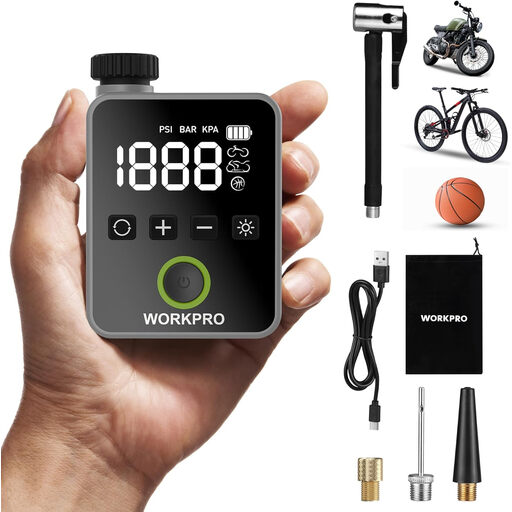
Why it's for you: Its feather-light weight (270 g) and slim profile make it the ideal companion for city dwellers. It slips into a glove box, a backpack, or even a large pocket, perfect for top-ups on a car, a scooter, or for use as an electric bike pump.
It doesn't promise the moon, and that's its strength. It focuses on extreme portability and simplicity, without being weighed down by superfluous gadgets that would only add bulk.
Versatile despite its size: electric air pump, power bank, and flashlight. Simple charging via USB-C.
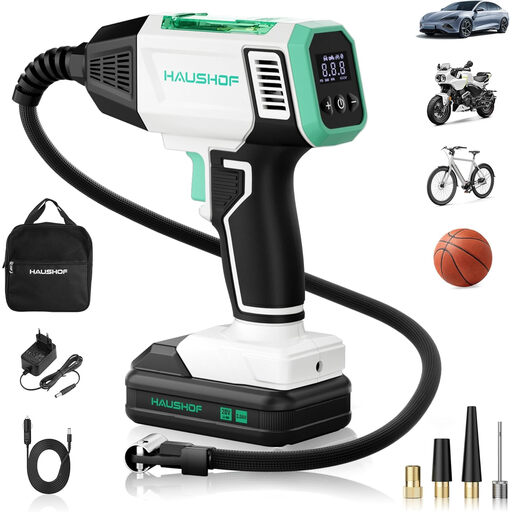
Why it's for you: It's the family's Swiss Army knife. It effortlessly switches from inflating car tires to the kids' bikes or a football thanks to its preset modes. Its versatility makes it useful far beyond the garage.
Its dual power supply (2,000 mAh battery and 4m 12V cable) is the perfect answer to the battery life problem. If the battery is dead, the cigarette lighter socket takes over.
4 preset modes (car, motorcycle, bike, ball) and a manual mode for full control. Airflow of 22 L/min, effective for car tires.
We have selected a full range of products that meet our performance and safety criteria.
The longevity of a cordless air compressor primarily depends on its battery and motor. To preserve the battery, remember to recharge it every 3 to 4 months, even when not in use. As for the motor, avoid extended inflation sessions: let the device cool down for a few minutes, as indicated in the manual, to prevent overheating. A well-maintained device can last you for several years.
Using a 12V mini compressor draws power from the vehicle's battery. If the battery is already a bit weak, prolonged use could drain it completely. The smart move: always start your car's engine before plugging in and using the compressor. The alternator will then provide the necessary power without draining the battery.
The built-in digital gauges are generally reliable enough for everyday use and pressure top-ups. Their accuracy is far superior to that of older analogue models. However, for a high-precision check, it's always a good idea to compare the reading with that of a quality manual pressure gauge at least once. Consider your compressor's display as an excellent field guide, but not a lab-grade instrument.