
Livraison le jour même ou le lendemain

Qualité garantie

Débloquez vos offres de bienvenue: Livraison GRATUITE | Jusqu'à -80 % | 30 jours d'essai gratuits à JoyPlus
Téléchargez l'application
An under-inflated tyre isn't just a minor inconvenience?— it's a genuine safety risk, not to mention a drain on your fuel economy. The portable air compressor has become an essential tool to ensure you're never caught unprepared, whether for a routine check or an emergency. The problem is, the market is flooded with marketing promises that often lead to disappointing purchases. As a product expert at Joybuy, I'm here to help you decode the spec sheets and avoid the most common traps. The goal: to find a reliable model that's truly right for your needs.
Before you pull out your credit card, watch out for these 3?common traps:
To avoid these disappointments, focus on objective technical data. It's the only way to compare models on a solid foundation.
The maximum pressure (often around 150?PSI / 10.3?Bar) indicates the force the device can achieve, which is useful for specific tyres like those on road bikes. But for a car tyre inflator, the air flow rate (L/min) is the real game-changer. This is what determines the actual inflation speed.
It all depends on your primary use case:
A good tyre inflator with a pressure gauge must be accurate. The auto-shutoff feature is a real bonus for peace of mind: you set the target pressure, and the compressor stops on its own. No more risk of over-inflation, which is dangerous for the tyre, and you're hands-free in the meantime.
Rather than an endless list, here are a few models that tick all the boxes for performance and reliability, each tailored to a specific user profile.

Why we chose it: The perfect tool to keep in your glove box for monthly checks or minor emergencies. Its feather-light weight (460g) and pocket-sized design make it incredibly practical.
Its promise is honest: it's not designed to reinflate four flat tyres. Its 4000 mAh battery is calibrated for regular top-ups (up to 8 tyres from 30 to 36 PSI, according to the manufacturer), which is a realistic and transparent expectation.
Its dual digital display (current and target pressure) and auto-shutoff function make it foolproof, even for a beginner.

Why we chose it: For those who drive daily (car or motorbike) and want a fast, durable tool for frequent checks. Because time is precious, even on the side of the road.
It directly counters the slowness trap with an advertised air flow of 35 L/min and a robust 7500 mAh battery. This allows for several quick top-ups without needing to go back to the charger.
The speed/battery life combo makes it a formidable ally for heavy use. The power bank function is a welcome bonus in a pinch.
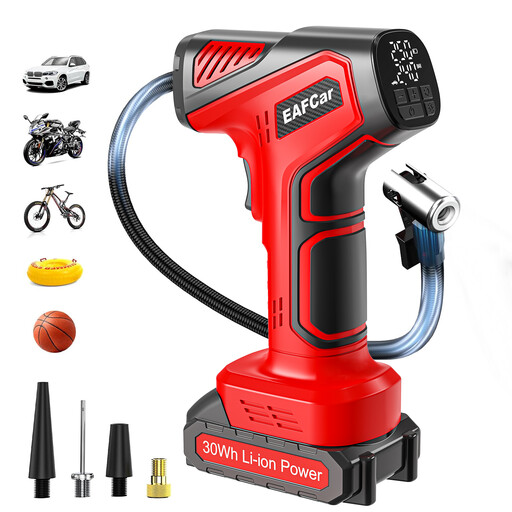
Why we chose it: The do-it-all tool for the active family. It handles everything from car tyres before a holiday trip to kids' bikes or the football for a day at the park.
It avoids the complexity trap with its 4 preset modes (Car, Motorbike, Bicycle, Ball). It's impossible to get the pressure wrong, even if you don't know the first thing about it.
This is the Swiss Army knife of inflation. Its smart modes and built-in flashlight (with SOS mode) make it a true companion for both the car and for leisure activities.
Explore our full selection of products that meet our performance criteria and current safety standards.
It all depends on the health of its lithium-ion battery. To preserve it, avoid letting it discharge completely and store the device in a cool, dry place. Most importantly, don't leave it in a scorching hot car. If you use it infrequently, giving it a quick charge every 3?months is a good habit to get into.
The risk exists, especially if your car battery is already showing signs of weakness. The solution is simple: always start your car's engine before plugging in and using the compressor. The alternator will then supply the power, sparing your battery.
Even though modern models are much more accurate than they used to be, a small discrepancy is still possible. Our advice: the first time you use it, compare the displayed value with a reliable pressure gauge, like one at a service station. This will tell you its margin of error, allowing you to account for it in future inflations.