
Livraison le jour même ou le lendemain

Qualité garantie

Débloquez vos offres de bienvenue: Livraison GRATUITE | Jusqu'à -80 % | 30 jours d'essai gratuits à JoyPlus
Téléchargez l'application
An underinflated tyre is more than just an inconvenience—it's a genuine safety risk, not to mention a drain on your fuel economy. The portable air compressor has become an essential tool to keep in your trunk. However, the market is saturated with models making tempting promises that often hide unpleasant surprises. As the Head of Product Selections at Joybuy, I'm here to help you cut through the noise and make the right choice.
Before you buy, watch out for these two common traps that cost drivers dearly?:
To avoid making a mistake, rely on concrete data. Here are the three parameters that truly determine the effectiveness of a car tyre inflator.
The maximum pressure, often listed as 150 PSI (about 10.3 bar), is standard on most models. This is more than enough for car, motorcycle, or bicycle tyres. However, the real game-changer for speed is the air flow rate, measured in litres per minute (L/min).
The choice depends on your primary use case.
Modern features greatly simplify use and enhance safety.
Here are the models that caught our eye, each tailored to a specific need.
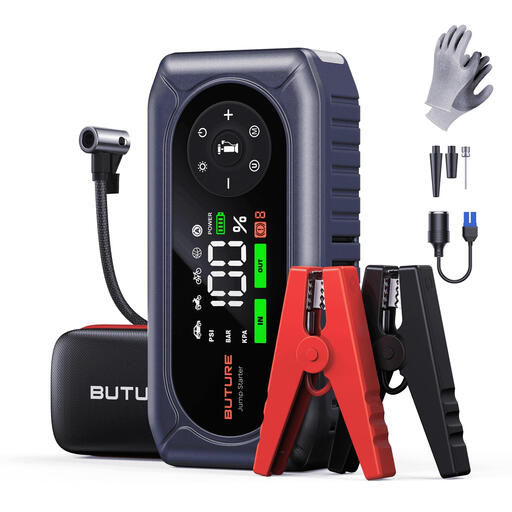
Why we chose it: This is the ultimate multi-tool for handling any eventuality. It combines a powerful jump starter (4500A peak), capable of starting large petrol (up to 9.0L) and diesel (up to 8.0L) engines, with a 150 PSI compressor. Ideal for those who put safety first.
It's not just another "all-in-one" gadget. Its jump-starting function is robust, and its compressor includes preset modes and auto-shutoff, making it genuinely effective in both of its key roles.
High Starting Power: 4500A peak for compatibility with almost all passenger vehicles. 10 levels of protection for risk-free jump-starting.

Why we chose it: For those seeking an ultra-compact and lightweight (460g) mini compressor without compromising on the essentials. It's perfect for regular top-ups, as a motorcycle tyre inflator, or for bicycles. It slips easily into a glove box or backpack.
It doesn't promise unrealistic speeds. It states a clear 17 L/min flow rate and provides a concrete inflation time (e.g., 1.5 mins to go from 30 to 36 PSI on a 195/65R15 tyre), which shows transparency and reliability.
Ultra-Portable: Weighs only 460g. Precise Display: The "TrueGauge" screen is designed for highly accurate pressure readings, a crucial point for tyre safety and performance.

Why we chose it: With its 7500mAh battery and high 35 L/min air flow rate, this model is an excellent choice for a variety of needs: car tyres, but also air mattresses or sports balls. Its battery life and speed make it the perfect companion for family outings and recreational activities.
It avoids the over-specced battery trap by offering a genuine 7500mAh capacity, which translates to real-world endurance (up to 45 minutes of continuous inflation). Its 35 L/min flow rate backs up its promise of speed.
High Air Flow (35 L/min): Fast inflation for all types of items. Large Battery Capacity (7500mAh): Ensures long runtimes and can serve as a power bank for your devices.
We have compiled a complete, up-to-date list of products that meet our standards for quality and safety.
The lifespan depends on the build quality and maintenance. For a cordless tyre inflator, the battery is the most critical component. To preserve its longevity, remember to recharge it every 3 to 6 months even if you don't use it, and store it in a cool, dry place. A well-made corded model can last for many years with normal use.
Excellent question, and the answer is crucial. Conventional lithium-ion batteries are sensitive to extreme temperatures. Leaving them in a car in direct summer sun (where temperatures can exceed 60°C / 140°F) or in freezing winter cold can reduce their performance and lifespan. Some newer models, such as those with sodium-ion batteries, can withstand a much wider temperature range (e.g., from -40°C to 80°C / -40°F to 176°F), making them far more suitable and safer for permanent storage in a vehicle.
When using a 12V compressor plugged into the 12V socket, it is essential to keep your car's engine running. Inflation, especially for a large tyre, consumes a significant amount of power. Running the engine allows the alternator to compensate for this power draw, so you can avoid the unpleasant surprise of a dead battery once you're finished.